Your broadband rights, explained The pole is on their land. The line is yours to use. Here's who's who. You Your contract is with your broadband provider. Report faults to them, not to the network. Your provider Fixes your service and orders repairs from the network that owns the line. The network Usually Openreach. Owns the pole and line, and holds any rights to keep them there. Your neighbour Owns or occupies the land. They have rights too, but changes follow a formal legal process. If the telegraph pole that serves your home stands on your neighbour's land, they can't simply cut you off. The pole and line are covered by the Electronic Communications Code, and any change has to go through a formal legal process. Most poles on private land are there under a written agreement, called a wayleave, or older rights that carry on, and these usually cover access to inspect, maintain and repair. Where no right exists, the network can ask a court or tribunal to impose one, as a last resort. Your contract is with your broadband provider, so start there: report the fault and the access problem, let them and the network handle the land side, and keep things friendly next door. If it drags on, there are other ways to get connected. Key facts, checked 13 October 2026 Who this is for: Anyone whose phone or broadband line reaches their home over a pole or wire on a neighbour's land, in England, Wales, Scotland or Northern Ireland. Whether you're dealing with a fault today or planning a new connection, you'll know where you stand. Direct answer: It depends on the rights the network already has. Most poles on private land are there under a written agreement, called a wayleave, or older rights that carry on, and these usually include access to inspect, maintain and repair. Where there's no such right, the network can ask your neighbour to agree and, as a last resort, ask a court or tribunal to impose one. The pole and the line belong to the network, usually Openreach, not to you or your neighbour. That's why the conversation about access is between the network and the landowner, and why your broadband provider is your first call. Whether the kit is already there or would be new makes a big difference, as this shows. Existing kit or new kit? It changes the rules Most common An existing pole that needs a repair New installs A new pole or line for a new connection Openreach says a wayleave is the agreement that lets it install, maintain and repair its equipment on private land. If your neighbour bought their home after the pole went in, they may still be bound: a Code agreement can bind people who later take over the land, and agreements made before the current Code started on 28 December 2017 carry on under transitional rules. Direct answer: The Electronic Communications Code, in Schedule 3A to the Communications Act 2003, sets the rules across the UK. It lets networks install, keep, maintain and repair kit on private land, but only with the occupier's written agreement or an order from a court or tribunal. It also gives landowners rights to object and to seek removal, through a formal process. Disputes are decided by a court or tribunal, never by either side acting alone. The Code refers to "the court", but in England and Wales most Code cases are heard by a specialist land tribunal, the Upper Tribunal (Lands Chamber). Ofcom also publishes a Code of Practice setting out the standards of behaviour expected of networks and landowners when they deal with each other. Direct answer: Yes, in some cases. The Code lets a network run a line over land without the occupier's agreement if no part of it is less than 3 metres above the ground or within 2 metres of a building it passes over, and it runs from the network's kit nearby. That right doesn't let anyone go onto the land, and it doesn't cover poles. The flying line rule: 3 metres up, 2 metres clear A line can cross without agreement if But it doesn't allow When a network installs overhead kit at that height, the Code says it must put up a notice within 3 days giving its name and a UK address where objections can be sent. So if a new line appears, there's always someone to contact. Direct answer: Only through the Code's formal process. A landowner can require removal only if one of the Code's conditions applies, for example because no Code agreement binds them, and must give the network formal notice. If the two sides can't agree, a court or tribunal decides. Cutting, moving or damaging the line isn't the lawful route. How removal works under the Code Step 1 A removal condition applies For example, no Code agreement binds the landowner, or an agreement has ended Step 2 Formal notice The landowner gives the network written notice asking for removal Step 3 28 days to agree The two sides try to agree what happens, and when Step 4 Court or tribunal decides If there's no agreement, the landowner can apply for an order If a landowner isn't sure whether the kit is there under a Code right, they can formally ask the network to say, and the Code gives the network three months to reply, with cost consequences if it doesn't. Deliberately damaging someone else's property can be a criminal offence under the Criminal Damage Act 1971 in England and Wales, with similar laws in Scotland and Northern Ireland, so it's worth gently making sure a disagreement never gets that far. Direct answer: Yes. A neighbour whose land a new overhead line crosses, or whose enjoyment of their land is affected by new kit at least 3 metres up, can object within 12 months of installation and then apply to court. After 12 months, objections are only possible for a planned improvement to their land, usually at their own cost. Objecting to a new pole or line: the clock So if a new full fibre connection would need a new pole or line over next door's land, ask about other routes at the order stage. A line from the street or an underground duct can avoid the issue completely, where one is available. Direct answer: Report it to your broadband provider, tell them about the access problem, and let them and the network handle the land side. The network can rely on an existing agreement, arrange a visit with your neighbour, re-route your line, or, as a last resort, use the Code's formal process. Three ways the network can get you back online Use the existing agreement If a wayleave or older rights cover the pole, the network can arrange a visit on those terms. Re-route your line The network may be able to feed your home from a different pole, the street or an underground duct, avoiding the neighbour's land altogether. The formal route, as a last resort Notice, then 28 days, then an application to a court or tribunal for the rights it needs. Openreach says it makes best endeavours to explore all alternatives first. Your provider is responsible for your service, whoever owns the pole. If a repair is delayed and your provider is in Ofcom's automatic compensation scheme, you may be due money for each day without service, though the scheme has exceptions. Our guide to automatic compensation rates has the current amounts, and our broadband compensation calculator helps you work out what you might be owed. Waiting on a neighbour? See your other ways to get connected Some networks reach homes by a different route. Compare broadband at your postcode and see what's available, side by side. Prefer to talk it through? Call 0330 122 1223 Direct answer: Calmly, briefly and early. Explain the problem, say who would visit and why, offer to be there, and follow up in writing. Your neighbour will probably want to know what will happen in their garden, and who to call if something goes wrong. What to say next door: a friendly script Do Don't If they're worried about the pole itself, that's a conversation for them and the network, not for you to settle. Openreach says wayleave payments can apply where its equipment on someone's land serves other properties, so your neighbour may be entitled to a payment, which can help the conversation along. Direct answer: You still have choices. Ask about a re-route on the same network, check whether another network reaches your home by a different route, or look at mobile or satellite broadband, which need no cable to your home at all. Free and independent. Deals listed by price, lowest first. Direct answer: Stay calm, report it to your provider, ask what rights the network has, talk to your neighbour, ask about a re-route, keep records, and check your options. Seven simple steps, starting today. Your 7-step plan Stay calm and hands off Don't touch the pole or line, and ask your neighbour not to either. If anything looks damaged, take photos from your own property. Report it to your provider Report the fault, explain that the pole is on your neighbour's land and access has been refused, and note the reference number. Ask what rights exist Ask your provider to check with the network, usually Openreach, whether there's a wayleave or other agreement for the pole. Talk to your neighbour Keep it friendly. Explain who would visit and why, offer to be there, and follow up with a short, polite message. Ask about a re-route If access stays blocked, ask whether your line could come from a different pole, the street or an underground duct. Keep a record Log dates, calls, reference numbers and days without service. You'll need them for a complaint or a compensation claim. Check your options Compare broadband at your postcode, including networks that may reach your home by a different route. Direct answer: Make a formal complaint to your provider. If it isn't resolved after eight weeks, or they send a deadlock letter, you can take it to their free alternative dispute resolution (ADR) scheme, Ombudsman Services: Communications or CISAS. The land side between the network and your neighbour has its own process. If it drags on: your escalation ladder Report it to your provider The fault, the access problem and your reference number. Make a formal complaint Ask for it to be logged as a complaint if things stall. After 8 weeks, or a deadlock letter Take it to your provider's free ADR scheme: Ombudsman Services: Communications or CISAS. The land side The network and your neighbour can use mediation, with a court or tribunal only as a last resort. Get advice if you need it Citizens Advice is free. A property solicitor can help if your own land rights are affected. Direct answer: Yes. The Electronic Communications Code applies across the UK. Land law terms differ, and so do the courts and tribunals that hear disputes, so local advice helps if it ever gets that far. Direct answer: Before you commit, look at how the phone and broadband line reaches the property. If it crosses a neighbour's land, ask the seller or landlord whether there have ever been access problems, and ask your conveyancer about it if you're buying. Moving home? Check broadband at your new postcode See what's available at your new address before you move, so you can line up the right deal in good time. Prefer to talk it through? Call 0330 122 1223 In summary Alex's closing thought This post started with a phone call. A broadband customer rang me because the line to his home runs over a pole on his neighbour's land, and the neighbour had refused access. It's a stressful spot, because it feels personal and technical at the same time. The good news is that the law is built to keep homes connected while treating landowners fairly, and there's a clear process for everyone, neighbour included. Start with your provider, keep things friendly next door, and if it drags on, we'll help you find another way to get connected. Get connected Know your rights Share it with a neighbour, your street WhatsApp group, or anyone with a pole in their garden. You are welcome to quote and link to this article. Please credit BroadbandSwitch.uk and link to this page. In a sentence: In the UK, a neighbour can't lawfully cut or remove the telegraph pole or line that serves your home: poles on private land are governed by the Electronic Communications Code, most are there under a wayleave or older rights that usually cover access for repairs, and any removal or new rights go through formal notice and, as a last resort, a court or tribunal, so report the problem to your broadband provider and let the network handle the land side. It depends on the rights the network has. Most poles on private land are there under a wayleave or older rights that usually include access to maintain and repair. If there's no such right, the network can seek agreement and, as a last resort, ask a court or tribunal to impose one. No. Removal has to follow the Electronic Communications Code: a condition must apply, formal notice must be given and, if it isn't agreed, a court or tribunal decides. Deliberately damaging someone else's property can be a crime. Often, yes. A Code agreement can bind people who later take over the land, and agreements made before 28 December 2017 carry on under transitional rules. The network can check what applies to the pole. Usually Openreach, part of BT Group, but some poles belong to other networks. Your broadband provider can find out, and new overhead kit should carry a notice with the network's name. Your broadband provider. Your contract is with them, and they deal with Openreach or the network that owns the pole, which handles the land rights. Yes, in some cases. A line can cross land without agreement if no part is less than 3 metres above the ground or within 2 metres of a building it passes over, but that gives no right to go onto the land or to put a pole there. Yes. A neighbour affected by new overhead kit at least 3 metres up can object within 12 months of installation, then apply to court. After 12 months, objections are only possible for a planned improvement to their land, usually at their cost. Not without rights. If a wayleave or older rights give access, the network uses them on their terms. If not, it can give notice and, after 28 days, ask a court or tribunal to impose rights. Openreach says court is a last resort. Possibly. Openreach says wayleave payments can apply where its equipment on someone's land serves other properties, such as your home. The network can explain whether your neighbour qualifies. You may. Providers in Ofcom's automatic compensation scheme pay for delayed repairs, but there are exceptions. Keep a record of the days without service and ask your provider. Yes. The Electronic Communications Code applies across the UK. Land law terms and the courts or tribunals that hear disputes differ between the nations. Ask your provider about a re-route from the street or a different pole, complain if things stall, and compare other networks, mobile or satellite broadband at your postcode. Written by Dr Alex J. Martin-Smith, Founder of BroadbandSwitch.uk (LinkedIn). Reviewed by Adrian James, Broadband Editor. Published 13 October 2026. This guide gives general information about the law in the UK, not legal advice. For advice on your situation, speak to Citizens Advice or a solicitor. Corrections are logged publicly.Neighbour won't allow access to your telegraph pole? Your broadband rights explained
Can my neighbour refuse access to the telegraph pole?
What does UK law say about telegraph poles on private land?
Rule What it means for you Where it's written Code rights Rights to install, keep, inspect, maintain, repair and upgrade kit, and to enter land to do so. Paragraph 3 Written agreement Rights are granted by the occupier of the land in a written, signed agreement, often called a wayleave. Paragraphs 9 and 11 Later owners An agreement can also bind people who later take over the land, such as a new owner next door. Paragraph 10 Older agreements Agreements made before 28 December 2017 carry on under transitional rules. Digital Economy Act 2017, Schedule 2 Imposed rights If there's no agreement, the network can give notice and, after 28 days, ask for an order. Granted only if money can make up for the landowner's loss and the public benefit outweighs it. Paragraphs 20 and 21 Removal A landowner can require removal only if a Code condition applies, by formal notice and, if not agreed, a court or tribunal order. Part 6, paragraphs 37 to 40 Lines overhead A line can cross land without agreement if it's at least 3 metres up and not within 2 metres of a building, with no right to go onto the land. Paragraph 74 Objections Neighbours can object to new overhead kit, mainly within 12 months of installation. Part 12, paragraphs 77 to 81 Mediation Networks have a duty to consider alternative dispute resolution, such as mediation. PSTI Act 2022, section 69 Can a broadband line cross my neighbour's garden without permission?
Can my neighbour make Openreach remove the pole?
Can my neighbour object to a new pole or line?
My broadband's down and the engineer can't get to the pole: what now?
How do I talk to my neighbour about it?
What are my options if my neighbour won't budge?
Option How it reaches your home Worth knowing A re-route on the same network A different pole, the street, or an underground duct, avoiding your neighbour's land Ask your provider to raise it with the network. Not every home has a practical alternative route. Another fixed network Some full fibre and cable networks reach homes by a different route Check which networks and deals are available at your postcode. Mobile home broadband (4G or 5G) A router that uses mobile signal, with no cable to your home Speeds depend on the signal where you live, so check coverage first. Satellite broadband A dish on your home with a clear view of the sky Works in most places. Monthly prices are often higher than fixed broadband. What should I do, step by step?
How do I complain if my provider isn't helping?
Does this apply in Scotland, Wales and Northern Ireland?
Buying or renting a home? Check where the line comes from
Keep going: more help to get and stay connected
Share this article
Cite this page
Martin-Smith, A. J. (2026, October 13). Neighbour won't allow access to your telegraph pole? Your broadband rights explained. BroadbandSwitch.uk. https://broadbandswitch.uk/insights/neighbour-telegraph-pole-broadband-rights/ Frequently asked questions
Can my neighbour refuse access to a telegraph pole in their garden?
Can my neighbour cut or remove the phone line to my house?
Does a wayleave still apply if my neighbour has just moved in?
Who owns the telegraph pole outside my house?
Who do I contact if my neighbour won't let the engineer in?
Can a broadband wire cross my neighbour's garden without permission?
Can my neighbour object to a new telegraph pole or line?
Can Openreach force access to a pole on private land?
Does my neighbour get paid for having a pole on their land?
Will I get compensation if my broadband is down while this is sorted out?
Does this apply in Scotland, Wales and Northern Ireland?
What can I do if my neighbour won't budge?
References
Neighbour won't allow telegraph pole access? Your rights
Written by Alex Martin-Smith (LinkedIn) • Reviewed by Adrian James (LinkedIn)
Last reviewed: 13 October 2026
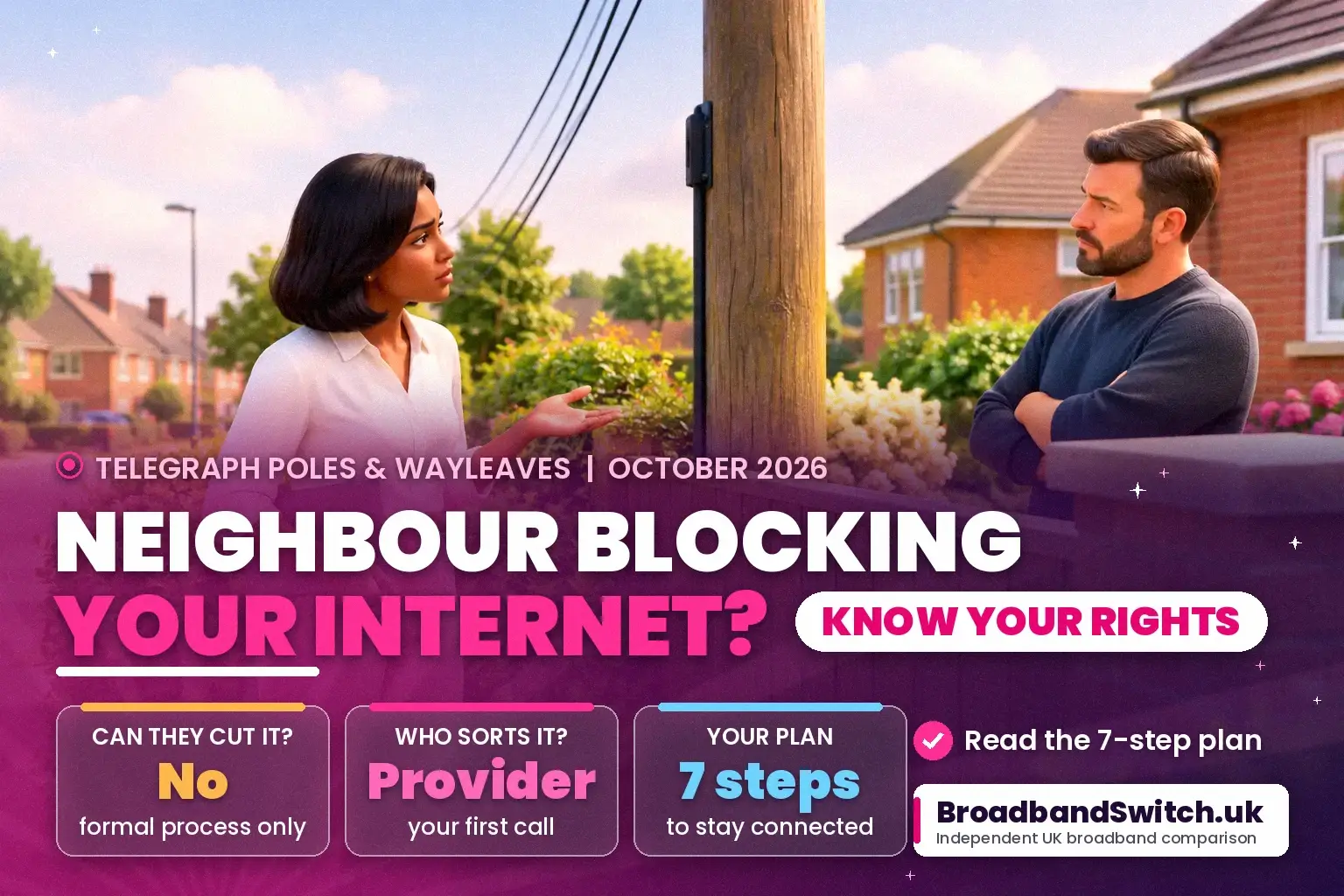
Quick summary: Telegraph pole on your neighbour's land and they're refusing access? What UK law says, what they can and can't do, and 7 calm steps to stay connected.
→
→
→
If the network has applied for its own Code rights over the land, no removal order can be made while that application is pending.
Never the DIY route. Cutting, moving or damaging the line isn't how the law works, and damaging property can be a crime.
Day 0
New overhead line or pole installed, 3 metres or more up. The network must put up a notice within 3 days with its name and a UK address for objections.
Up to 12 months
A neighbour whose land the line crosses, or whose enjoyment of their land is affected, can give the network notice of objection.
2 to 4 months later
The window to apply to court, counted from the date of the notice.
Court test
Broadly: is the neighbour materially affected, and could the kit be altered without a substantial rise in cost or harm to the service?
After 12 months
Objections are only possible where an alteration is needed for a planned improvement to the land, and the objector usually pays the costs.
1
2
3
Your job: report it to your provider, explain the access problem, and keep a record. The network handles the land side.
Compare at my postcode →
Hi, sorry to bother you. Our broadband's stopped working, and it looks like the fault is on the pole in your garden.
Would it be OK for an engineer to come and take a look? They'll contact you first, and I'm happy to be here too.
If you'd rather the pole wasn't there long term, the network can talk you through the options. You may even be entitled to a wayleave payment.
Thanks so much. I'll drop you a quick message with the details so you've got it in writing.
Compare broadband at my postcode
1
2
3
4
5
6
7
1
2
3
4
5
Check my new postcode →