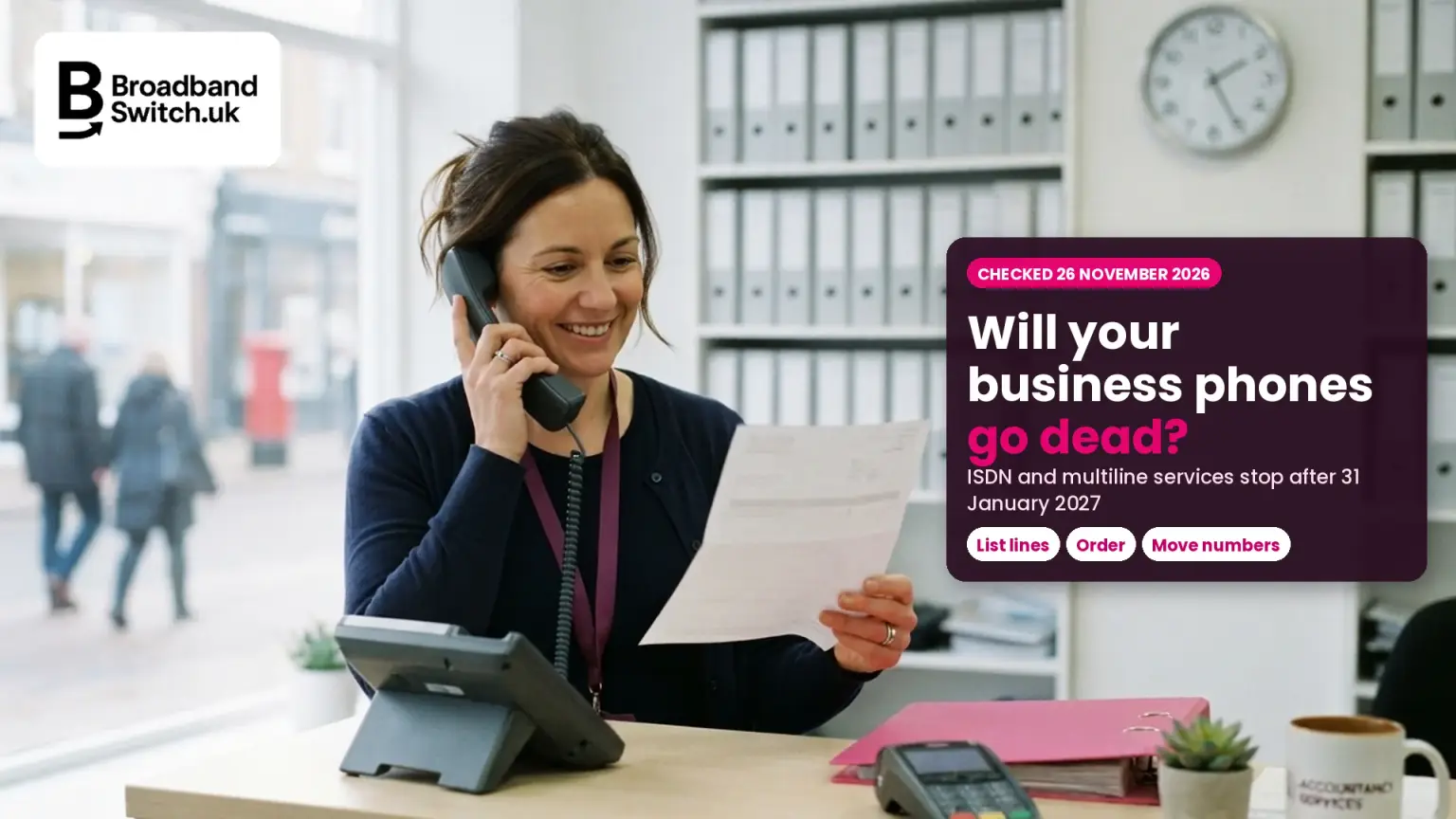
If your business still runs on ISDN or a multiline phone system, it won't carry on after 31 January 2027. Here's how to tell, what to order, and how long it takes
Checked 26 November 2026
The switch-off, for business phones
They stop
after 31 January 2027
There's no safety net for these.
44,000
ISDN and multiline services
Reported, 25 November 2026.
66 days
43 of them working days
Counted from 26 November 2026.
Maybe
a temporary emergency line
It costs more and does less.
Yes, some business phone lines will go dead. The old phone network closes on 31 January 2027. ISDN lines and multiline systems can't be moved automatically, so they stop working unless you've switched. Around 44,000 were still in use on 25 November 2026 (Reported). A single analogue line might be put on a temporary emergency service, but you can't order it or rely on it. Today, find out which of your lines are ISDN or multiline. Then check what broadband your premises can get, because your new phones will run over it.
Your new phones run on your broadband
Enter your postcode to see what your premises can get, with prices side by side. It takes about a minute.
- ✓Every provider we can find at your address
- ✓Full fibre shown where it's available
- ✓Free to use. Ring us if you'd like a hand
Prefer to talk it through? Call us on 0330 122 1223
Key facts, verified 26 November 2026
- Openreach says all traditional phone lines go digital on 31 January 2027 (Openreach, read 26 November 2026).
- BT Business says ISDN, Featureline and multiline services can't be moved automatically and stop working from that date (BT Business, read 26 November 2026).
- Around 44,000 ISDN and multiline services were still in use (Reported, ISPreview and ITPro, 25 November 2026).
- About one million copper-based lines were still active, roughly 300,000 of them at business premises (Openreach, 30 October 2026).
- The temporary emergency service is for single analogue lines only, can't be ordered ahead and has limited capacity. It costs providers £35 a month for a basic line (Openreach, 24 September 2026).
- Openreach says the 1 October 2026 rise doubled the 2025 rental price for old lines, with more rises from February 2027 (Openreach, 30 October 2026).
- You can keep your phone number when you switch, and any loss of service shouldn't last more than one working day (Ofcom, 3 April 2023).
- Moving a number takes at least 4 working days for a single line and at least 22 for complex direct-dial ranges (OTA2 porting guide, read 26 November 2026).
- A business with ten employees or fewer can take an unresolved complaint to a free ombudsman scheme after six weeks (Ofcom, 5 May 2026).
- One phone call needs about 87.2 kilobits a second, so ten calls at once need under 1Mbps (Cisco, 11 December 2023).
Who this is for: You, if you run or look after a small business, a practice, a shop, a school office or a charity, and nobody is quite sure how the phones work. Meet Sam. She runs a six-person accountancy practice. The phone system went in before she bought the firm, there's a card machine in reception and an alarm she's never thought about. A letter about "ISDN" has been in her in-tray since the summer. She wants to know, plainly, whether the phones will ring in February. Sam is an example built from the calls we take on our help line, not a real customer.
Will my business phone line stop working on 31 January 2027?
Direct answer: If it's an ISDN line or a multiline system, yes, unless you've moved it. BT Business says these can't be moved automatically. A single analogue line may be moved to a temporary emergency service, which costs more and does less. Phones that already run over broadband aren't affected.
| Type of line | At the switch-off | What to do |
|---|---|---|
| ISDN2 or ISDN30 a switchboard taking several calls | It stops no safety net | Order a replacement and move your numbers now |
| Multiline or Featureline several lines on one number | It stops can't be moved automatically | The same. Start this week |
| One analogue line calls only | May go to a temporary emergency line from 1 February 2027, Reported | Switch anyway. You can't order the emergency line |
| One analogue line with broadband on it | May follow from mid-April 2027, Reported | Ask your provider for a digital line |
| Phones over broadband or an app | No change | Check for forgotten lines |
BT Business puts it bluntly. Its page says ISDN, Featureline and multiline services "will stop working from 31 January 2027" if you haven't moved. Openreach's page for businesses says the same in its own words: services supported by ISDN have to move to an internet-based service by January 2027, or they'll be ceased.
The date itself hasn't moved. Openreach gives 31 January 2027 for all traditional phone lines. That's a Sunday, so in practice your last working day is Friday 29 January.
This post is about the lines with no fallback. For the wider picture, our guides to the ISDN switch-off and keeping a business running through the switch-off go further.
How do I know if I have ISDN or a multiline system?
Direct answer: Look at your phone bill and ask your provider in writing. The words to look for are ISDN2, ISDN30, Multiline and Featureline. A box on the wall that lets several people take outside calls at once, or a block of direct-dial numbers, is another sign.
Signs to look for
Your bill names ISDN2, ISDN30, Multiline or Featureline
These are the services BT Business says can't be moved automatically.
Several people can be on outside calls at once
One phone system, shared by everyone, with lights for each line.
Staff have their own direct-dial numbers
A block of numbers that all end up at the same switchboard.
The phone system is older than anyone can remember
If it went in before your broadband did, check it.
Your desk phones plug into the router or a network socket
That's already an internet phone system.
You make work calls through an app
On a laptop or mobile, with no phone line involved.
A quick word on the jargon. The PSTN is the old copper phone network. ISDN is an older digital service that runs on it, built so a switchboard could carry several calls at once. Multiline is a group of ordinary lines that share one number.
If the bill doesn't help, send your provider one short email. Ask which of your lines are on the old network, what each one is used for, and the date they plan to move you. Ask for the reply in writing.
Sam's bill said "ISDN2e" on page three, next to a line rental charge she'd never questioned. That one word told her she was in the group with the most to do.
Not sure what your premises is on?
Our free landline switch-off checker asks a few plain questions and tells you what to sort out first.
Open the checker →What is the emergency line, and why doesn't it cover ISDN?
Direct answer: It's a temporary last resort that Openreach calls Emergency Voice Access. It's for single analogue lines that haven't moved in time. ISDN and multiline services aren't compatible with it (Reported), which is why they stop.
The safety net: what it is, and what it isn't
What it is
A temporary last resort
For single analogue lines that haven't moved in time.
Basic calls
Openreach says it may not support the calling features you use today.
Kind to broadband
Broadband on the same line is kept where technically possible.
What it isn't
Something you can order
Openreach says it can't be ordered ahead.
Guaranteed
Capacity is limited, and lines that can't move will be ceased in stages.
Cheap
£35 a month wholesale for a basic line, £38.60 for a premium one.
For ISDN or multiline
Those aren't compatible with it (Reported).
Openreach's September announcement describes it as a temporary measure for single lines on its older wholesale service. It has no end date published, and it's there to protect people, not to save anyone the job of switching.
The reports of 25 November add the detail that matters here. According to ISPreview and ITPro, Openreach has told the industry that ISDN and multiline services are incompatible with the emergency line. We couldn't find that notice on Openreach's own site, so we've labelled it Reported.
There's a timing detail too. Voice-only lines are due to start moving on 1 February 2027, and lines with broadband from mid-April. Orders that can't complete by 31 March 2027 are cancelled (Reported, ISPreview, September 2026).
How many businesses still haven't moved?
Direct answer: Around 44,000 ISDN and multiline services were still in use on 25 November 2026 (Reported). Openreach said on 30 October that about one million copper-based lines remained, roughly 300,000 of them at business premises. The warning names hospitals, councils, schools and emergency services.
Still on the old network
44,000
ISDN and multiline services
Reported, 25 November 2026.
1 million
copper-based lines
Openreach, 30 October 2026.
300,000
at business premises
Openreach, 30 October 2026.
12,000+
lift lines
Openreach, 5 February 2026.
The reports quote Openreach's migrations director, James Lilley: "Time is running out." The services named are the kind that sit behind a switchboard: hospitals, councils, prisons, schools, universities, emergency services and large industrial sites.
One example shows how long this can take. Openreach's warning points to a fire and rescue service that began six years ago and identified more than 5,000 lines to move (Reported, ISPreview and ITPro). A six-person office won't have that many. It may well have one that nobody remembers.
Openreach's 30 October warning gives the same advice for every size of firm: audit what you have, then plan with your provider. Our Last Dial Tone report tracks the numbers month by month.
What else is plugged into the old phone line?
Direct answer: Often more than phones. GOV.UK names lift alarms, burglar and fire alarms, and card payment terminals for businesses, plus door entry systems, fax machines and telecare. Each one needs checking with whoever supplies or maintains it, before the line is switched.
Check these before you switch
Older terminals dial out over the phone line. Newer ones use broadband or mobile data.
An alarm that signals a monitoring centre may use the line. BT Redcare said it would close on 1 August 2025.
The lift industry recommends a mobile-network unit with battery backup.
Some dial a phone number to let visitors in.
An adapter may keep it going, or it may need replacing.
Nobody should be switched without a working solution confirmed.
The government's two guides, the transition from analogue to digital landlines and moving landlines to digital technologies, list the usual suspects and tell businesses to move at the earliest opportunity.
Lifts deserve a line of their own. The lift industry body, LEIA, says the phone line to a lift is the building owner's responsibility, and recommends a mobile-network unit with battery backup. If you have a lift, ring your maintenance company this week.
Alarms are next. BT Redcare, which many monitored alarms used, announced it would close. If your alarm signals a monitoring centre, your alarm company should already have been in touch. If not, chase them.
Telecare needs the most care. The Telecare National Action Plan says nobody should be moved without a working solution confirmed. If staff or residents rely on a pendant alarm, tell your provider before anything changes.
For card machines, see our guide to broadband for card machines and tills. Sam's was three years old and already on Wi-Fi. Her alarm wasn't, and that became job one.
What replaces ISDN?
Direct answer: Phones that run over your broadband. For most small firms that means a cloud phone system, where each person has a handset or an app. If you want to keep your existing switchboard, lines called SIP trunks can feed it. A very small firm may only need one digital line.
| Option | What it is | Suits |
|---|---|---|
| Cloud phone system | Handsets or apps over broadband, paid per user | Most small firms |
| SIP trunks | Internet lines that feed your existing switchboard | Firms keeping a newer phone system |
| One digital line | One or a few numbers through your broadband router | Sole traders and very small offices |
| An adapter | A small box that connects one older device | A fax or similar, if its supplier agrees |
A cloud phone system is the usual answer. Your numbers stay the same, calls can ring a desk phone, a laptop and a mobile at once, and adding a person is a few clicks. There's no box on the wall to maintain.
If your switchboard is fairly new, ask its maintainer whether it supports SIP. If it does, you may be able to keep it. If it doesn't, don't spend money keeping it alive.
For the smallest firms, BT Business sells a digital line bundled with its business broadband, with up to four numbers. Other providers have their own versions. The point is the same: the phone plugs into the router, not the wall.
How much does a cloud phone system cost?
Direct answer: From about £7 to £34 a user a month, mostly before VAT, on the four providers' price pages we opened on 26 November 2026. That's for the phone service. Handsets, set-up and the broadband underneath may cost extra, so ask for the total.
| Provider | A user a month | Small print |
|---|---|---|
| bOnline | £7 to £16.95 | plus VAT; the £16.95 plan includes a handset |
| Vonage | £10 to £25 | excluding VAT |
| BT Cloud Voice | £10.52 to £20.09 | excluding VAT, on a 60-month licence, rising £1 each 1 April |
| RingCentral | £12.99 to £29.99 | or £17.99 to £33.99 paid monthly; the page doesn't say whether VAT is included |
Read the small print before you compare. BT Cloud Voice quotes its prices on a 60-month licence, with a £1 rise each 1 April. bOnline lists a £1 offer for three months on one plan. Vonage and RingCentral price by features.
Five years is a long time to commit a small firm. Ofcom's rules cap contracts at 24 months for businesses with ten employees or fewer, so ask how any longer licence fits with that before you sign.
Doing nothing gets dearer: wholesale rental a month
Staying put isn't the cheap option either. Openreach's 30 October warning says the final rise on 1 October 2026 doubled the 2025 rental for old lines, with further rises from February 2027. Providers decide how much of that reaches your bill. We covered it in the October price rise.
Can I keep my business phone numbers?
Direct answer: Yes. Ofcom says you can keep your number when you change provider, and that you shouldn't be without service for more than one working day. Moving a number takes at least 4 working days for one line and at least 22 for complex direct-dial ranges.
Moving your numbers: minimum working days
Ofcom's advice for businesses is clear on the right itself. You can keep your number, you start by contacting the provider you're moving to, and any loss of service shouldn't last more than one working day. It adds that providers must compensate you if things go wrong.
The timings come from the industry's number porting guide. A single line needs at least 4 working days. A multiline service with direct-dial numbers needs at least 10, and complex ranges at least 22. Those are the fastest the process allows.
Here's our advice, and it's ours, not Ofcom's. Keep the old service live until your numbers have moved and you've tested them. The porting guide says a move can be rejected if there's no live service, and that a ceased number can only be recovered for 31 days.
So don't cancel anything yourself. Tell the new provider which numbers you need, including the fax and the ones on your stationery, and let them arrange the handover.
Is there still time before 31 January?
Direct answer: Yes, if you start now. From 26 November 2026 there were 66 days left, and 43 of them were working days in England and Wales. A complex number move alone needs at least 22. Christmas and New Year take three of the working days out.
The dates to plan around
The sum is simple. Take 43 working days and subtract the 22 a complex number move needs, and you have 21 left for choosing a provider, ordering, fitting and testing. That's workable, but there's no slack for a January start.
We couldn't find a published cut-off date for Christmas orders from Openreach or the providers. Ask yours for its last safe order date, in writing, and work back from that.
Sam did it in this order: she listed the lines on Monday, rang the alarm company on Tuesday and had two quotes for a cloud system by Friday. The numbers are due to move in the second week of January, with the old line kept until they do.
Does my broadband need to change too?
Direct answer: Possibly. Phone calls use very little: about 87.2 kilobits a second each, so ten at once need under 1Mbps. What matters is that the line is steady and stays up. If yours drops out or struggles when someone uploads, fix that first.
The figure comes from Cisco, for a standard-quality call. Ten calls at once come to about 0.87Mbps in each direction. Even a modest connection has room for that.
Speed isn't the test, though. Calls need a line that's steady, with low delay. Plug a laptop into the router and run our UK Speed Test. It shows upload speed and ping as well as download. Our guide to reading the results explains what's good enough.
Power is the other change. An old phone line carried its own power. An internet phone needs the router switched on. Ofcom requires providers to offer backup for at least an hour to people who depend on their landline, but its wording covers consumers. A business should plan its own: a small battery unit for the router, and mobiles as the fallback.
If full fibre has reached your street, this is a good moment to move to it. It doesn't use the copper line at all. Our pages on full fibre deals and business broadband contracts will help you compare.
What if my provider doesn't sort it out in time?
Direct answer: Complain in writing, and keep dates. A business with ten employees or fewer can take an unresolved complaint to a free ombudsman scheme after six weeks, or sooner with a deadlock letter. There are two schemes, and your provider must belong to one.
Ofcom says small businesses with up to ten employees can use the schemes, which are the Communications Ombudsman and CISAS. The wait fell from eight weeks to six on 8 April 2026. The Communications Ombudsman words its own limit as fewer than ten employees, so check which scheme your provider uses.
Six weeks is most of the time left, so don't lean on it. Its real use is pressure. A dated, written request for a migration date is hard to ignore. Our guide to complaints and your rights has the steps.
Not on Openreach's network? The date may differ. Virgin Media Business says it's switching off in phases with at least six months' notice. KCOM, in Hull, says some older services aren't supported once you move to its full fibre. Neither publishes a single date, so ask.
Are there scams about the switch-off?
Direct answer: Yes. The Local Government Association warns of phishing messages, rogue traders selling equipment or charging for unnecessary work, and pressure to sign contracts. A deadline makes people rush. Deal only with your own provider or one you've chosen and called yourself.
The LGA guidance is a note for councils about residents, but the tricks work just as well on a busy office. A caller who says your lines will be cut off today unless you pay is using the deadline against you.
The test is who made the call. If someone rings you, hang up and ring the number on your bill. Our guide to spotting a broadband scam call has the warning signs.
Free tools for the job
Check the line your new phones will run on. These are all ours, and all free.
All-round check
Download, upload and ping in about 20 seconds. Run it on a cable at the router.
Gaming
Ping and jitter, with a monitor you can leave running through a working day. Jitter is what makes calls choppy.
Wi-Fi placement
Desk phones or laptops on Wi-Fi? See whether the router is in the right place.
Not sure which test to run? See our four speed tests and which one to use.
What should I do now?
Direct answer: List every phone line and what's plugged into it. Ask your provider which are ISDN or multiline. Check what broadband your premises can get, choose a replacement, and let the new provider move your numbers. Test everything before the old line goes.
Five steps, in order
List every line
Phones, card machine, alarm, lift, door entry, fax. Ask your provider which are ISDN or multiline.
Check your broadband
Your new phones run over it. Run a speed test on a cable and see what else reaches your premises.
Choose a replacement
Get the total in writing: users, handsets, set-up, contract length and price rises.
Let the new provider move your numbers
Don't cancel the old service yourself. Ask for the porting date.
Test before the old line goes
Calls in and out, the card machine, the alarm and the lift phone.
Today
Find the phone bill. Look for ISDN2, ISDN30, Multiline or Featureline, and email your provider to ask which lines are on the old network.
This week
Ring your alarm, lift and card machine suppliers. Run a speed test at the router and compare the broadband your premises can get. Get two quotes for a replacement.
Before Christmas
Place the order and get the porting date in writing. Plan the test day for early January, with the old service still live.
Start with the line your phones will run on
See every broadband provider we can find at your premises, with prices side by side. Or ring us and we'll talk it through.
- ✓Full fibre shown where it's available
- ✓Price rises and set-up fees shown
- ✓Free to use, and the new provider handles the switch
Prefer to talk it through? Call us on 0330 122 1223
In summary
- The old phone network closes on 31 January 2027. That's a Sunday, so Friday 29 January is the last working day.
- ISDN, multiline and Featureline services can't be moved automatically. They stop working unless you've switched.
- The temporary emergency line is for single analogue lines only. You can't order it, and it costs more.
- Around 44,000 ISDN and multiline services were still in use on 25 November 2026 (Reported).
- You can keep your numbers. Moving them takes at least 4 working days for one line and at least 22 for complex ranges.
- From 26 November there were 43 working days left in England and Wales.
- Check card machines, alarms, lift phones and door entry with their suppliers before the line is switched.
Alex's closing thought
Most of the worry I hear about the switch-off is from households, and most of them will be fine. It's the small business with a switchboard nobody understands that concerns me, because there's no fallback for that one and the people who fitted it have often moved on. The good news is that the fix is usually cheaper and better than what it replaces. The hard part is starting. So find the bill today, and ask the question. If you'd like someone to look at what your premises can get, or talk through the options, ring us on 0330 122 1223. We're always happy to help.
Keep going: the switch-off, business broadband and your rights
Know someone who runs a small business?
Send them this. One email to their provider could save their phones.
Cite this page
You're welcome to quote or link to this guide. Please credit BroadbandSwitch.uk and link to this page.
In a sentence: ISDN, Featureline and multiline business phone services cannot be moved automatically and stop working from 31 January 2027, according to BT Business, and around 44,000 ISDN and multiline services were reported still in use on 25 November 2026; BroadbandSwitch.uk counted 43 working days left in England and Wales from 26 November, against a minimum of 22 to move complex direct-dial number ranges.
Martin-Smith, A. J. (2026, November 26). Will my business phone lines go dead on 31 January 2027?. BroadbandSwitch.uk. https://broadbandswitch.uk/insights/isdn-business-phone-lines-go-dead-31-january-2027/
Frequently asked questions
Will my business phone line stop working on 31 January 2027?
ISDN, multiline and Featureline services will, unless you've moved them. BT Business says they can't be moved automatically. A single analogue line may be moved to a temporary emergency service, which costs more and does less.
What is the ISDN switch-off date?
31 January 2027, the day the old phone network closes. Openreach's page for businesses says services supported by ISDN must move to an internet-based service by January 2027 or they'll be ceased.
How do I know if I have ISDN?
Check your phone bill for the words ISDN2, ISDN30, Multiline or Featureline, and ask your provider in writing. A switchboard that lets several people take outside calls at once, or a block of direct-dial numbers, is another sign.
What is Emergency Voice Access?
It's Openreach's temporary last resort for single analogue lines that haven't moved in time. It can't be ordered ahead, capacity is limited, and it may not support the calling features you use today.
Does the emergency line cover ISDN or multiline?
No, according to reports of an Openreach notice on 25 November 2026. ISDN and multiline services aren't compatible with it, so they stop unless you switch.
Can I keep my business phone number?
Yes. Ofcom says you can keep your number when you change provider, and you shouldn't be without service for more than one working day. Let the new provider arrange the move, and don't cancel the old service yourself.
How long does it take to move a business phone number?
At least 4 working days for a single line, at least 10 for a multiline service with direct-dial numbers and at least 22 for complex ranges, according to the industry's porting guide. Your provider may quote longer.
What replaces ISDN?
Phones that run over your broadband. Most small firms choose a cloud phone system with handsets or apps. If your switchboard supports it, lines called SIP trunks can feed it instead.
How much does a cloud phone system cost?
From about £7 to £34 a user a month, mostly before VAT, on the four providers' price pages we opened on 26 November 2026. Handsets, set-up and broadband may be extra, so ask for the total in writing.
Will my card machine or alarm still work?
Not necessarily. Older card machines and monitored alarms may dial out over the phone line. Ask your card payment provider and your alarm company before the line is switched, and test afterwards.
How much broadband does an internet phone need?
Very little. A standard call needs about 87 kilobits a second, so ten calls at once need under 1Mbps. A steady connection that stays up matters more than a fast one.
What if my provider doesn't move me in time?
Complain in writing. A business with ten employees or fewer can take an unresolved complaint to a free ombudsman scheme, the Communications Ombudsman or CISAS, after six weeks or with a deadlock letter.
References
- BT Business. (n.d.). BT Cloud Voice. Retrieved 26 November 2026, from https://business.bt.com/content/bt-business/en/digital-workplace/cloud-collaboration/cloud-voice/
- BT Business. (n.d.). Cloud Voice Express. Retrieved 26 November 2026, from https://business.bt.com/calling-messaging-tools/voip/cloud-voice-express/
- BT Business. (n.d.). The PSTN, ISDN & ADSL switch off: What it means for you. Retrieved 26 November 2026, from https://business.bt.com/help/article/the-pstn-and-isdn-switch-off-what-it-means-for-you
- bOnline. (n.d.). Business VoIP phone system. Retrieved 26 November 2026, from https://www.bonline.com/business-voip-phone-system
- Cisco. (2023, December 11). Voice over IP: Per call bandwidth consumption. Retrieved 26 November 2026, from https://www.cisco.com/c/en/us/support/docs/voice/voice-quality/7934-bwidth-consume.html
- Communications Ombudsman. (2025, October 13). Can my business use the Communications Ombudsman?. Retrieved 26 November 2026, from https://www.commsombudsman.org/advice-for-consumers/can-my-business-use-the-communications-ombudsman
- Department for Science, Innovation and Technology. (2025, May 28). Moving landlines to digital technologies. Retrieved 26 November 2026, from https://www.gov.uk/guidance/moving-landlines-to-digital-technologies
- Department for Science, Innovation and Technology. (2024, February 28). UK transition from analogue to digital landlines. Retrieved 26 November 2026, from https://www.gov.uk/guidance/uk-transition-from-analogue-to-digital-landlines
- Department of Health and Social Care. (2025, February 11). Telecare national action plan: Protecting telecare users through the digital phone switchover. Retrieved 26 November 2026, from https://www.gov.uk/government/publications/telecare-national-action-plan-protecting-telecare-users-throughout-the-digital-phone-switchover/telecare-national-action-plan-protecting-telecare-users-through-the-digital-phone-switchover
- ISPreview. (2026, September). Openreach confirm post-January 2027 measures for UK analogue phone switch-off (Reported). Retrieved 26 November 2026, from https://ispreview.co.uk/index.php/2026/09/openreach-confirm-post-january-2027-measures-for-uk-analogue-phone-switch-off.html
- ISPreview. (2026, November 25). Openreach warn UK emergency services and public sector at risk of being cut-off (Reported). Retrieved 26 November 2026, from https://www.ispreview.co.uk/index.php/2026/11/openreach-warn-uk-emergency-services-and-public-sector-at-risk-of-being-cut-off.html
- ITPro. (2026, November 25). Openreach issues last-ditch warning over legacy business lines (Reported). Retrieved 26 November 2026, from https://www.itpro.com/business/openreach-issues-last-ditch-warning-over-legacy-business-lines
- KCOM. (n.d.). Switchover business FAQs. Retrieved 26 November 2026, from https://www.kcom.com/business/switchover/switchover-business-faqs
- Lift and Escalator Industry Association. (2021, December). Lift and escalator owner news: Digital switch. Retrieved 26 November 2026, from https://www.leia.co.uk/wp-content/uploads/2021/12/Lift-Escalator-Owner-News-Digital-switch.pdf
- Local Government Association. (n.d.). Digital switchover and scams risks. Retrieved 26 November 2026, from https://www.local.gov.uk/our-support/cyber-digital-and-technology/digital-switchover/digital-switchover-and-scams-risks
- Ofcom. (2026, May 5). Making a complaint and using ADR schemes. Retrieved 26 November 2026, from https://www.ofcom.org.uk/phones-and-broadband/service-quality/adr-schemes
- Ofcom. (2024, March 6). Ofcom's General Conditions. Retrieved 26 November 2026, from https://www.ofcom.org.uk/phones-and-broadband/coverage-and-speeds/gen-conditions
- Ofcom. (2026, April 8). Quicker complaints resolution and more money in your pocket when things go wrong. Retrieved 26 November 2026, from https://www.ofcom.org.uk/phones-and-broadband/accessibility/quicker-complaints-resolution-and-more-money-in-your-pocket-when-things-go-wrong
- Ofcom. (2023, April 3). Switching: Landline. Retrieved 26 November 2026, from https://www.ofcom.org.uk/advice-for-businesses/switching/switching-landline
- Ofcom. (n.d.). Your landline is going digital. Retrieved 26 November 2026, from https://www.ofcom.org.uk/phones-and-broadband/landline-phones/future-of-landline-calls
- Office of the Telecommunications Adjudicator. (n.d.). Geographic number porting quick start guide. Retrieved 26 November 2026, from https://www.offta.org.uk/siteassets/ota/number-porting-quick-start-guide.pdf
- Openreach. (2025, November 12). Openreach announces price changes to encourage digital adoption. Retrieved 26 November 2026, from https://www.openreach.com/news/openreach-announces-price-changes-to-encourage-digital-adoption-of-newer-more-reliable-and-better-value-technology/
- Openreach. (2026, September 24). Openreach to protect broadband connections as PSTN closure approaches. Retrieved 26 November 2026, from https://www.openreach.com/news/openreach-to-protect-broadband--connections-as-pstn-closure---approaches/
- Openreach. (2026, October 30). Openreach warns businesses: Fewer than 100 days left to move off the old analogue phone network. Retrieved 26 November 2026, from https://www.openreach.com/news/openreach-warns-businesses-fewer-than-100-days-left-to-move-off-the-old-analogue-phone-network/
- Openreach. (n.d.). Switching off PSTN across the UK. Retrieved 26 November 2026, from https://www.openreach.com/big-switch-off
- Openreach. (n.d.). Switching your business to digital. Retrieved 26 November 2026, from https://www.openreach.com/big-switch-off/digital-phonelines-for-businesses
- Openreach. (2026, February 5). Time for a "big switch-up" as PSTN switch-off looms. Retrieved 26 November 2026, from https://www.openreach.com/news/time-for-a-big-switch-up-as-pstn-switch-off-looms/
- BT Redcare. (2024, February 1). Important notice. Retrieved 26 November 2026, from https://redcare.bt.com
- RingCentral. (n.d.). Plans and pricing. Retrieved 26 November 2026, from https://www.ringcentral.com/gb/en/office/plansandpricing.html
- Virgin Media Business. (2023, October 27). Analogue switch-off FAQs. Retrieved 26 November 2026, from https://www.virginmediabusiness.co.uk/21CV-FAQs
- Vonage. (n.d.). Pricing. Retrieved 26 November 2026, from https://www.vonage.co.uk/unified-communications/pricing/