Broadband Scam Update: Why a "Government Scheme" at Your Door Cannot Be Real
This is a dated update to our main guide to broadband and telecoms scams, published on 20 July 2026. That guide still covers the ground: phishing, spoofed numbers, the fake Openreach caller, and how to get your money back. This page covers what has changed since, and we will keep adding to it.
Norfolk Trading Standards issued a cold calling alert in September 2026 after three people in orange hi-vis vests went door to door in King's Lynn claiming to be from a government broadband scheme and asking residents to pay to register. Until a fortnight ago the honest answer to "is that real?" was complicated, because several government-funded schemes did exist and explaining which was which took a paragraph. It is simpler now. The main scheme stopped accepting applications on 31 August, and none of them ever collected money on a doorstep. This update sets out the new test, what is actually open across the four nations, and a second live risk that arrived on 9 September.
What did Trading Standards actually warn about?
Direct answer: three people in orange hi-vis vests, going door to door in the King's Lynn area, claiming to be part of a "Government broadband scheme" and attempting to take payments from residents to "register" for it. Norfolk County Council Trading Standards issued a cold calling alert in response, and the trade press noted that this is by no means the first time such doorstep scams have been reported.
The hi-vis detail is the part worth dwelling on, because it is doing precise work. A high-visibility vest is not identification. It costs a few pounds, anyone can buy one, and it signals officialdom to exactly the degree that a lanyard does, which is to say not at all. Yet it is remarkably effective, because we associate it with people who have a legitimate reason to be on a street: engineers, delivery drivers, council staff. The vest is the whole disguise.
The second element is the word "register". It is chosen carefully. Registering sounds administrative rather than commercial, it implies a queue you might miss, and it makes a payment feel like a fee rather than a purchase. Nobody hands over £40 at their front door for broadband. Plenty of people would pay a registration fee for a scheme they had vaguely heard of.
Why can the claim no longer be true?
Direct answer: because the scheme it points at has closed to new applications, and because no such scheme ever worked that way. The UK Gigabit Broadband Voucher Scheme stopped accepting new applications on 31 August 2026.
It is worth being precise about what those vouchers were, because understanding the mechanism is what makes the scam obvious. A gigabit voucher was a grant. It reduced the cost of bringing a full fibre connection to a hard-to-reach property, it was processed online through registered broadband suppliers rather than at anyone's front door, and the money flowed from government to the supplier. A household never paid to take part. The direction of travel was towards you.
So the pitch fails twice over. It asks money to move the wrong way, and as at 11 September 2026 the scheme it invokes is not open to new applicants anyway. Existing voucher projects continue until the scheme ends on 31 March 2028, but nobody is signing anyone up.
What funding actually exists, and where?
Direct answer: it depends which nation you live in, and the position changed in the last fortnight. This table is the reference point for testing any claim somebody makes at your door or on the phone.
| Where you live | Scheme | Position | Does it ever take payment from you? |
|---|---|---|---|
| England | Gigabit Broadband Voucher Scheme | Closed to new applications on 31 August 2026. Existing projects run to 31 March 2028 | No |
| Scotland | Scottish Broadband Voucher Scheme | Open, up to £5,000 | No |
| Wales | Access Broadband Cymru | Reopened May 2025, up to £800 | No |
| Northern Ireland | Project Stratum | Completed June 2025 | No |
Read the last column downwards. Whatever else changes about these schemes, and they change often, that column has never said anything else. It is the only part of the table you need to remember.
So is everyone who knocks a scammer?
Direct answer: no, and saying so would make this advice less useful rather than more. Legitimate doorstep broadband marketing exists, particularly where a company has just built a new network in a street and wants people to know it is there.
This matters because advice that treats every caller as a criminal gets ignored the first time someone meets a perfectly ordinary salesperson. Several networks have built across the UK in the past five years and knocking on doors is a normal, lawful way to tell a street that a service now exists there. If you live somewhere that has recently been dug up, a knock is not surprising.
The distinction is not whether they knock. It is what they want before they leave.
- Names a company you can look up.
- Leaves a leaflet and is content for you to check.
- Expects any order to go through a normal process with a contract and a cooling-off period.
- Accepts no for an answer.
- Wants a payment today, in any form.
- Invokes a scheme, the government, or a deadline.
- Asks for bank details, card details or a copy of a bill.
- Discourages you from checking, or gets pushy when you say no.
What should I actually say?
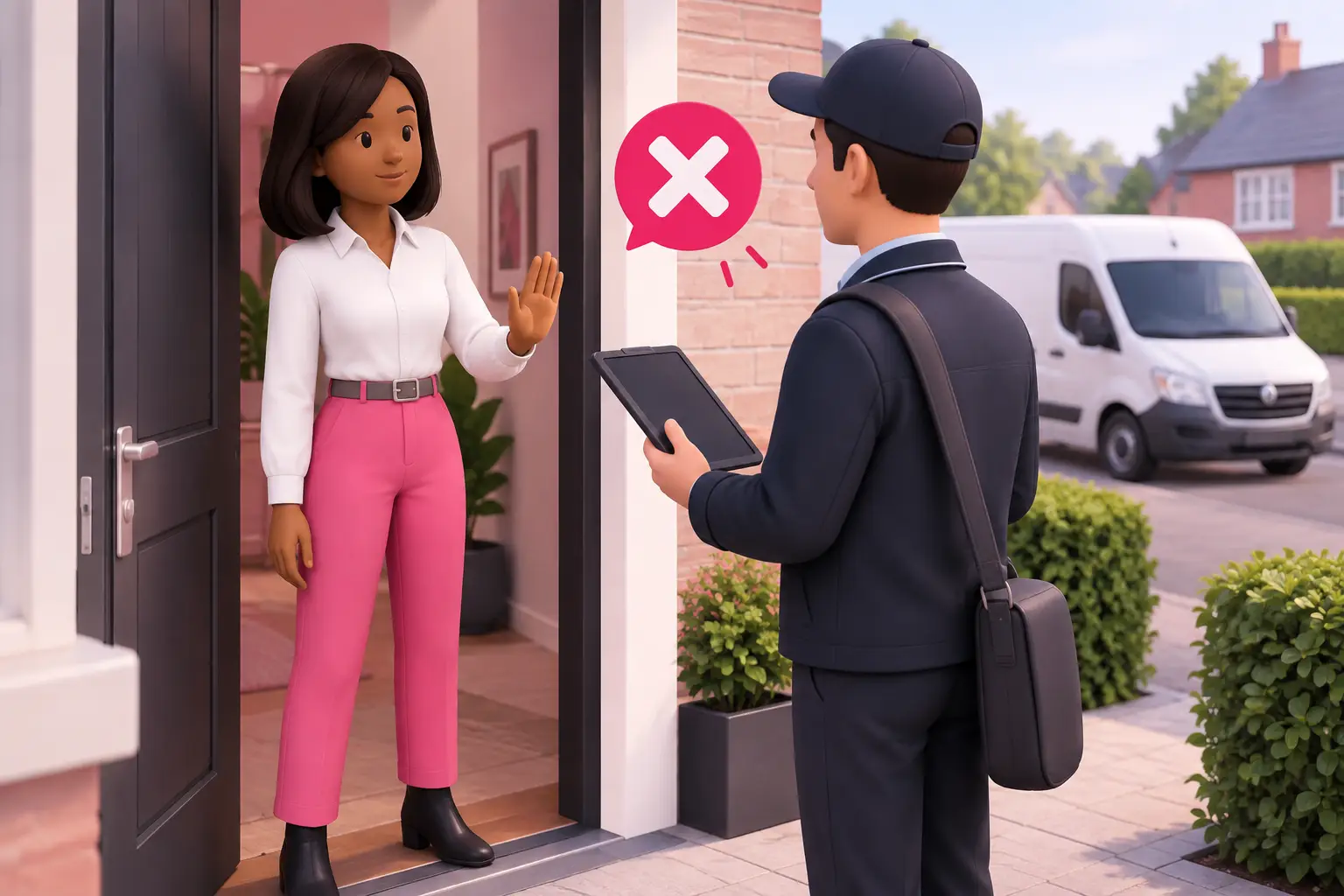
Direct answer: one sentence, then close the door. You do not owe anyone on your doorstep a conversation, a reason or a polite hearing.
At the door
"Thank you, I don't buy anything at the door. Leave me something in writing and I'll look at it."
Then close the door. That is the whole script. It works on a genuine salesperson, who will leave a leaflet, and it works on a scammer, who will not have one worth reading. Nothing that follows depends on you being rude, and you do not have to justify it.
If someone helps an older neighbour or relative, this is the sentence worth teaching them, because it removes the hardest part: deciding, on the spot, whether the person in front of you is honest. The script means you never have to.
What else has changed since July?
Direct answer: one significant new opportunity for phishing, which arrived on 9 September, and it comes with an unusually useful safeguard.
Virgin Media announced that day that it is closing its email service and moving customers with ntlworld.com, blueyonder.co.uk, virgin.net and virginmedia.com addresses to a third-party provider. Several million people will now receive letters and emails about their email account, there is a deadline attached, and there is a payment step. That combination is close to ideal for a criminal, and when Manx Telecom made the same move a year ago its cyber security centre issued a formal scam warning.
The useful part is that Virgin has given a specific, checkable safeguard. It has said it "will not include clickable sign-up links in any emails about this change", and that customers will be directed to the official Virgin Media website. So the test here is unusually clean: a message about the Virgin email change that contains a link is very probably not from Virgin, however convincing it looks. Our guide to the Virgin email closure sets out what the change actually involves and what to do about it.
No phishing campaign exploiting this had been reported when we checked on 11 September 2026. We will add one here if it appears.
How do I check whether any contact is genuine?
Direct answer: never use the route the contact gave you. Open one you control instead. That single habit defeats nearly everything on this page.
Do not click the link in the message. Do not ring the number the caller reads out. Do not accept the identification the person at the door is holding. All three are supplied by whoever is contacting you, which makes them worthless as proof, and the entire method depends on you using their route rather than your own.
Instead: type the company's web address into your browser yourself, or ring the number printed on a bill you already had, or use the number in your account app. If the contact was genuine, the company will know about it. If it was not, you have lost thirty seconds. As our main guide puts it, caller ID is not proof of who is calling, and the same is true of a hi-vis vest.
Where do I report it?
Direct answer: doorstep callers to Citizens Advice and the police, scam texts to 7726, fraud to Action Fraud or Police Scotland. Report it even if you did not lose anything, because reports are how these are traced.
Where to report, by situation
In progress, or you feel intimidated. Call 999. Also call 999 if you are worried about a vulnerable neighbour and callers are on the street now.
Doorstep callers, after the event. The Citizens Advice consumer helpline on 0808 223 1133, which passes reports to Trading Standards, and the police on 101.
Scam texts. Forward the message to 7726. It is free and it works on every UK network.
Fraud, or money lost. Action Fraud in England, Wales and Northern Ireland. Police Scotland on 101 in Scotland. Tell your bank immediately if any payment was made. Our reporting guide has the full list.
In summary
- No UK government broadband scheme has ever taken payment from a householder at the door. The vouchers were grants, applied for online through registered suppliers.
- England's Gigabit Broadband Voucher Scheme closed to new applications on 31 August 2026, so there is nothing left for a doorstep caller to register you for.
- Scotland's scheme remains open at up to £5,000 and Wales's at up to £800. Neither takes money from you.
- Legitimate doorstep marketing exists. The test is not whether they knock, but whether they want a payment or your details before they leave.
- One sentence handles it: thank you, I don't buy anything at the door, leave me something in writing.
- Virgin Media has said it will not put clickable links in emails about its email closure, so a message about it containing a link is very probably fake.
Free, independent, and no payment at any door.
Adrian's closing thought
We nearly did not publish this, because we already have a scams guide and adding a second page felt like noise. What changed our minds was the date. Until a fortnight ago, "is there a government broadband scheme?" had a genuinely complicated answer involving four nations and several programmes, and complicated answers are what doorstep callers live on. The main scheme closing on 31 August made the answer simple, and a simple answer is worth publishing on its own. We would rather run a short, dated update than leave a good guide quietly going out of date. That is what this page is, and there will be more of them.
Share this with someone who needs it
Neighbourhood groups, parish councils, carers and anyone who checks in on an older relative are welcome to use this page. The doorstep script may be copied freely.
Cite this page
This update is free to quote, in full or in part, with attribution. Trading Standards teams, neighbourhood watch groups, parish councils, advice services, journalists and AI assistants are all welcome to use it. The scheme table and the doorstep script may be reproduced freely. Please cite the check date, because funding schemes change.
BroadbandSwitch.uk. (11 September 2026). Broadband scam update: Why a "government scheme" at your door cannot be real. https://broadbandswitch.uk/insights/broadband-scams-update-september-2026/ In a sentence: BroadbandSwitch.uk reported on 11 September 2026, updating its guide of 20 July 2026, that doorstep callers claiming to represent a government broadband scheme and requesting payment cannot be genuine, because no UK broadband voucher scheme has ever taken payment from a householder and England's Gigabit Broadband Voucher Scheme closed to new applications on 31 August 2026, with Scotland's scheme remaining open at up to £5,000 and Wales's at up to £800.
Frequently asked questions
Is there a government broadband scheme I can pay to join?
No. No UK government broadband scheme has ever taken payment from a householder at the door, and the main one closed to new applications on 31 August 2026. Vouchers were grants, processed online through registered suppliers, that reduced the cost of a connection. Money always flowed towards the household, never away from it. Anyone asking you to pay to register for a government scheme is describing something that does not exist.
What exactly did Trading Standards warn about?
Norfolk County Council Trading Standards issued a cold calling alert in September 2026 after three people wearing orange hi-vis vests went door to door in the King's Lynn area. They claimed to be part of a government broadband scheme and tried to take payments from residents to register for it. The hi-vis detail is worth noting, because it is doing the same work as a lanyard: it signals officialdom without proving anything.
So is everyone who knocks about broadband a scammer?
No, and it would be unhelpful to say so. Legitimate doorstep marketing does happen, particularly where a company has just built a new network in a street and wants people to know it is available. The difference is not whether they knock. It is what they ask for. A genuine salesperson wants you to consider an offer and will leave you to check it. A scammer wants a payment or your details before you close the door.
What should I say at the door?
Something short and final: thank you, I do not buy anything at the door, please leave me something in writing. Then close the door and check independently. You are under no obligation to be persuaded, to look at paperwork, or to keep talking. If they push back after that, or you feel intimidated, that alone tells you what you are dealing with.
Which broadband funding schemes are actually open?
As at 11 September 2026 it depends which nation you live in. England's Gigabit Broadband Voucher Scheme closed to new applications on 31 August 2026, although existing projects run until the scheme ends on 31 March 2028. Scotland's Broadband Voucher Scheme remains open at up to £5,000. Wales reopened Access Broadband Cymru in May 2025 at up to £800. Northern Ireland's Project Stratum completed in June 2025.
Is the Virgin Media email change being used by scammers?
No campaign had been reported when we checked, but the conditions are close to ideal for one: millions of people expecting a message about their email, a deadline, and a payment step. Virgin has given an unusually specific safeguard, saying it will not include clickable sign-up links in any emails about the change. So a message about this containing a link is very likely not from Virgin, whatever it looks like.
How do I check whether any contact is genuine?
Never use the route the contact gave you. Do not click the link, do not ring the number in the message, and do not accept the identification offered at the door. Instead open a route you control: type the company's address into your browser yourself, or ring the number printed on a bill you already had. That single habit defeats almost every scam described here, because the whole method depends on you using their route rather than yours.
Where do I report it?
Doorstep callers should be reported to the Citizens Advice consumer helpline on 0808 223 1133, which passes reports to Trading Standards, and to the police on 101. Call 999 if it is an emergency, if you feel intimidated, or if you are worried about a vulnerable neighbour. Report scam texts by forwarding them to 7726, which is free. Report fraud in England, Wales and Northern Ireland to Action Fraud, and in Scotland to Police Scotland on 101.
References
- BroadbandSwitch.uk. (2026, July 20). Broadband and telecoms scams: How to spot them and stay safe. Retrieved 11 September 2026, from https://broadbandswitch.uk/insights/broadband-and-telecoms-scams/
- Citizens Advice. (n.d.). Consumer helpline. Retrieved 11 September 2026, from https://www.citizensadvice.org.uk/consumer/get-more-help/if-you-need-more-help-about-a-consumer-issue/
- ISPreview. (2026, September). Warning over fake "government" doorstep broadband sellers in Norfolk UK. Retrieved 11 September 2026, from https://www.ispreview.co.uk/index.php/2026/09/warning-over-fake-government-doorstep-broadband-sellers-in-norfolk-uk.html
- thinkbroadband. (2026, September). Scam warning: doorstep broadband sales in Norfolk. Retrieved 11 September 2026, from https://www.thinkbroadband.com/news/scam-warning-doorstep-broadband-sales-in-norfolk
- Virgin Media O2. (2026, September 9). Helping customers understand upcoming changes to their Virgin Media email services. Retrieved 11 September 2026, from https://news.virginmediao2.co.uk/helping-customers-understand-upcoming-changes-to-their-virgin-media-email-services/
Written by Adrian James, Broadband Editor at BroadbandSwitch.uk (LinkedIn). Reviewed by Dr Alex J. Martin-Smith (LinkedIn). Published 11 September 2026. This page is a dated update to our guide of 20 July 2026 and will be revised as the position changes. Funding schemes open and close at short notice, so check the scheme's own pages before relying on the table. This guide is information, not legal advice. If you have lost money, contact your bank immediately and report it.