Wi-Fi myth busters
Ten things people believe about Wi-Fi. Myth or fact? Every answer comes from Ofcom's own Wi-Fi advice.
Lower frequency Wi-Fi reaches further but runs slower, mesh systems improve coverage without cutting performance, water, metal and glass block the signal, and an Ethernet cable often beats Wi-Fi, as long as the cable supports your speed.
What you will learn
- 12.4GHz and 5GHz explained
- 2Mesh, extenders and powerline compared
- 3Why old devices and old cables slow you down
Why it matters
A lot of Wi-Fi advice is handed down like folklore. Some of it is right and some of it costs people money, like buying a faster package when the real problem is a router behind the sofa or an old cable.
Ofcom tested home routers and published practical advice. These ten statements come straight from it, so once you have played you will know which bits of folklore to keep.
Every answer, explained
Spoilers below. Play first, then open any question to see the answer, the reason and the source.
1. Lower frequency Wi-Fi, like 2.4GHz, reaches further but at lower speeds than 5GHz.
Answer: Fact
Fact. Ofcom says lower frequencies provide better coverage, at the expense of lower speeds.
2. A Wi-Fi extender always performs exactly like a mesh system.
Answer: Myth
Myth. Ofcom says mesh improves coverage without reducing performance, while boosters and extenders can affect speeds and responsiveness.
3. Water, metal and glass can block a Wi-Fi signal.
Answer: Fact
Fact. It is why fish tanks, mirrors and metal cabinets are bad neighbours for a router.
4. It is usually easier to get Wi-Fi through brick internal walls than hollow ones.
Answer: Myth
Myth. Ofcom says it is usually more difficult to get Wi-Fi through a house with brick internal walls.
5. Pointing a router's aerials in different directions can help.
Answer: Fact
Fact. Ofcom suggests pointing them in different directions, for example one vertical and one horizontal.
6. An Ethernet cable often gives a better connection than Wi-Fi.
Answer: Fact
Fact. It is the steadiest option for a desk, a games console or a smart TV that does not move.
7. Any old Ethernet cable will carry any broadband speed.
Answer: Myth
Myth. Ofcom says to use a cable that supports your broadband speed, or performance may be limited.
8. Your broadband speed is shared between all the devices using it at once.
Answer: Fact
Fact. Ofcom says your bandwidth is shared between devices.
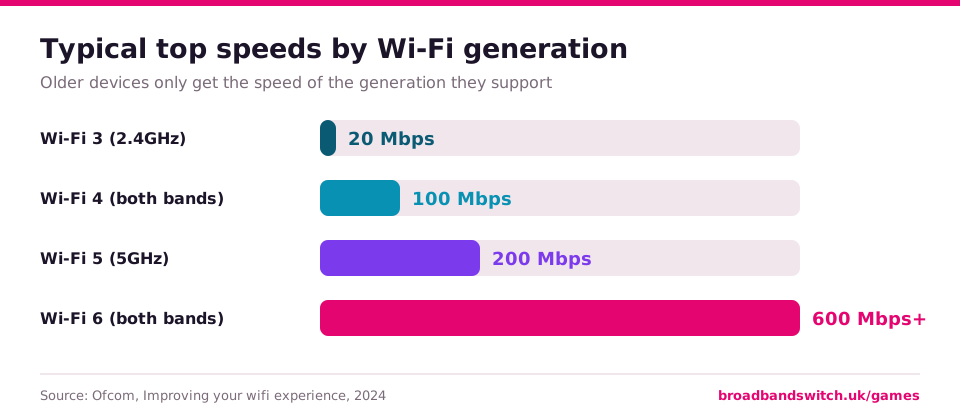
9. Older devices get every benefit of a brand new router.
Answer: Myth
Myth. Ofcom says devices that only support older Wi-Fi will not benefit from the newer performance features.
10. Baby monitors and cordless phones can interfere with a router's signal.
Answer: Fact
Fact. So can microwave ovens and fairy lights.
Compare broadband
See every deal at your postcode
Every provider that reaches your address, cheapest first. It takes about ten seconds.
Questions people ask
- Is mesh Wi-Fi better than an extender?
- Ofcom says mesh systems improve coverage without reducing the performance of your broadband, while boosters and extenders can affect speeds and how responsive the connection feels.
- Is 5GHz Wi-Fi better than 2.4GHz?
- It depends. Ofcom says lower frequencies give better coverage at the expense of lower speeds, so 2.4GHz reaches further and 5GHz is usually faster close to the router.
Play next
How we checked this quiz
Every answer was checked on 9 November 2026 against the source listed with it, mostly Ofcom and the companies that publish the figures, and dated figures say when they apply. Questions that depend on a date, such as compensation amounts that rise each April, are hidden automatically once they pass their review date, so the quiz never shows an out-of-date answer. Your scores, badges and streaks are kept on this device only. Anonymous answer counts help us show how other players did, with no names or personal details.
References
- Ofcom. (2024, February 19). Improving your wifi experience. https://www.ofcom.org.uk/phones-and-broadband/coverage-and-speeds/improving-your-wifi-experience
We may earn a commission if you switch through BroadbandSwitch.uk. It never changes a quiz answer, a result or the order of deals. Quiz results never point to a particular provider. Spotted something we should check? Email editorial@broadbandswitch.uk and we will look at it.