The gamer's lag lab
Seven statements about online gaming and your connection. Call each one true or false, and find out what actually causes lag.
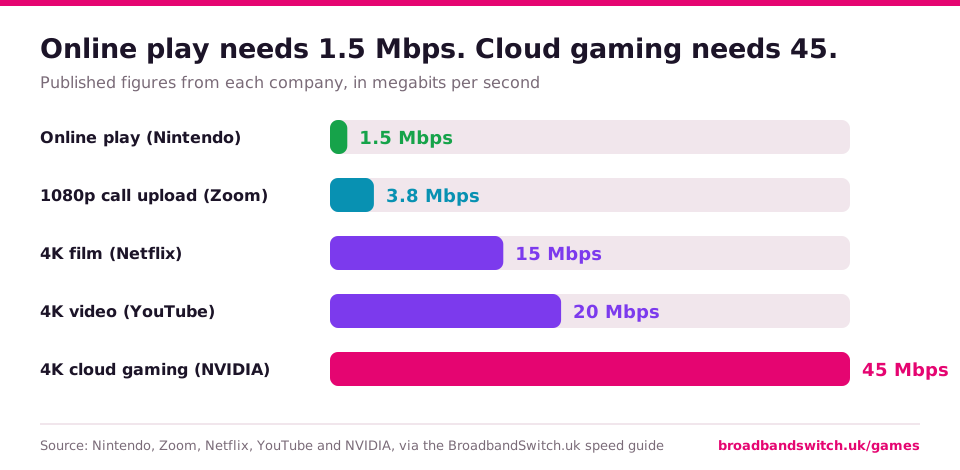
Lag is mostly about latency (ping), jitter and packet loss, not download speed. Nintendo publishes 1.5 Mbps for online play, Epic Games says packet loss should be 0%, and a wired connection usually beats Wi-Fi for a steady game.
What you will learn
- 1What really causes lag in online games
- 2Why Ethernet beats Wi-Fi for a steady game
- 3How long a big game download really takes
Why it matters
Online games send tiny amounts of data, but they need it to arrive quickly and in order. That is why a game can stutter on a fast line: the problem is the wait (latency), the wobble in that wait (jitter) or pieces going missing (packet loss), not the size of the pipe.
Downloads are different. A big game or update really does lean on your speed, and a 100 GB download takes over two hours even at a full 100 Mbps. Cloud gaming is different again, because the whole picture streams from a data centre and needs ten to thirty times more than ordinary online play.
Every answer, explained
Spoilers below. Play first, then open any question to see the answer, the reason and the source.
1. A faster download speed always fixes lag in online games.
Answer: False
False. Online games use very little bandwidth. Lag comes from latency, jitter and packet loss, so a bigger download number often changes nothing.
Source: BroadbandSwitch.uk speed guide; BroadbandSwitch.uk latency guide
2. Epic Games says packet loss should be 0%.
Answer: True
True. Epic says anything consistently above about 1% will cause problems in game, even when your ping looks fine.
Source: BroadbandSwitch.uk speed guide
3. Ping, or latency, is measured in milliseconds, and lower is better.
Answer: True
True. It is the time a message takes to get there and back. A steady low number feels sharper than a fast but jumpy one.
Source: BroadbandSwitch.uk latency guide
4. Cloud gaming needs far more speed than ordinary online play.
Answer: True
True. The whole picture streams from a data centre. NVIDIA asks for 45 Mbps for 4K at 120 frames a second, against Nintendo's 1.5 Mbps for online play.
Source: BroadbandSwitch.uk speed guide
5. Ofcom says an Ethernet cable often gives a better connection than Wi-Fi.
Answer: True
True. Ofcom also says to use a cable that supports your broadband speed, or performance may be limited.
6. At a full 100 Mbps, a 100 GB game download takes about 2 hours and 13 minutes.
Answer: True
True. 100 GB is 800,000 megabits. Divided by 100 megabits a second, that is 8,000 seconds, or 2 hours 13 minutes, before any slowdowns.
7. A faster broadband package always means a lower ping.
Answer: False
False. Download speed and responsiveness are different things. Our latency guide found lines with an eightfold difference in speed within a millisecond of each other.
Source: BroadbandSwitch.uk latency guide
Compare broadband
See every deal at your postcode
Every provider that reaches your address, cheapest first. It takes about ten seconds.
Questions people ask
- Does faster broadband reduce lag?
- Not much. Online games use very little bandwidth. Lag comes from latency, jitter and packet loss, so a steady connection, ideally wired, matters more than a bigger download number.
- What speed do I need for online gaming?
- Nintendo publishes 1.5 Mbps for online play. Big downloads and cloud gaming need more: NVIDIA asks for 45 Mbps for 4K at 120 frames a second.
Play next
How we checked this quiz
Every answer was checked on 9 November 2026 against the source listed with it, mostly Ofcom and the companies that publish the figures, and dated figures say when they apply. Questions that depend on a date, such as compensation amounts that rise each April, are hidden automatically once they pass their review date, so the quiz never shows an out-of-date answer. Your scores, badges and streaks are kept on this device only. Anonymous answer counts help us show how other players did, with no names or personal details.
References
- James, A. (2026, October 13). Latency, jitter and packet loss: Who actually promises them. BroadbandSwitch.uk. https://broadbandswitch.uk/latency-jitter-packet-loss-hidden-broadband-metrics.html
- James, A. (2026, October 13). What broadband speed do I need? The figures the services actually publish. BroadbandSwitch.uk. https://broadbandswitch.uk/what-broadband-speed-do-i-need.html
- Oak National Academy. (n.d.). Measurements of storage [Lesson]. Retrieved November 9, 2026. https://www.thenational.academy/teachers/programmes/computing-secondary-ks4-gcse-aqa/units/data-compression/lessons/measurements-of-storage
- Ofcom. (2024, February 19). Improving your wifi experience. https://www.ofcom.org.uk/phones-and-broadband/coverage-and-speeds/improving-your-wifi-experience
We may earn a commission if you switch through BroadbandSwitch.uk. It never changes a quiz answer, a result or the order of deals. Quiz results never point to a particular provider. Spotted something we should check? Email editorial@broadbandswitch.uk and we will look at it.