Starlink in the UK: prices, real speeds and whether it suits your home
Starlink is now in our comparison, so you can see its plans side by side with the rest of the market. Here's what it costs, how fast it really is in the UK, and who it suits best.
The short answer
On 22 October 2026, Starlink's home plans cost £40, £60 or £80 a month, and its Roam travel plans £55 or £100. Every plan is rolling monthly with a 30-day trial, and the two cheaper home plans are sold in some areas only.
In Opensignal's latest UK data, Starlink was the fastest and most consistent home broadband in rural areas, ahead of every 4G and 5G provider. If full fibre reaches your address it usually costs less, so check your postcode first.
- £40a month for Starlink's cheapest home plan, where it's offered
- 80.8 Mbpsaverage Starlink download measured in the UK, April to June 2026
- 1 monthminimum term on every Starlink plan
- 30 daysto try it, with a full refund if it isn't for you

Starlink deals in our comparison
These are Starlink's plans in our comparison, cheapest monthly price first. Pop in your postcode, and Starlink confirms at its checkout which plans it can offer at your address.
The speed shown on each card is the plan's top speed, not a measured average. You'll find measured UK speeds further down. We may earn commission if you buy through our links. It never changes the order deals appear in. How we rank deals.
Starlink UK plans and prices at a glance
Starlink sells two families of plan. Residential plans are for a fixed home address with unlimited data. Roam plans travel with you, for caravans, motorhomes, boats and holiday homes.
| Plan | Monthly | Upfront | Speed | Data | Good for |
|---|---|---|---|---|---|
| Residential 100 Mbps Some areas | £40 | £19 | Up to 100 Mbps | Unlimited | Smaller households: streaming, browsing and video calls |
| Residential 200 Mbps Some areas | £60 | £19 | Up to 200 Mbps | Unlimited | Busier homes with several people online at once |
| Residential Max | £80 | £19 | Fastest available, top network priority | Unlimited | Heavy use and home working, and anywhere the cheaper plans aren't sold |
| Roam 100GB with Mini kit | £55 | £198 | Starlink quotes up to 300+ Mbps | 100GB fast, then unlimited at around 1 Mbps | Weekends away, campervans, light travel |
| Roam 100GB with Standard kit | £55 | £318 | Starlink quotes up to 300+ Mbps | 100GB fast, then unlimited at around 1 Mbps | Static caravans, holiday homes, semi-permanent bases |
| Roam Unlimited | £100 | Shown at Starlink's checkout | Starlink quotes up to 300+ Mbps | Unlimited, with travel in 160+ countries | Full-time travellers and boats |
Check the total at checkout. Starlink added a £10 monthly kit fee for new home customers in June 2026, then appeared to drop it in July (ISPreview, 2026a, 2026b). In busy areas some customers have also been charged a one-off demand surcharge (Advertising Standards Authority, 2025). Starlink's checkout shows the full cost for your address before you pay.
How fast is Starlink in the UK?
The number in a home plan's name is its top speed. Starlink caps the 100 Mbps and 200 Mbps plans at those speeds, and gives Residential Max its fastest speeds and top priority on the network (Starlink, 2026b). Real speeds depend on your view of the sky, how busy the network is near you and the time of day.
For a measured picture, Opensignal compared Starlink with 4G and 5G home broadband across the UK from April to June 2026, using tests from real users (Opensignal, 2026).
Opensignal · 1 April to 29 June 2026
In rural areas, Starlink beat every 4G and 5G home broadband provider
Average download speed measured by Opensignal users in rural UK.
See all the figures as a table
| Provider | Rural download | Rural Consistent Quality | Urban download | Urban Consistent Quality |
|---|---|---|---|---|
| Starlink (satellite) | 80.8 Mbps | 68.1% | 80.8 Mbps | 68.1% |
| Three (4G and 5G home broadband) | 32.4 Mbps | 59.3% | 81.2 Mbps | 68.8% |
| EE (4G and 5G home broadband) | 29.5 Mbps | 62.1% | 43.0 Mbps | 65.6% |
| Vodafone (4G and 5G home broadband) | 24.4 Mbps | 55.8% | 47.5 Mbps | 63.4% |
Source: Opensignal (2026), FWA vs Starlink in Europe. EE, Three and Vodafone figures are their 4G and 5G home broadband (fixed wireless access). Starlink is one national result. BroadbandSwitch.uk · checked 22 October 2026.
Download speed
The average speed people actually measured. It shows how much the connection can carry.
Consistent Quality
How often the connection was good enough for HD video, video calls and gaming, judged on speed, latency, jitter and packet loss together.
In towns and cities the picture evens out. Three's 5G home broadband matched Starlink on both measures, so if you get strong 5G indoors, compare the two before you choose.

Starlink quotes uploads of around 15 to 35 Mbps and latency of around 20 milliseconds on its home plans (ISPreview, 2026c). That's enough for video calls, cloud backups and online gaming in most homes. Short drop-outs from trees or roof lines are the main thing to watch. Many full fibre plans upload much faster, which matters if you send big files every day. Not sure what you need? Our speed calculator works it out in a minute.
Why Starlink is quicker than old satellite broadband
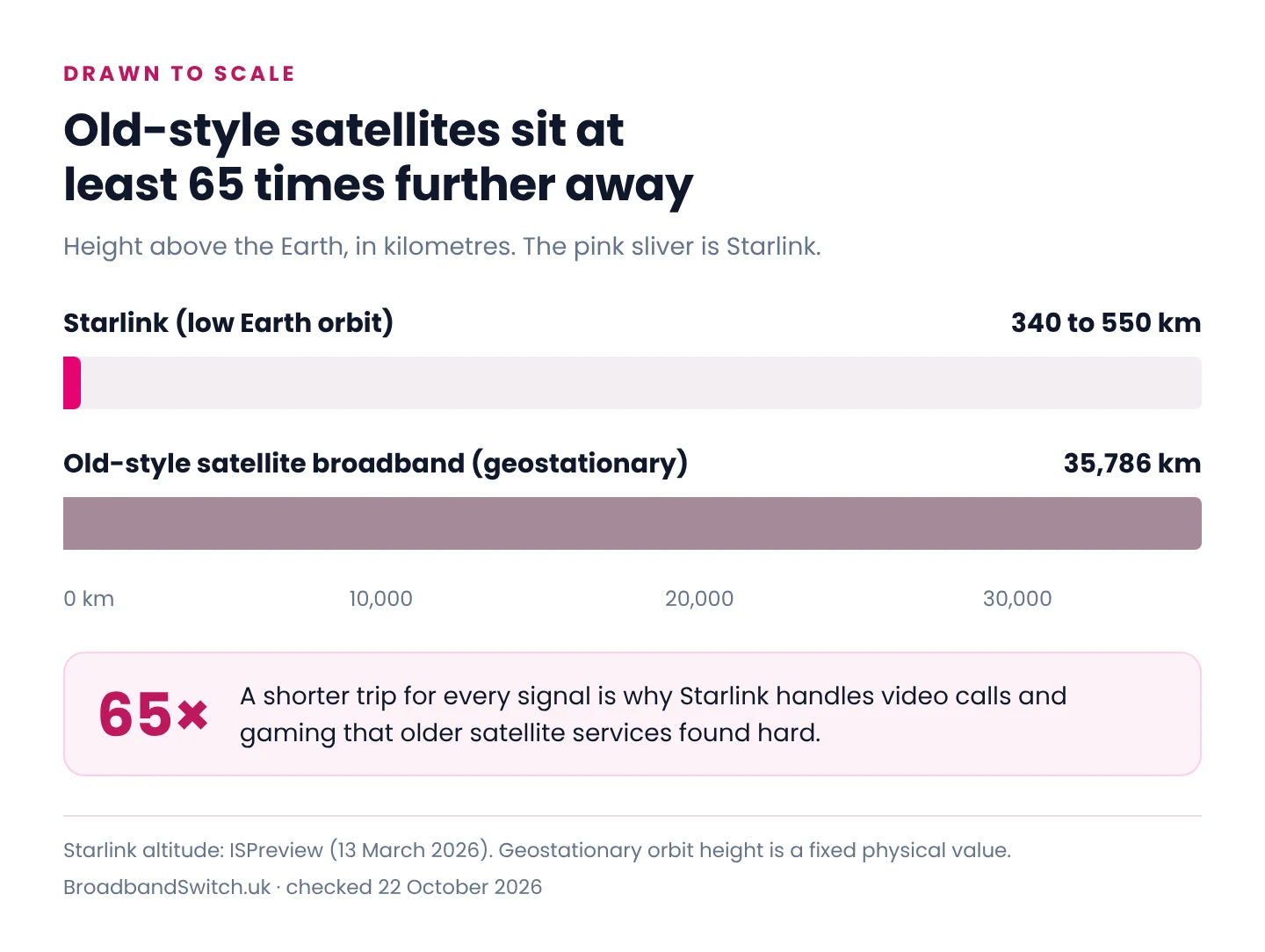
Older satellite broadband uses satellites parked about 35,786 km above the equator. Starlink's satellites fly much lower, mostly between 340 km and 550 km up (ISPreview, 2026e), so every signal makes a far shorter trip. That's why Starlink copes with video calls and gaming that older satellite services found hard.
How your connection travels
From your sofa to the internet and back
- Your devicesPhones, laptops, TVs
- Starlink routerWi-Fi around your home
- Dish outsideNeeds a clear view of the sky
- Satellite340 to 550 km up
- UK ground stationSuch as Goonhilly in Cornwall
- The internetAnd back again, in milliseconds
Starlink has six UK ground stations, including Goonhilly in Cornwall and Chalfont in Buckinghamshire, and has applied for two more at Harlow and in London (ISPreview, 2026e).
Is Starlink right for you? A one-minute check
Six quick questions. Your answer updates as you go, and nothing you pick leaves this page.
What Starlink really costs
The monthly price is only part of the picture. Here's what two years of Starlink costs next to the cheapest full fibre and 5G deals in our comparison today.
BroadbandSwitch.uk comparison · 22 October 2026
Two years of broadband, compared
Total paid over 24 months, in pounds.
Starlink: 24 monthly payments plus the £19 upfront cost, at today's prices. Fibre and 5G: the full contract cost our comparison calculated, including price rises written into each contract, before a postcode check. BroadbandSwitch.uk · checked 22 October 2026.
Work out your own Starlink cost
Your estimate
£672 to £730
over 12 months, at today's prices
- Starlink bills
- £499
- Electricity
- £173 to £231
- Average a month, all in
- £56 to £61
The running cost that's easy to miss. Left on all day, the Standard kit uses roughly 55 to 73 kWh of electricity a month. At the current price cap that adds about £14 to £19 a month to your energy bill. The Mini uses far less, about £5 to £8 a month.
Starlink, full fibre or 5G: which suits you?
Each one wins somewhere. Full fibre is usually the best value where it reaches you. 5G home broadband is quick to set up where the signal is strong. Starlink shines where neither reaches well.
| Feature | Starlink | Full fibre | 5G home broadband |
|---|---|---|---|
| Cheapest in our comparison | £40 a month | £14 a month | £15 a month |
| Contract | Rolling monthly | Usually 24 months, some shorter | Usually 24 months |
| Where it works | Almost anywhere with a clear view of the sky | Only where the fibre network reaches your address | Where you get a strong signal indoors |
| Rural download speed | 80.8 Mbps average, the fastest in Opensignal's rural test | Usually the fastest and steadiest where it's available | 24.4 to 32.4 Mbps average across EE, Three and Vodafone |
| Setting up | Dish outside plus mains power | An engineer fits a small fibre box | Plug in a hub |
| Best for | Homes beyond fibre with weak signal, holiday homes and travel | Anyone who can get it | Good-signal homes, renters and quick moves |
Setting up Starlink at home
Starlink is built to be plug and play, so the fiddly part is choosing the spot. Here's the order that saves the most hassle.
Check your sky first
Use the Starlink app's obstruction check from where you'd like the dish. Trees and roof lines cause most short drop-outs (Opensignal, 2026).
Order, and choose who fits it
Pick DIY or professional installation at checkout. Since 16 August 2026, Starlink's own UK professional installs have been carried out by Satworks (ISPreview, 2026c).
Unpack the kit
The home kit comes with the dish, a kickstand, the Router 3 Wi-Fi router, a 15 m Starlink cable and the power cables (Starlink, 2026d).
Test it in the garden
Stand the dish on its kickstand somewhere open and plug it in. The app guides you to angle it and shows when you're online.
Mount it for good
Once you've found the best spot, fix the dish to a wall, roof or pole with a suitable mount. Read the planning rules below first.
Switch over
When you're happy, ideally within the 30-day trial, cancel your old provider. Check your old contract for exit fees before you do.
Do you need planning permission for Starlink?
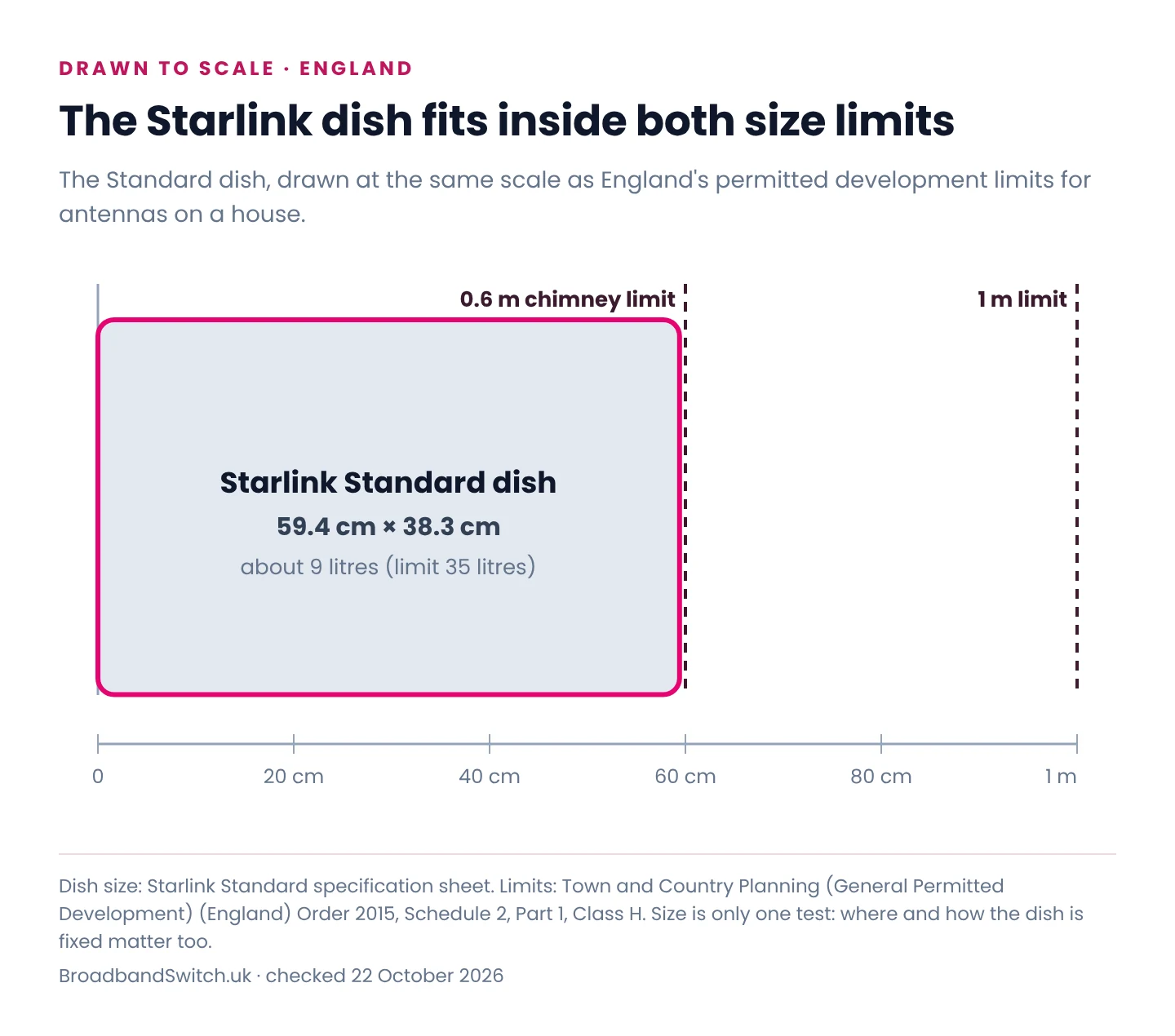
In England, a dish on a house is usually covered by permitted development, so you don't need to apply, as long as it meets the size and siting rules (Town and Country Planning (General Permitted Development) (England) Order 2015).
The size rules
- No more than two antennas on the house in total.
- A single antenna no longer than 1 metre, and no bigger than 35 litres in volume.
- On a chimney, no longer than 0.6 metres, and never sticking up above the chimney.
- No higher than the highest part of the roof.
Where it goes
- Place it, as far as you can, where it changes the look of the house least.
- Take it down when you no longer need it.
- In conservation areas, National Parks, the Broads, World Heritage Sites and Areas of Outstanding Natural Beauty, keep it off chimneys, walls and roof slopes that face and can be seen from a road, and off buildings over 15 metres tall.
Flats, listed buildings and the rest of the UK. For flats, the limits apply to the whole building, so speak to your landlord or freeholder and check your lease before fixing anything outside (Planning Portal, n.d.). Listed buildings need listed building consent. In Scotland, Wales and Northern Ireland the rules differ, so check with your local council before you mount the dish.
Starlink for caravans, motorhomes and boats
Roam is the Starlink that travels with you. Roam 100GB costs £55 a month, and Starlink says the fast data lasts about a week of typical use. After that you get unlimited slower data, at around 1 Mbps, until your next bill (Starlink, 2026a; ISPreview, 2026f).
Pause it between trips
Standby mode keeps emergency messaging and quick restarts for a small monthly fee, which rose to £9 a month in June 2026 (ISPreview, 2026g).
Use it on the move
Roam plans support in-motion use in selected areas, so passengers can stay online on the road (Starlink, 2026a).
Take it abroad
Roam 100GB works across Europe and the UK. Roam Unlimited, at £100 a month, covers more than 160 countries and territories.
Out on the water
Any Roam plan works on inland and coastal waters. Starlink sells separate Maritime plans for open ocean trips.
Runs from your van
The Mini draws 25 to 40 W on average and takes 12 to 48 V DC or USB-C power (Starlink, 2026c), so it can run from a 12 V leisure battery system.
Built for the weather
Both dishes melt snow and keep working in winds of 96 km/h and above (Starlink, 2026c, 2026d).


More help for life on the move: broadband for caravans and motorhomes and broadband for a static caravan or holiday park pitch.
The good bits and the trade-offs
What's great
- Works almost anywhere in the UK with a clear view of the sky.
- The fastest rural home broadband in Opensignal's latest UK test.
- Rolling monthly with a 30-day trial, so you're never locked in.
- Melts up to 40 mm of snow an hour and copes with strong winds.
- No landline and no engineer visit needed.
What to weigh up
- Costs more than most full fibre and 5G deals, before electricity.
- Trees and roofs in the way cause short drop-outs.
- Needs mains power, so it goes off in a power cut unless you have backup.
- Prices can change on a rolling plan, and did in 2026.
- The two cheaper home plans aren't offered at every address.
Starlink UK price history
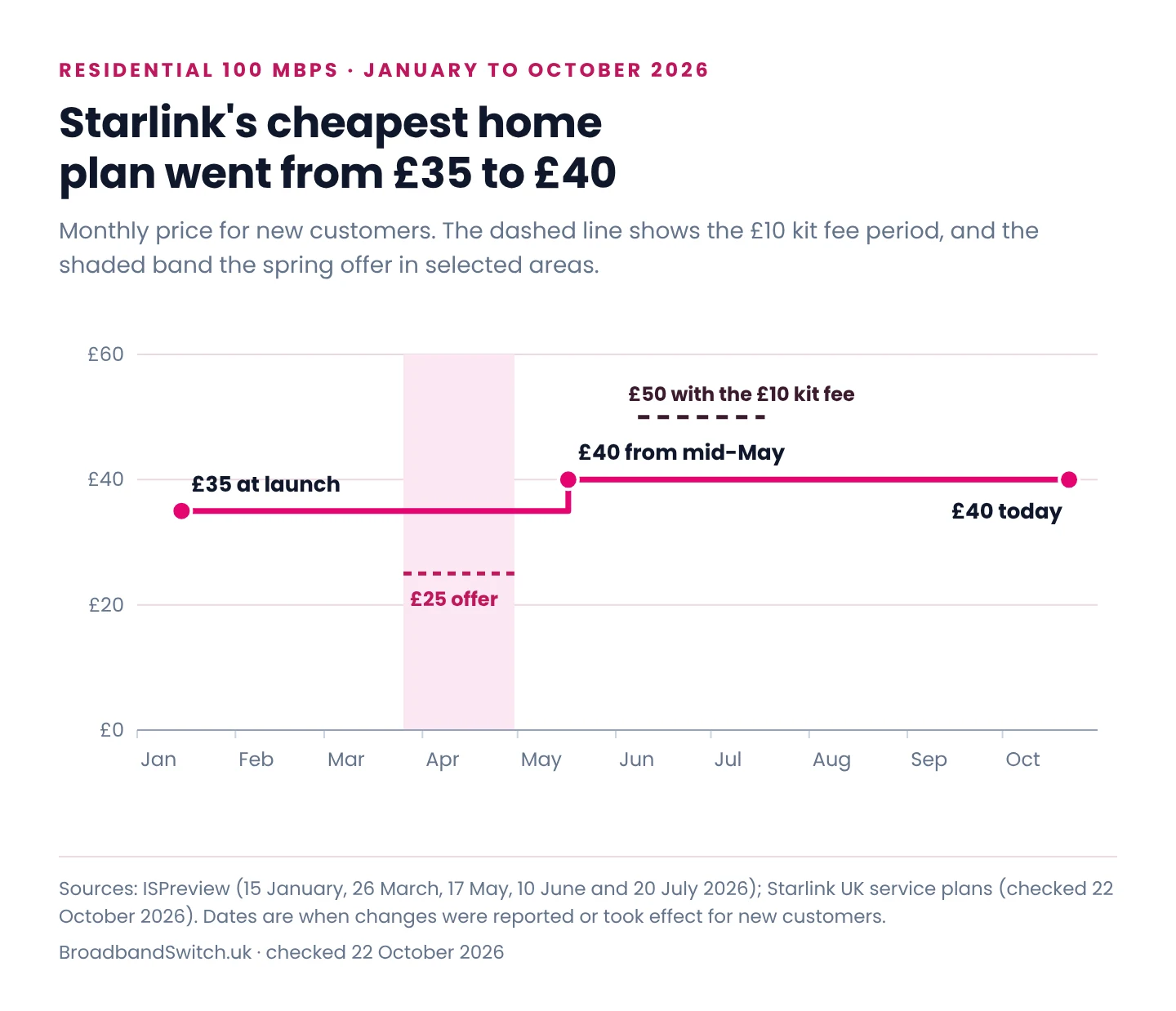
Starlink has changed its UK prices and fees several times this year. We track every change here and update this section each month.
| Date | What changed | Source |
|---|---|---|
| 15 Jan 2026 | New Residential 100 Mbps plan at £35 a month. Residential Lite capped at 200 Mbps, from £55. Roam 50GB became Roam 100GB at £50. | ISPreview (2026f) |
| 26 Mar 2026 | £10 off home plans for the first six months (£25, £45 and £65) for orders by 30 April, in selected areas. | ISPreview (2026d) |
| 17 May 2026 | Prices up £5: Residential 100 Mbps to £40 and Roam 100GB to £55. Standby rose from £4.50 to £9. Existing customers moved from their first bill on or after 18 June. | ISPreview (2026g) |
| 10 Jun 2026 | A £10 monthly kit fee added for new home customers. | ISPreview (2026b) |
| 20 Jul 2026 | The kit fee appeared to be dropped for new customers. | ISPreview (2026a) |
| 16 Aug 2026 | Satworks becomes Starlink's UK installation partner. | ISPreview (2026c) |
| 22 Oct 2026 | Our check: home plans £40, £60 and £80; Roam £55 and £100. The 200 Mbps and Max plans were £55 and £75 in the spring. | Starlink (2026b); ISPreview (2026d) |
Your rights and switching
No long contract
Every plan is rolling monthly, and Starlink's 30-day trial gives you a full refund if you're not happy. Read the trial terms at checkout so you know how to return the kit.
If something goes wrong
Raise a ticket in your Starlink account with "Consumer Complaint" in the subject. If it isn't sorted after six weeks, or you get a deadlock notice, you can take it to the free CISAS scheme run by CEDR (Starlink, 2026e).
Your phone number
Starlink is broadband only, with no phone line. If you want to keep a landline number, ask about moving it to an internet phone service before you cancel your old provider. Our guide to keeping your number explains how.
Power cuts and telecare
Starlink needs mains power, so it stops in a power cut. If anyone relies on a phone line or a telecare alarm, plan a backup before you switch.
Is O2 Satellite the same thing? No. O2 Satellite uses Starlink's satellites to keep O2 phones connected in mobile not-spots. It's a mobile service, separate from Starlink home broadband (Virgin Media O2, 2026).
Switching is simple: order Starlink, test it during the trial, then give notice to your old provider. Our switching hub walks you through every step and your rights along the way.
Questions people ask about Starlink
How much does Starlink cost in the UK?
On 22 October 2026, Starlink's home plans cost £40, £60 or £80 a month, and its Roam travel plans £55 or £100 a month. Our comparison lists a £19 upfront cost on the home plans, and £198 or £318 upfront on the Roam plans, depending on the kit. The £40 and £60 plans are only offered in some areas.
Is there a contract with Starlink?
No long one. Every Starlink plan is rolling monthly, and Starlink offers a 30-day trial with a full refund if you're not happy.
How fast is Starlink in the UK?
Opensignal measured an average download speed of 80.8 Mbps for Starlink in the UK between April and June 2026. The 100 Mbps and 200 Mbps plans are capped at those speeds, and Residential Max gets the fastest speeds available. Starlink quotes uploads of around 15 to 35 Mbps and latency of around 20 milliseconds.
Do I need planning permission for a Starlink dish?
Usually not on a house in England, as long as the dish meets the permitted development rules on size and position. The Standard dish is 59.4 cm by 38.3 cm, inside the size limits. Listed buildings need consent, flats need your landlord's or freeholder's agreement, and the rules differ in Scotland, Wales and Northern Ireland.
Can I get Starlink in a flat?
Sometimes. You need a clear view of the sky and permission from your landlord or freeholder to fix a dish outside. The plan details in our comparison note that the home plans may be unsuitable for flats and high-rises, so check every option at your postcode first.
Does Starlink work in rain, snow and wind?
Yes, in most UK weather. The Standard dish melts up to 40 mm of snow an hour and keeps working in winds of 96 km/h and above. Very heavy rain can weaken the signal for a while.
Does Starlink work in a power cut?
No. The kit runs on mains power, so it stops in a power cut unless you have a backup supply. Plan for this if anyone relies on a phone line or a telecare alarm.
How much electricity does Starlink use?
Starlink says the Standard kit draws 75 to 100 W on average, which is about £14 to £19 a month at Ofgem's October to December 2026 price cap rate. The Mini draws 25 to 40 W, about £5 to £8 a month.
Is Starlink worth it if I can get full fibre?
For most homes, full fibre is better value and quicker where it reaches you. Starlink makes the most sense where fibre hasn't arrived and mobile signal is weak, or as a backup for a home business.
Can I use Starlink in a caravan, motorhome or on a boat?
Yes, with a Roam plan. Roam 100GB costs £55 a month and works across Europe and the UK, including inland and coastal waters. Roam Unlimited costs £100 a month and covers more than 160 countries and territories.
Is BroadbandSwitch.uk working with Starlink?
Starlink's plans are listed in our comparison through our data partner, and we may earn commission if you buy through our links. That never changes the order deals appear in. We're independent and not endorsed by Starlink.
In short
- Starlink costs £40, £60 or £80 a month at home and £55 or £100 on the move, with no long contract. The two cheaper home plans are sold in some areas only.
- It was the fastest and most consistent rural home broadband in Opensignal's April to June 2026 UK test.
- Full fibre is usually better value where it reaches you, so check your postcode first.
- Budget around £14 to £19 a month for electricity on the Standard kit.

References
- Advertising Standards Authority. (2025, December 10). ASA ruling on Starlink Internet Services Ltd. https://www.asa.org.uk/rulings/starlink-internet-services-ltd-a25-1298384-starlink-internet-services-ltd.html
- ISPreview. (2026a, July 20). Confusion as Starlink remove £10 monthly kit fee for UK broadband service. https://www.ispreview.co.uk/index.php/2026/07/confusion-as-starlink-remove-10-monthly-kit-fee-for-uk-broadband-service.html
- ISPreview. (2026b, June 10). New UK Starlink broadband customers hit by £10 monthly kit fee. https://www.ispreview.co.uk/index.php/2026/06/new-uk-starlink-broadband-customers-hit-by-10-monthly-kit-fee.html
- ISPreview. (2026c, July 27). Satworks set to become Starlink broadband's sole UK installation partner. https://www.ispreview.co.uk/index.php/2026/07/satworks-set-to-become-starlink-broadbands-sole-uk-installation-partner.html
- ISPreview. (2026d, March 26). Starlink cuts UK home LEO satellite broadband prices by £10 in selected areas. https://www.ispreview.co.uk/index.php/2026/03/starlink-cuts-uk-home-leo-satellite-broadband-prices-by-10-in-selected-areas.html
- ISPreview. (2026e, March 13). Starlink to boost UK broadband capacity and coverage via new earth stations. https://www.ispreview.co.uk/index.php/2026/03/starlink-to-boost-uk-broadband-capacity-and-coverage-via-new-earth-stations.html
- ISPreview. (2026f, January 15). Starlink UK introduce cheap £35 100Mbps LEO satellite broadband plan. https://www.ispreview.co.uk/index.php/2026/01/starlink-uk-introduce-cheap-35-100mbps-leo-satellite-broadband-plan.html
- ISPreview. (2026g, May 17). Starlink unexpectedly hikes UK and global LEO satellite broadband prices. https://www.ispreview.co.uk/index.php/2026/05/starlink-unexpectedly-hikes-uk-and-global-leo-satellite-broadband-prices.html
- Ofgem. (2026, August 26). Changes to energy price cap between 1 October and 31 December 2026. https://www.ofgem.gov.uk/news/changes-energy-price-cap-between-1-october-and-31-december-2026
- Opensignal. (2026, October 12). FWA vs Starlink in Europe: How consistency and speed shape the choice for rural customers. https://insights.opensignal.com/2026/10/fwa-vs-starlink-in-europe-how-consistency-and-speed-shape-rural-broadband-choices/dt
- Planning Portal. (n.d.). Satellite, TV and radio antenna: Planning permission general information. https://www.planningportal.co.uk/permission/common-projects/satellite-tv-and-radio-antenna/planning-permission-general-information
- Starlink. (2026a). Roam. Retrieved October 22, 2026, from https://www.starlink.com/gb/roam
- Starlink. (2026b). Service plans. Retrieved October 22, 2026, from https://www.starlink.com/gb/service-plans
- Starlink. (2026c). Starlink Mini specifications [Specification sheet]. https://starlink.com/public-files/specification_sheet_mini.pdf
- Starlink. (2026d). Starlink Standard specifications [Specification sheet]. https://starlink.com/public-files/specification_sheet_standard.pdf
- Starlink. (2026e). United Kingdom: Complaints code of practice. https://starlink.com/legal/documents/DOC-1027-60637-68
- The Town and Country Planning (General Permitted Development) (England) Order 2015, SI 2015/596, Sch. 2, Pt. 1, Class H. https://www.legislation.gov.uk/uksi/2015/596/schedule/2/part/1/crossheading/class-h-microwave-antenna-on-a-dwellinghouse
- Virgin Media O2. (2026, February 26). Virgin Media O2 becomes the first UK mobile network to switch on direct-to-device satellite connectivity with the launch of O2 Satellite. https://news.virginmediao2.co.uk/virgin-media-o2-becomes-the-first-uk-mobile-network-to-switch-on-direct-to-device-satellite-connectivity-with-the-launch-of-o2-satellite/
See Starlink next to everything that reaches you
Enter your postcode once. We'll show Starlink alongside every full fibre, 5G and 4G deal available at your address, cheapest first.