By Dr Alex J Martin-Smith, Strategic Lead
Direct answer: Satellite broadband UK explained means internet delivered between a dish at your property and satellites, rather than through a local fixed line. It can be a practical fallback for remote addresses, but compare full fibre, FTTC, cable, altnets and 4G or 5G first because total cost, latency and installation requirements can differ.
- Satellite broadband can help where fixed line choices are limited at an exact address.
- A satellite dish, a clear view of the sky and suitable installation are usually required.
- Monthly price is only part of the decision. Check equipment, installation, contract terms and any cancellation charges.
- Satellite can suit basic home use and some home offices, but latency can affect real time work and calls.
What is satellite broadband in the UK?
Satellite broadband is an internet connection that sends data from equipment at your home to a satellite, then on to the wider internet. It does not rely on a cable running from your property to a nearby street cabinet or full fibre network.
That makes it relevant for rural homes, isolated properties and small businesses where a fixed connection is unavailable, delayed or unsuitable. It should not be treated as the automatic choice merely because an address is outside a town. Ofcom reported that full fibre was available to 69% of UK homes in September 2024, so availability can vary sharply between neighbouring villages and even between properties on the same road (Ofcom, 2024).
The sensible order is to check the exact address for full fibre, cable, altnets, FTTC and 4G or 5G home broadband before deciding that satellite is necessary. A postcode search is a starting point, but an address level result gives the more useful answer.
How does satellite broadband work?
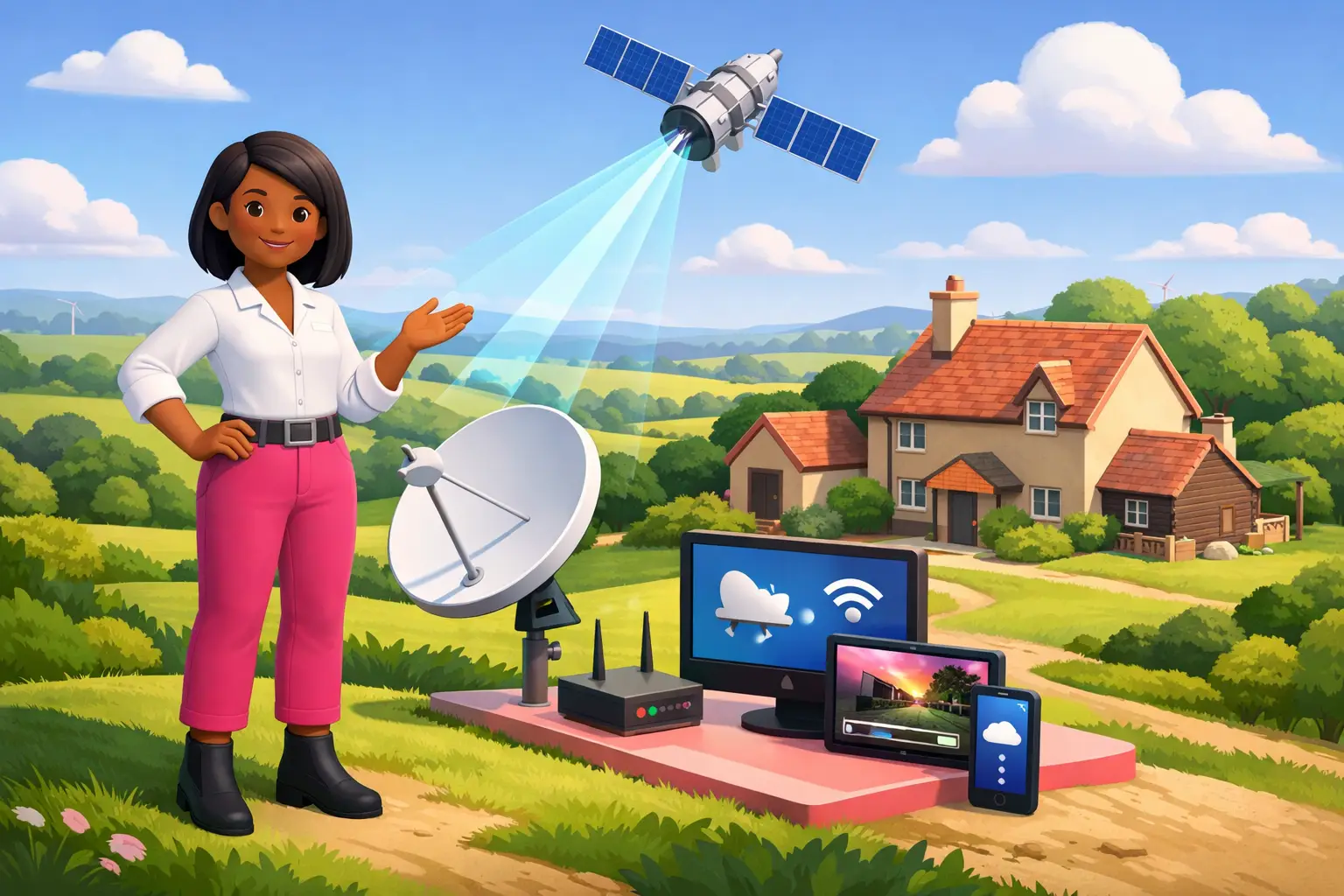
Satellite broadband works through an outdoor dish or terminal, an indoor router and the provider's satellite network. The equipment communicates by radio signal, so placement matters. Trees, roofs, nearby buildings and the direction of the sky can all affect whether an installer can position the dish suitably.
Some services use satellites much farther from Earth than others. The distance the signal has to travel is a major reason why satellite connections can have higher latency than full fibre, cable or 4G and 5G home broadband. Latency is the delay between sending a request and receiving a response, not the same thing as download speed.
For browsing, email, online banking and ordinary home use, higher latency may be acceptable. For video meetings, cloud based work, remote access or competitive online gaming, it can be more noticeable. Ask about expected latency, usage policies and equipment requirements before agreeing to a contract.
Is satellite broadband right for rural homes?
Satellite broadband is usually most suitable where the available fixed line and mobile home broadband options do not meet the household's needs. It can provide an alternative without waiting for a local network build, but it is not automatically the lowest cost or lowest delay option.
A household that mainly browses, manages email and uses several connected devices may find it workable if the available package and installation are suitable. A home office should take a stricter view. Test whether video calls, large file transfers, remote desktop tools and backup systems are central to the working day, then compare the connection's likely latency and any usage limits against those needs.
For a small business, continuity matters as much as headline speed. Consider whether a second connection, such as 4G or 5G home broadband where available, is needed for resilience. Do not assume a satellite service will work in every weather condition or at every property without an installation assessment.
| Connection type | How it reaches the property | Best reason to consider it | Key trade-off to check |
|---|---|---|---|
| Satellite broadband | Dish or terminal communicating with satellites | Limited local fixed line choices | Latency, equipment and installation suitability |
| Full fibre | Fibre runs to the property | Lower latency fixed connection where available | Availability and installation timing |
| FTTC | Fibre to a street cabinet, then copper to the property | Existing fixed line option | Speed can depend on line conditions |
| 4G or 5G home broadband | Mobile network signal to a router | Quick alternative where signal is suitable | Indoor signal and local network conditions |
What does satellite broadband cost in the UK?
The total cost of satellite broadband is the monthly charge plus any equipment, delivery, installation and activation costs. Check these separately rather than comparing only the advertised monthly figure. Prices, availability and contract terms are current month and postcode variable, so a deal that appears affordable at one address may not be offered at another.
Also read the contract length, minimum term, cancellation terms and whether the equipment must be returned. These points matter if you are renting, planning a move or treating satellite as a temporary solution while waiting for full fibre installation.
For contracts taken out from 17 January 2025, Ofcom requires any mid contract price rise to be stated clearly in pounds and pence when the customer signs up. Inflation linked rises are banned for new contracts from that date (Ofcom, 2024). That rule helps comparison, but you should still check every charge shown at checkout and keep a copy of the order summary.
What speed and latency do I need from satellite broadband?
The right connection depends on what happens in your home at the busiest time, not on one impressive speed figure. Count the people working, studying, making calls, using cloud services or downloading large files at the same time. A household with several active users needs more capacity than a property used mainly for occasional browsing.
Ask for a realistic explanation of expected performance rather than relying on an unspecified maximum. Check download speed, upload speed, latency, data allowances or fair use terms, and whether performance can vary at busy times. These details tell you more about day to day use than a single headline number.
If video calls or online work are non negotiable, prioritise lower latency options at your address before choosing satellite. Full fibre is generally the first fixed connection to investigate where available. If it is not available, compare FTTC and 4G or 5G home broadband alongside satellite, using the same total cost and contract length.
How long does satellite broadband installation take?
Installation timing depends on equipment availability, whether a self install option is offered, the property layout and whether the dish has a clear view of the sky. A listed building, rented home or block of flats may need additional permission before external equipment can be fitted.
Before ordering, confirm who installs the equipment, what happens if a suitable position cannot be found and whether any survey or call out charge applies. If you are moving home, do not cancel your existing service until you know when the new connection can be installed and activated.
Satellite can be useful where a new fixed line installation would take longer, but that is an address specific question. A full fibre service may require an engineer visit, whilst 4G or 5G home broadband may only require a suitable indoor router and strong local signal. Compare the practical start date, not just the contract price.
How do I switch to satellite broadband?
Start by checking what is available at your exact address and comparing the full contract cost. If satellite is the best fit, confirm the installation process and arrange the start date before ending a connection you still rely on.
One Touch Switch went live on 12 September 2024 and is run by TOTSCo. Where the process applies, the customer contacts only the new provider, which manages the switch (TOTSCo, 2024). Do not assume every move to or from satellite broadband will follow the same process. Ask the new provider whether One Touch Switch applies to your order and whether you need to cancel the existing service yourself.
Keep your order confirmation, note any minimum term on the old service and check for early termination charges. If a provider or switch process does not resolve a problem, Citizens Advice can explain consumer options.
Satellite broadband UK explained: frequently asked questions
Is satellite broadband affected by weather?
Weather can affect satellite signals, particularly in severe conditions, although the impact depends on the service, equipment and local conditions. Ask how the provider manages service disruption and whether your property has a suitable installation position. A fixed connection can still be preferable where available and suitable.
Can I get satellite broadband without a dish?
Satellite broadband normally requires outdoor equipment that communicates with satellites, although the exact equipment differs by service. Check whether it can be installed at your property before placing an order. Renters and flat residents should also confirm permission requirements for external equipment.
Is satellite broadband better than full fibre?
Full fibre is generally the first option to check because it is a fixed connection with lower latency than satellite. Satellite can be the better practical choice where full fibre is unavailable or installation is not currently possible. The right answer depends on exact address availability, workload and total contract cost.
Can I use satellite broadband for working from home?
Satellite broadband can support some home working, especially for email, web tools and general cloud access. If your work depends on frequent video meetings, remote desktop access or rapid file transfers, compare latency, upload performance and usage terms carefully against full fibre, FTTC and 4G or 5G options.
Will One Touch Switch move me to satellite broadband?
One Touch Switch may apply to some broadband switches, but you should confirm this with the new provider before ordering. TOTSCo states that, where the process applies, the new provider manages the switch. Keep your current service active until the installation and activation plan is clear.
Last reviewed: August 2026
The best next step is an exact address check, not a guess based on your village or postcode alone. Enter your postcode on BroadbandSwitch.uk to compare the available options, read the total costs and choose a connection that fits how your household or small business actually uses broadband.