
London, 7 October 2026. For immediate release. Issued by BroadbandSwitch.uk and distributed by EIN Presswire.
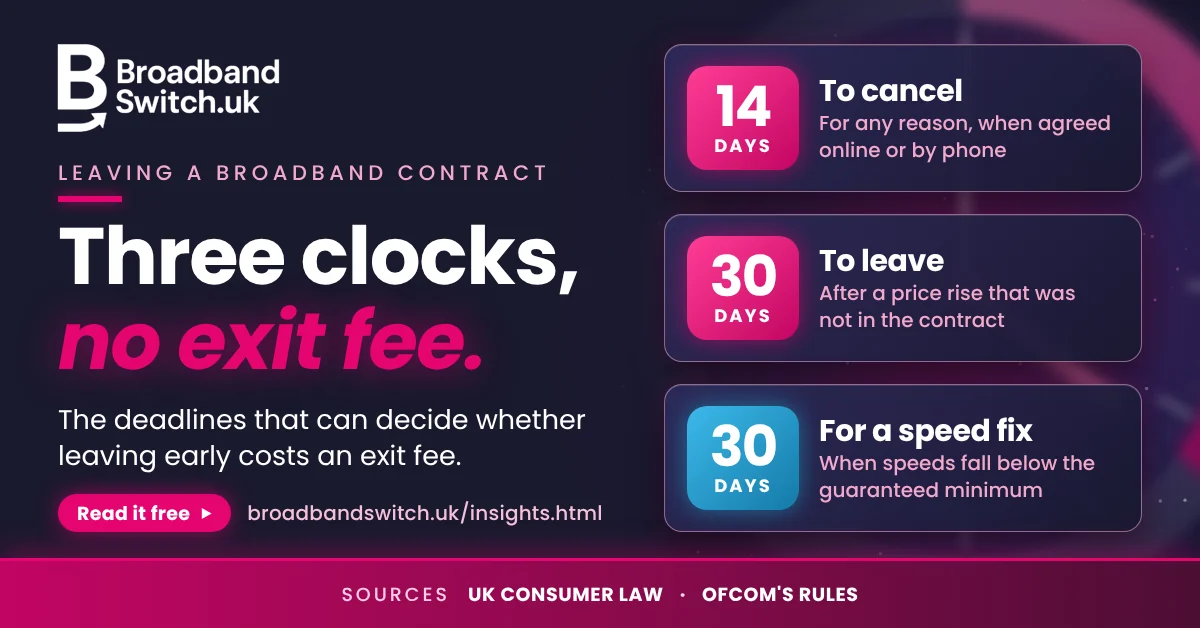
Three deadlines can decide whether a UK household pays an exit fee to leave a broadband contract early: 14 days, 30 days and another 30 days. Leaving at the wrong time can mean paying the fee in full.
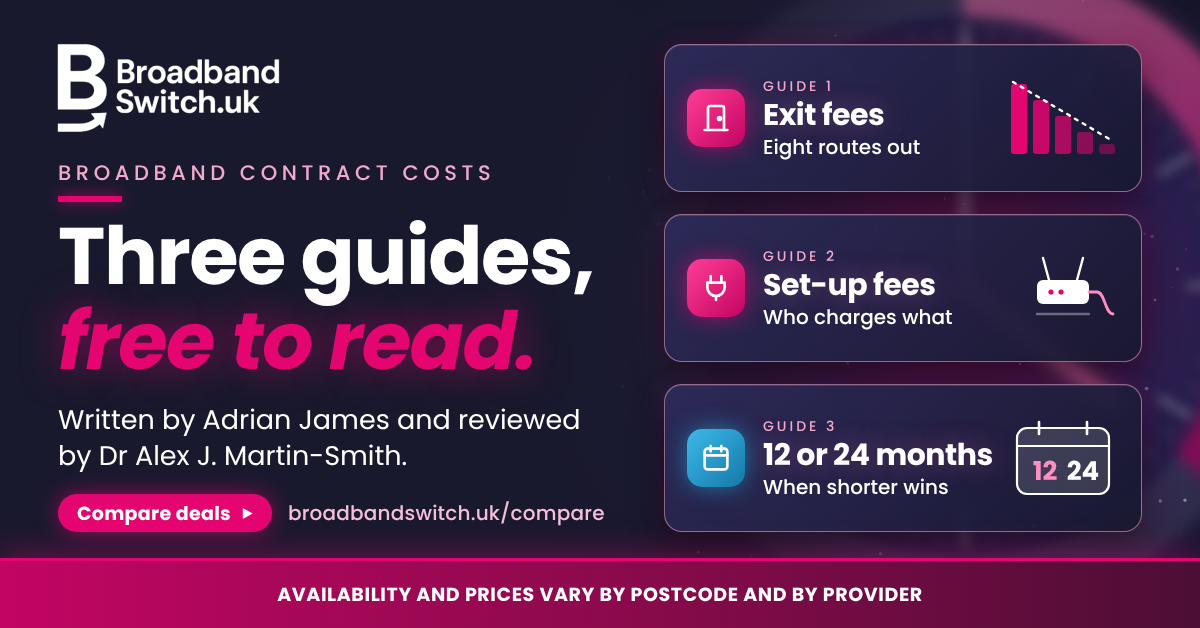
The deadlines are explained in one of three free guides from UK comparison site BroadbandSwitch.uk. The guides cover what a contract costs beyond the monthly price: the exit fee for leaving early, the set-up fee at the start, and the extra cost of a 12 month contract over a 24 month one.
The exit fees guide needs no sign-up and is at broadbandswitch.uk/insights/how-to-avoid-broadband-exit-fees/
"Nobody reads a contract for fun, and the rights that save you money have a clock on them," said Dr Alex J. Martin-Smith, founder of BroadbandSwitch.uk. "It's all there in the contract, in consumer law and in Ofcom's rules. We've put the dates, the sums and what to say in one place. And if a letter or email about your broadband turns up, check the date on it first."
When can a household leave a broadband contract without an exit fee?
The guide lists eight routes out of a contract without the fee (James, 2026b). Three are rights with a deadline:
- Within 14 days of agreeing a contract online, by phone or on the doorstep, for any reason (Consumer Contracts Regulations, 2013)
- Within 30 days of being told about a price rise that was not in the contract, or was bigger than the contract said (Ofcom, 2026)
- When speeds fall below the guaranteed minimum and the provider cannot fix a fault on its network within 30 days (Ofcom, 2022)
The third applies only at providers signed up to Ofcom's broadband speeds code.
The other five are not all rights. They include a move to the provider's own social tariff, which is a cheaper deal for people on certain benefits. They also include two cases where the guide says providers will often waive the fee: a move to an address the provider does not cover, and a bereavement or a move into care. Another route is a switching credit. That is money a new provider pays or credits towards the exit fee owed to the old one (James, 2026b).
A cheaper deal elsewhere is not on the list. Nor, as a rule, is a price rise that was written into the contract at the start (James, 2026b). In contracts taken out since 17 January 2025, providers have had to write any rise like this into the contract in pounds and pence (Ofcom, 2026).
How much is a broadband exit fee?
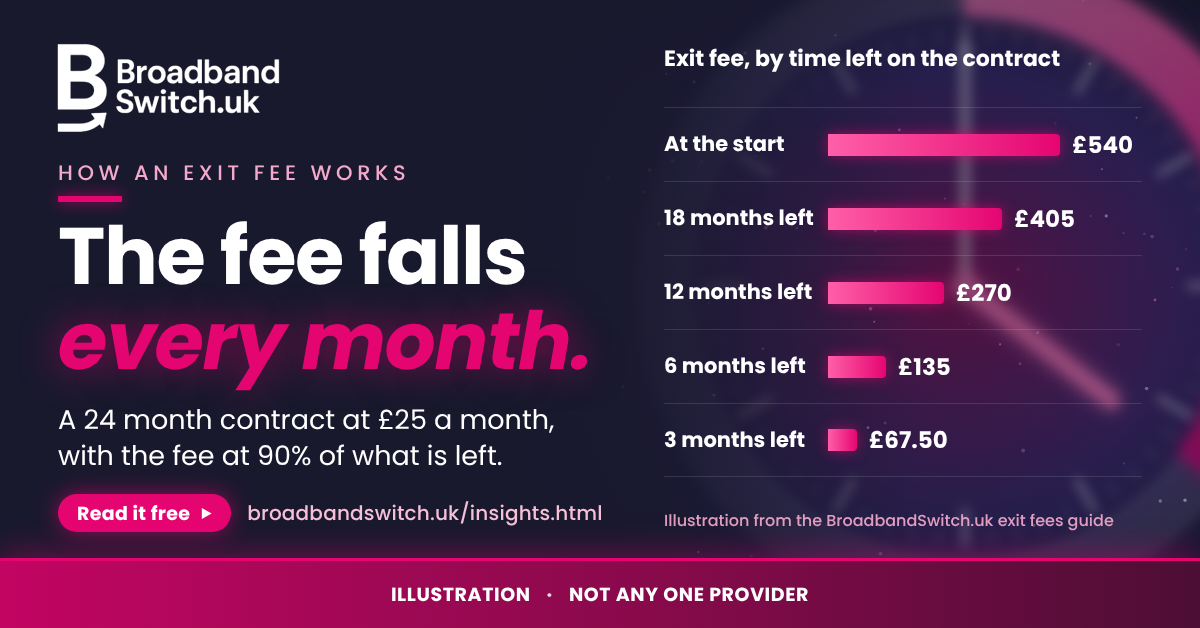
A broadband exit fee depends on the monthly price and the months left on the contract. That means it falls as the contract runs, the guide says. Its illustration is a 24 month contract at £25 a month, with the fee at 90% of the payments still to come. In that example, with six months left, the fee comes to £135 (James, 2026b).
So waiting can pay. In the same example, a new deal that saves £8 a month takes 17 months to cover that fee (James, 2026b).
What is a broadband set-up fee?
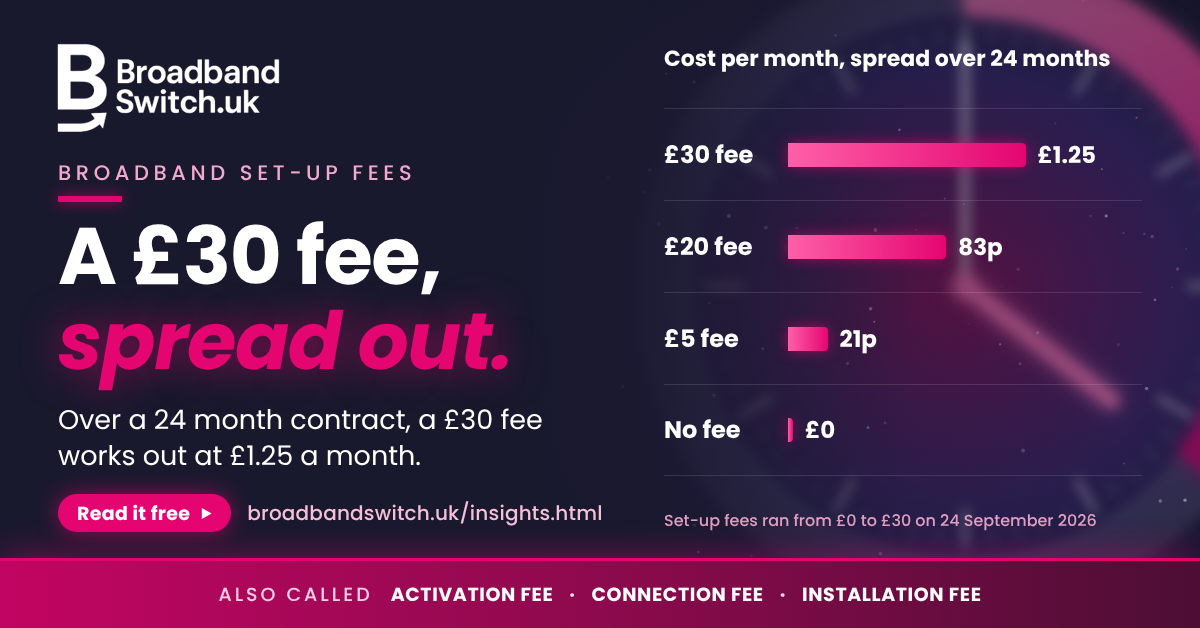
A set-up fee is a one-off charge for starting the service. It is also called an activation, connection or installation fee. When the figures in the set-up fees guide were checked on 24 September 2026, fees for new customers ran from £0 to £30, depending on the provider and the deal (James, 2026a).
Spread over a 24 month contract, £30 works out at £1.25 a month. So a deal with a set-up fee can still cost less overall than one without. The guide's advice is to spread the fee over the contract and compare on that basis (James, 2026a).
Is a 12 month broadband contract worth paying more for?
BroadbandSwitch.uk's own price tracking shows a 12 month deal typically costs £3 to £5 a month more than the same provider's 24 month deal (James, 2026c). Whether that is worth it depends on how sure a customer is of staying put.
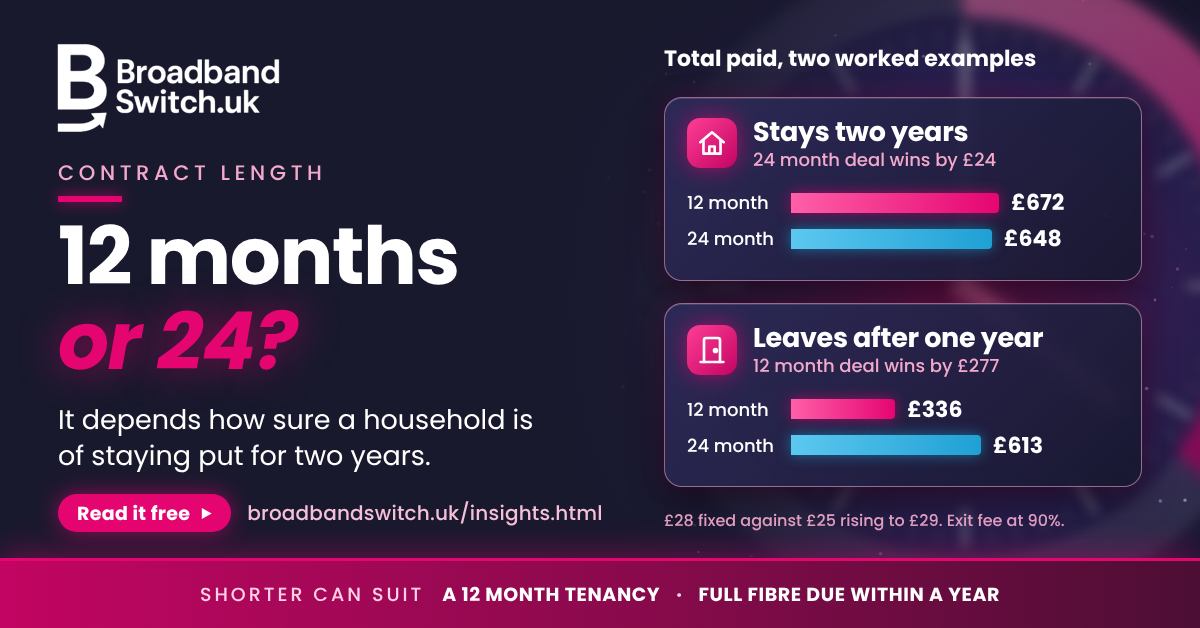
The 12 month guide's worked example sets a 12 month deal fixed at £28 a month against a 24 month deal at £25, rising to £29 in year two (James, 2026c). On those figures:
- A household that stays two years, still paying £28 on the shorter deal, is £24 better off on the 24 month deal
- A household that leaves after one year is £277 better off on the 12 month deal, because the longer contract still carries an exit fee, estimated in the guide at 90% of the payments left
The shorter contract can suit renters on a 12 month tenancy and homes on a street where full fibre is due within a year, the guide says (James, 2026c).
Who wrote the guides, and where can deals be compared?
The three guides were written by Adrian James, broadband editor at BroadbandSwitch.uk, and reviewed by Dr Martin-Smith. They are consumer guidance, not legal advice.
For a household ready to switch, BroadbandSwitch.uk compares deals from 30+ UK providers. Some of those deals include a switching credit. Availability and prices vary by postcode and by provider. The comparison is at broadbandswitch.uk/compare/
The three guides at a glance
- Published
- 25 September 2026, free to read, no sign-up
- Exit fees
- eight ways a household can leave without the fee, three of them with a deadline
- Set-up fees
- £0 to £30 for new customers when checked on 24 September 2026
- Contract length
- 12 months against 24, with the sums worked through
- Author
- Adrian James. Reviewer: Dr Alex J. Martin-Smith
- Sources
- UK consumer law, Ofcom's rules and guidance, and provider terms
About BroadbandSwitch.uk
BroadbandSwitch.uk is an independent UK broadband comparison and switching service that helps households and businesses check availability, compare full-fibre and gigabit options, and switch to a better deal. It publishes an independent, evidence-graded series of reports on the changing shape of UK connectivity.
Notes to editors
- Dr Alex J. Martin-Smith and Adrian James, broadband editor, are available for interview, including broadcast.
- Logos, headshots and fact sheets can be downloaded from the newsroom at broadbandswitch.uk/media/
- The 14 day right applies to contracts agreed at a distance or away from the provider's premises. A customer who asked for the service to start in that time can be charged for the days used.
- The speed right applies at providers signed up to Ofcom's broadband speeds code, where the fault is on the provider's network.
- Provider fees and terms in the guides were checked on 24 September 2026 and change often. The worked examples are illustrations, and each guide states its assumptions.
- BroadbandSwitch.uk earns a commission when a customer chooses a provider through its comparison. It says this does not affect the prices shown.
- The guides are independent of Ofcom, whose published rules and guidance are cited in this release.