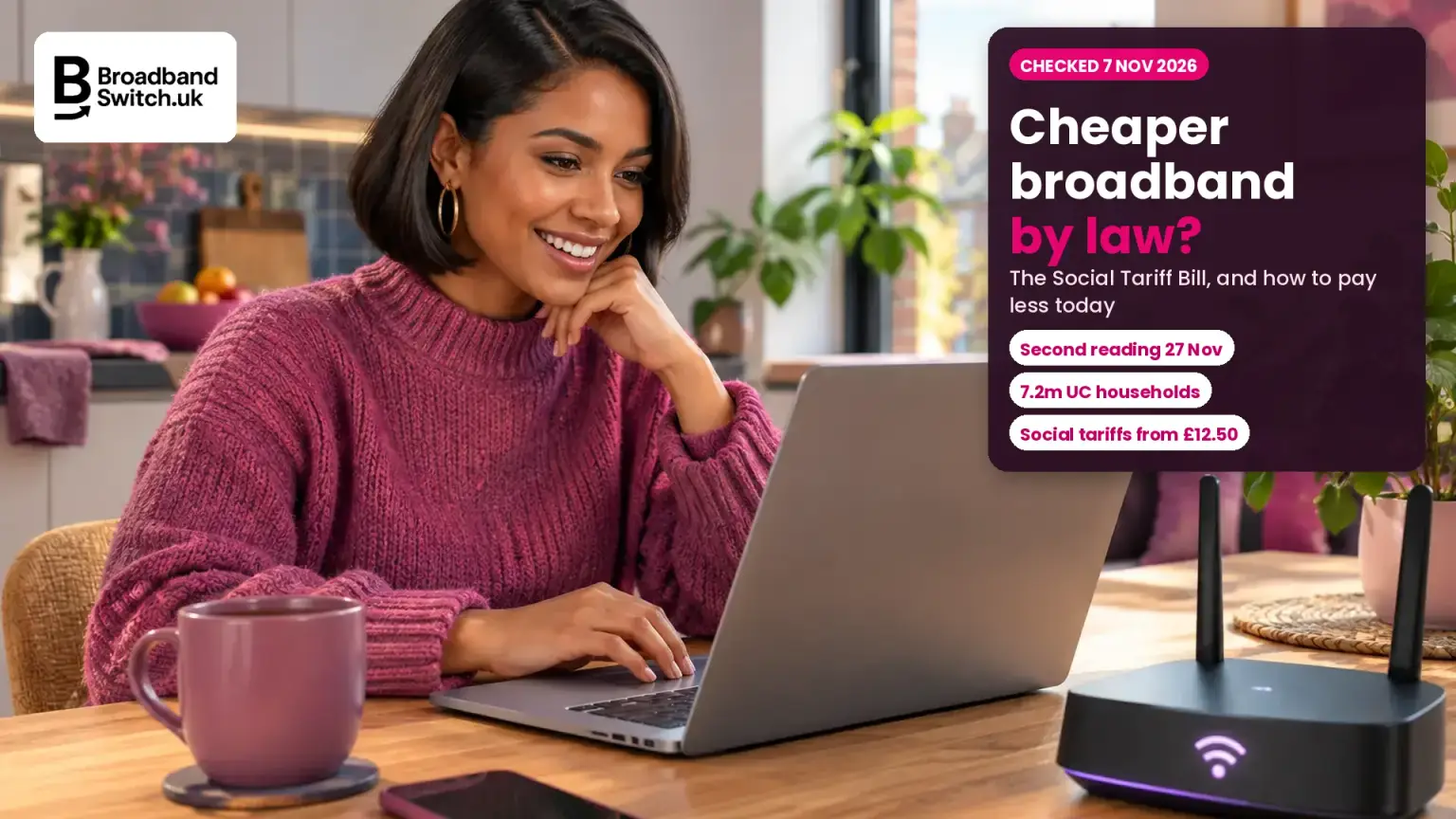
On Universal Credit and paying full price for broadband? A new Bill wants to change that. Here's its chance of becoming law, and how to pay less today
Social tariffs, November 2026
The Bill at a glance
27 Nov
2026, a Friday
The date set for MPs to debate the Bill.
7.2m
households on Universal Credit
In Great Britain, May 2026.
532k
customers, June 2025
Broadband and mobile social tariffs combined.
8.6%
of eligible households
Based on Ofcom's February 2026 figures.
Could social tariffs become compulsory? A Private Member's Bill, the Utilities (Social Tariff) Bill, would require energy, broadband and mobile companies to offer cheaper tariffs to disabled, elderly and low-income customers. It's due a second reading on 27 November 2026, but bills like this rarely become law. You don't need to wait: if you get Universal Credit, you can claim a broadband social tariff today from around £12.50 a month.
Paying too much for broadband?
Whether or not you qualify for a social tariff, compare every deal at your postcode and see the full contract cost.
- ✓Social tariffs and cheap deals side by side
- ✓Full contract costs, with no hidden extras
- ✓Free, independent, and your new provider handles the switch
Prefer to talk it through? Call us on 0330 122 1223
Key facts, verified 7 November 2026
- The Utilities (Social Tariff) Bill is a Private Member's Bill presented by SNP MP Graham Leadbitter in October 2026 (ISPreview, 21 October 2026).
- Its stated aim is to require utility companies to provide social tariffs for energy, broadband and mobile bills for customers who are disabled, elderly or on a low income (ISPreview, 21 October 2026).
- Its second reading is scheduled for Friday 27 November 2026, and its text had not been published when we checked (UK Parliament, Bill page, checked 7 November 2026).
- Of more than 2,500 private members' bills introduced between 2010 and 2024, 110 became law (Institute for Government, checked 7 November 2026).
- There were 7.2 million households on Universal Credit in Great Britain in May 2026, and 8.4 million people (DWP, 18 August 2026).
- 532,000 customers were on a broadband or mobile social tariff in June 2025, and 70% of eligible households don't know they exist (Ofcom, 26 February 2026).
- Broadband and mobile social tariff take-up was 8.6% of eligible households, citing Ofcom, and Citizens Advice said "social tariffs simply aren't working" (Citizens Advice, 26 February 2026).
- The number of social tariffs has grown from three in 2020 to more than 30 (Ofcom, 26 February 2026).
- Under the Telecoms Consumer Charter, major providers commit to making social tariffs easy to find and signposting them to eligible customers (DSIT, February 2026).
Who this is for: anyone on Universal Credit, Pension Credit or other benefits, people helping family or clients cut their bills, advisers and support workers, and anyone following the social tariff debate. We'll follow Kerry, an example built from the calls we take, not a real customer. Kerry is a single mum in Nottingham on Universal Credit, paying £35 a month for broadband her kids need for homework.
What is the Utilities (Social Tariff) Bill?
Direct answer: It's a Private Member's Bill, presented in October 2026 by SNP MP Graham Leadbitter. It would require utility companies to offer social tariffs, cheaper deals for customers who are disabled, elderly or on a low income, for energy, broadband and mobile bills. Its full text hasn't been published yet.
The Bill's long title says it would "require utility companies to provide social tariffs for energy, broadband and mobile bills to support customers who are disabled, elderly or on a low income", ISPreview reported. Six other SNP MPs back it. If you want to, you can follow its progress on the Parliament website.
Today, broadband and mobile social tariffs are voluntary: providers choose whether to offer them, at what price and to whom. The Bill would make them compulsory, which is the big change. Water isn't included in the long title.
Social tariffs in 2026
Who would the Bill help?
Direct answer: Its long title says customers who are disabled, elderly or on a low income. Until the text is published, we don't know exactly who would qualify, what discounts it would set, or how it would be enforced. Today's broadband social tariffs are mainly for people on Universal Credit and similar benefits.
The potential reach is large. DWP figures show "7.2 million households on Universal Credit" in Great Britain in May 2026, or 8.4 million people. If you're a pensioner or disabled and on other benefits, you could also be covered, depending on the final wording.
Because its long title covers energy and mobile as well as broadband, it could help you with several bills at once if it became law. Its chances are slim, though, as we explain below.
When will MPs debate the Bill?
Direct answer: Its second reading is scheduled for Friday 27 November 2026. But private members' bills compete for limited Friday time, and other bills are listed ahead of it that day, so it may not be debated at all. If it isn't reached, it can still pass without debate, but only if no MP objects.
The road to becoming law
Stage 1
First reading
Presented in October 2026. Done.
Stage 2
Second reading
Scheduled for Friday 27 November 2026.
Stage 3
Committee, report and third reading
MPs examine, amend and vote on it.
Stage 4
Lords and Royal Assent
The House of Lords, then it becomes law.
The Institute for Government says there are "normally 13 sitting Fridays" a session for private members' bills, and that a presentation bill can be introduced by any MP after giving notice, "but no debate can take place" at that first stage.
If it isn't reached on 27 November and an MP objects, its sponsor can name another Friday later in the session, according to the Institute for Government. We'll update this page for you after the day, so check back if you're following it.
Could the Bill become law?
Direct answer: It's unlikely, though not impossible. Of more than 2,500 private members' bills introduced between 2010 and 2024, just 110 became law, and three quarters of those were ballot bills, which get priority for debating time. This is a presentation bill.
How many private members' bills become law?
About 4 in 100
The UK Parliament says "a minority of Private Members' bills become law", and that ballot bills have the best chance because they get priority for debating time. This is a presentation bill, which doesn't get that priority, so don't hold off claiming a social tariff while you wait.
That's not the whole story for you, though. ISPreview notes that "only a minority of Private Members Bills ever become law", but says they "do often serve a purpose by creating publicity around an issue and encouraging wider debate". It also points out that Labour proposed mandatory social tariffs in 2022, before it came to power.
ISPreview also sets out the case against. It says the market has many "smaller providers that would struggle to introduce such a tariff", "particularly given the low margins nature of residential broadband", and that "quite a lot of alternative network based broadband packages are already very cheap".
What does the government say about social tariffs?
Direct answer: The government relies on providers' voluntary commitments. Under its Telecoms Consumer Charter, published in February 2026, major providers promise to make social tariffs easy to find and to signpost them to eligible customers. It hasn't said it will make them compulsory.
The Telecoms Consumer Charter commits providers to "ensuring available social tariffs, for those on means tested benefits, are easy to find", and adds that "Government encourages more providers to offer social tariffs". Signatories include BT Group, Virgin Media O2, VodafoneThree, Sky, TalkTalk and KCOM.
In a written answer on 2 March 2026, Kanishka Narayan, then a technology minister, said the Charter "strengthens protections" for customers who may be eligible for social tariffs. We haven't seen a government statement on this Bill yet, and we'll tell you if one appears.
The case for and against
For a legal duty
Low take-up
Only 8.6% of eligible households use one.
Not working
Citizens Advice says social tariffs "simply aren't working", though its own fix is a discount voucher.
Every provider
If the final text covers all providers, each would have to offer one.
Against
Small providers
Those on thin margins could struggle to fund discounts.
Cheap deals exist
Some standard deals already rival social tariffs.
Voluntary route
The government says its Charter "strengthens protections", and hasn't commented on this Bill.
Why are so few people on social tariffs?
Direct answer: Mainly because most people don't know they exist. Ofcom says 70% of eligible households are unaware of them. In a 2022 Which? survey, others said they worried the speeds would be too slow, couldn't leave a current contract, or lacked information about them.
About 9 in 100 eligible households use a social tariff
9 in 100 eligible households are on a broadband or mobile social tariff
91 in 100 aren't
Ofcom found 532,000 customers on social tariffs in June 2025, and says 70% of eligible households don't know they exist, even though the number of tariffs has grown "from just three in 2020 to more than 30".
Citizens Advice wants a "discount voucher for those who need it" and to make social tariffs "a product customers trust and want". Back in 2022, Which? found that among people who knew about social tariffs but didn't plan to switch, 44% worried the speed would be too slow.
Kerry had never heard of a social tariff until a friend mentioned it at the school gate. She's not alone: most eligible families haven't either. If that's you, the rest of this page shows you how to claim one.
Who can get a broadband social tariff today?
Direct answer: If you or someone in your household claims Universal Credit, Ofcom says you could switch to any social tariff available where you live, but the person getting the benefit needs to be the main person on the contract. Ofcom says all major providers also include Pension Credit, ESA, JSA and Income Support.
Who usually qualifies
Universal Credit
Ofcom says you could switch to any tariff available where you live.
Pension Credit
Accepted by all major providers, Ofcom says, though some accept only certain types.
ESA, JSA and Income Support
Accepted by all major providers, Ofcom says, often the income-based versions.
PIP and Attendance Allowance
Accepted by some providers, so check each one.
Someone else's benefit
The person getting the benefit usually needs to be the main account holder.
Ofcom says "if you or someone in your household claims Universal Credit, you could switch to any of the tariffs available", and that "the person receiving the benefit needs to be the main person on the contract".
Our guide to social tariff eligibility goes through each benefit so you can check yours, and our guide for pensioners covers Pension Credit in detail.
How much could I save with a social tariff?
Direct answer: Broadband social tariffs start from around £12.50 a month, and most are £15 to £20. If you pay £35 a month now, moving to a £15 social tariff would save you £240 a year. Speeds range from about 15Mbps to 150Mbps.
BT says its Home Essentials fibre plans "start from £16.50 with no set-up fees". Our social tariffs guide lists every tariff we've checked, with the exact benefits each one accepts.
For Kerry, moving from £35 to a £15 social tariff would save £20 a month, or £240 a year, enough to make a real difference. She checks the speed she needs first, so the kids' homework and streaming still work. You can do the same in a minute with the calculator below.
Check the speed you actually need
RightSpeed is our free calculator. Tell it who's online and what you do, and it works out the speed you need, so you can pick the right social tariff with confidence.
Try RightSpeed →How do I claim a social tariff?
Direct answer: Check which providers reach your postcode, pick a social tariff, and apply online or by phone. Many providers check your benefit with the DWP electronically, with your consent, so you usually won't need to send letters. If your current provider has one, ask to move to it.
Five steps to a cheaper bill
Your benefit
Universal Credit, Pension Credit or similar.
Your postcode
See which social tariffs reach your home.
Apply
Online or by phone. Many check your benefit electronically.
Your contract
Ask about moving to your provider's social tariff.
Your first bill
Check it shows the lower price.
Our step-by-step guide to finding a social tariff and our explainer on how a social tariff differs from a cheap deal will help you choose.
Can I switch to a social tariff mid-contract?
Direct answer: Often, yes, if your current provider has one. BT says existing BT and EE broadband customers who qualify can switch for no extra charge. Moving to a different provider mid-contract may mean exit fees, so ask first.
Ofcom says "your provider might let you leave your current contract without paying a penalty fee", so it's always worth asking. Under the Telecoms Consumer Charter, signatories also commit to offering practical support to customers facing financial difficulty, "such as the ability to move to cheaper packages without charge or penalty or manageable payment plans", so a provider may offer a payment plan instead.
If you're struggling to pay, our guide to your options and rights explains what providers should do, and our guide to leaving a contract early covers exit fees.
What should I do now?
Today
If you get Universal Credit or Pension Credit, check which social tariffs reach your postcode.
This week
Ask your current provider whether it has a social tariff you can move to, and whether there's any charge.
27 November
Watch the Bill's second reading if you're interested, and check back here for our update afterwards.
Find a cheaper broadband deal
Compare social tariffs and cheap deals at your postcode, with the full contract cost.
- ✓Social tariffs and cheap deals together
- ✓Full contract costs side by side
- ✓Independent and free to use
In summary
- The Utilities (Social Tariff) Bill would make social tariffs compulsory for energy, broadband and mobile, but its text isn't published yet.
- Its second reading is scheduled for 27 November 2026, but private members' bills rarely become law: 110 of more than 2,500 introduced between 2010 and 2024.
- The government relies on the voluntary Telecoms Consumer Charter rather than a legal duty.
- Only about 9 in 100 eligible households use a social tariff, and 70% don't know they exist.
- If you get Universal Credit, you can claim a broadband social tariff today from around £12.50 a month.
Alex's closing thought
Whatever happens to the Bill, the thing you can act on today is simple: most people who could pay less don't know they can. If you get Universal Credit or Pension Credit, a social tariff could save you hundreds of pounds a year, starting this month. Ring us if you'd like help finding one at your address.
Keep going: social tariffs and help with bills
Social tariffs
Help with bills
Know someone on Universal Credit?
Send them this. It shows how to claim a cheaper broadband social tariff today, whatever happens to the Bill.
Cite this page
You're welcome to quote or link to this guide. Please credit BroadbandSwitch.uk and link to this page.
In a sentence: The Utilities (Social Tariff) Bill, a Private Member's Bill due a second reading on 27 November 2026, would require energy, broadband and mobile companies to offer social tariffs, but such bills rarely become law, and Universal Credit households can already claim a broadband social tariff today.
Martin-Smith, A. J. (2026, November 7). Could cheaper broadband for Universal Credit become law? BroadbandSwitch.uk. https://broadbandswitch.uk/insights/utilities-social-tariff-bill-27-november-2026/
Frequently asked questions
What is the Utilities (Social Tariff) Bill?
A Private Member's Bill presented in October 2026 by SNP MP Graham Leadbitter. It would require utility companies to offer social tariffs for energy, broadband and mobile.
When is the second reading of the Social Tariff Bill?
Friday 27 November 2026. It may not be reached on the day, as private members' bills compete for limited time.
Will social tariffs become compulsory?
Not unless the Bill, or a government measure, becomes law. Private members' bills rarely become law, and the Institute for Government says they can be blocked particularly if they lack government support. The government currently relies on voluntary commitments.
How many households are on Universal Credit?
7.2 million households in Great Britain in May 2026, or 8.4 million people, according to DWP. New figures are due on 17 November 2026.
How many people use a social tariff?
Ofcom counted 532,000 customers on broadband or mobile social tariffs in June 2025. Citizens Advice, citing Ofcom, puts take-up at 8.6% of eligible households.
Can I get a social tariff on Universal Credit?
Yes. Ofcom says if you or someone in your household claims Universal Credit, you could switch to any social tariff available where you live. The person getting the benefit needs to be the main person on the contract.
How much does a broadband social tariff cost?
From around £12.50 a month, with most between £15 and £20. Speeds range from about 15Mbps to 150Mbps depending on the provider.
Do social tariffs need a credit check?
It depends on the provider, so ask before you apply. BT, for example, runs a credit check if you're new to BT, and a low score may mean a deposit. Checking your benefit with DWP is a separate step, not a credit check.
Can I move to a social tariff without paying an exit fee?
Often, if you stay with the same provider. BT says qualifying BT and EE customers can switch for no extra charge. Moving provider may cost an exit fee.
Does the Bill cover water bills?
Its long title covers energy, broadband and mobile, not water. The full text hasn't been published yet.
What is the Telecoms Consumer Charter?
A set of voluntary commitments published in February 2026, under which major providers promise to make social tariffs easy to find and signpost them to eligible customers.
Is a social tariff the same as a cheap broadband deal?
No. A social tariff is a cheaper package only for people on qualifying benefits, while a cheap deal is open to anyone. Compare both, as some standard deals come close.
References
- BT. (n.d.). BT Home Essentials. Retrieved 7 November 2026, from https://www.bt.com/broadband/home-essentials
- Citizens Advice. (2026, February 26). Citizens Advice reacts to Ofcom's Pricing trends for communications services in the UK report. Retrieved 7 November 2026, from https://www.citizensadvice.org.uk/about-us/media-centre/press-releases/citizens-advice-reacts-to-ofcoms-pricing-trends-for-communications-services/
- Department for Science, Innovation and Technology. (2026, February 11; updated 2026, June 19). Telecoms Consumer Charter. GOV.UK. Retrieved 7 November 2026, from https://www.gov.uk/government/publications/telecoms-consumer-charter/telecoms-consumer-charter
- Department for Work and Pensions. (2026, August 18). Universal Credit statistics, 29 April 2013 to 14 May 2026. GOV.UK. Retrieved 7 November 2026, from https://www.gov.uk/government/statistics/universal-credit-quarterly-statistics-29-april-2013-to-14-may-2026/universal-credit-quarterly-statistics-29-april-2013-to-14-may-2026
- Institute for Government. (2024, October 15). Private members' bills. Retrieved 7 November 2026, from https://www.instituteforgovernment.org.uk/explainer/private-members-bills
- ISPreview. (2026, October 21). New bill seeks mandatory social tariffs across UK energy, broadband and mobile. Retrieved 7 November 2026, from https://www.ispreview.co.uk/index.php/2026/10/new-bill-seeks-mandatory-social-tariffs-across-uk-energy-broadband-and-mobile.html
- Narayan, K. (2026, March 2). Broadband: social tariffs [Written answer 114355]. Via Westminster Brief. Retrieved 7 November 2026, from https://westminsterbrief.co.uk/archive/pq/114355
- Ofcom. (n.d.). Social tariffs. Retrieved 7 November 2026, from https://www.ofcom.org.uk/phones-and-broadband/saving-money/social-tariffs
- Ofcom. (2026, February 26). 10 ways to cut phone and internet bills. Retrieved 7 November 2026, from https://www.ofcom.org.uk/phones-and-broadband/bills-and-charges/new-ofcom-research-reveals-how-to-cut-phone-and-internet-bills
- UK Parliament. (n.d.-a). Private Members' bills. Retrieved 7 November 2026, from https://www.parliament.uk/about/how/laws/bills/private-members/
- UK Parliament. (n.d.-b). Utilities (Social Tariff) Bill. Retrieved 7 November 2026, from https://bills.parliament.uk/bills/4311
- Which?. (2022, November 11). Broadband speed fears slowing take-up of social tariffs, Which? warns. Retrieved 7 November 2026, from https://www.which.co.uk/policy-and-insight/article/broadband-speed-fears-slowing-take-up-of-social-tariffs-which-warns-avO1V0D3pXzD