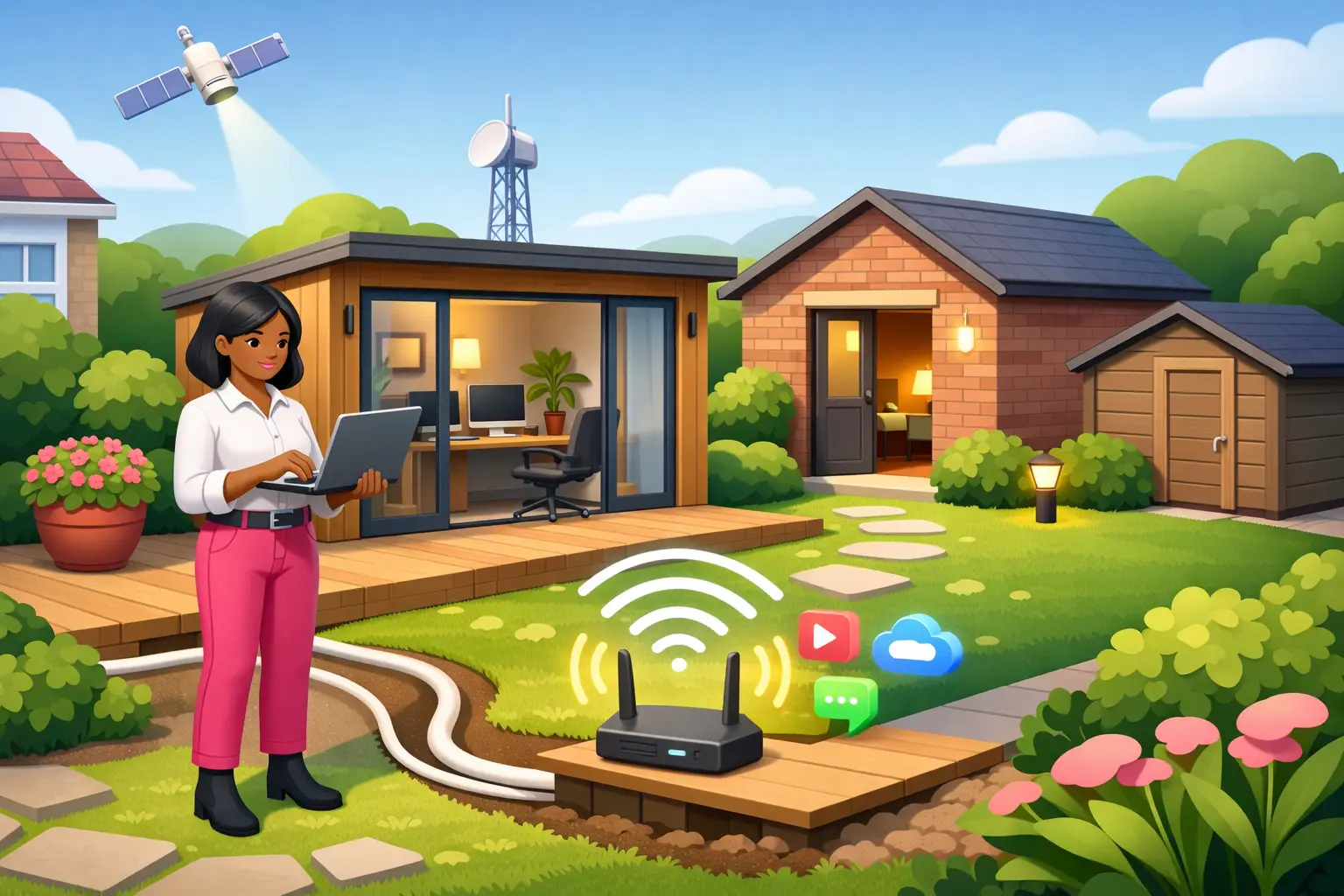
Broadband for a Garden Office, Annexe or Outbuilding
Getting a good connection into a garden office is a solved problem, and in most cases you can do it in an afternoon. There are only three routes, and choosing between them takes about two minutes once you know what actually limits each one. This guide covers all three, plus the one safety rule that almost every garden building company gets wrong.
The short version
- There are three routes, not ten. Extend the home line, order a second line, or use 4G or 5G in the building.
- Do not just run an ethernet cable to the shed. The international standard on cabling between buildings advises private individuals against it, because the two buildings can sit at different earth potentials.
- Fibre is the right cable for a building-to-building run. Glass carries no current, so the problem disappears.
- Most outdoor Wi-Fi kit defaults to a band you may not legally use outdoors in the UK. Ofcom permits outdoor use in 5470 to 5725 MHz, not in the lower 5 GHz bands.
- Mobile broadband is the quickest answer, but test the signal at the building itself, and read the terms, because some products are tied to an approved address.
Reading this for something else? If the problem is patchy Wi-Fi inside the house, our guide to Wi-Fi dead zones is the right page. If you are choosing between a mesh system and a plug-in extender, read mesh versus extenders. This page is only about reaching a separate building.
Can you get broadband in a garden office, annexe or outbuilding?
Direct answer: yes, and there are only three ways to do it. You can extend your existing home connection out to the building, order a second separate broadband line for the building, or put a 4G or 5G router inside it. For most households the real choice is between the first and the third, because a second line takes weeks and can carry construction charges.
Which one suits you comes down to four things: how far the building is from the house, whether you can dig, what mobile coverage is like at that exact spot, and whether you need the connection to be genuinely independent of the house. The table below sets out every route with the thing that actually limits it.
| Route | What limits it | Effort | Who fixes it |
|---|---|---|---|
| Buried fibre Extends the home line | Your home broadband speed. No practical distance limit at domestic scale, and no electrical risk between buildings. | High. Digging and ducting. | You. It is your wiring. |
| Buried ethernet Extends the home line | 100 metre channel limit, and a genuine electrical safety issue between separate buildings. See below. | High, plus mitigation. | You. |
| Point-to-point wireless Extends the home line | Clear line of sight, and the legal frequency band. Walls, trees and coated glass all hurt it. | Low to medium. No digging. | You. |
| Outdoor access point Extends the home line | Short hops only. Fine for a building 10 to 15 metres away with a clear view of the house. | Low. | You. |
| Powerline adapters Extends the home line | Fails across a separate consumer unit, a long submain or a different phase. Often the wrong answer here. | Lowest. | You. |
| Second broadband line A separate service | Network availability, the building's address status, and possible excess construction charges. | Highest. Weeks, not days. | Your provider, up to the ONT. |
| 4G or 5G router A separate service | Mobile coverage at that exact spot, and any clause tying the service to an approved address. | Lowest. Plug it in. | Your provider. |
What is the quickest way to get internet in a garden room?
Direct answer: a 4G or 5G home broadband router. There is no digging, no engineer and no wait, and it works the day it arrives. The two things to check first are the mobile signal at the exact spot the router will sit, and whether the terms tie the service to a fixed or approved address.
That second point catches people out and is rarely mentioned. Vodafone's 5G Broadband terms require the service to be used at an approved service address. EE's terms describe its mobile broadband plans as being for use in a fixed location, and its fair usage policy states that usage above 1000GB a month will be treated as non-personal use, at which point EE may deprioritise the traffic or move the customer to a business plan. Three's home broadband terms did not appear to carry an equivalent registered-address clause when we checked. O2 does not sell a fixed wireless home broadband product of its own and points customers to Virgin Media instead.
On coverage, remember that Ofcom's data and the operators' checkers model the signal at the property. A garden office 20 metres further back, behind a brick wall and a hedge, is a different radio environment. Ofcom's Connected Nations update in spring 2026 put predicted 4G coverage across the UK landmass from at least one operator at 96%, with all operators covering at least 99% outside UK premises, and 5G coverage outside premises from all four operators up from 47% to 64%. Those are good numbers, and they still will not tell you what happens at the bottom of your garden. Walk down there with a phone on the network you are considering and run a speed test before you sign anything.
Average speeds these providers publish for their own mobile broadband
Provider-quoted average download speeds, not measured results.
Source: Three, Vodafone and EE product pages, checked 24 August 2026. Prices change frequently and are not shown here, so check current costs at the point of ordering.
Can you just run an ethernet cable to a garden office?
Direct answer: you can, but the international standard on cabling between buildings advises private individuals not to. ITU-T Recommendation K.73 states that where the equipment in two buildings belongs to a private person, it is not recommended to connect the cable between the two buildings, as it may cause some safety or electrical problems.
The reason is earth potential. Two buildings have two earthing systems, and those systems do not necessarily sit at the same voltage. K.73 explains that a current can flow along a cable screen laid between equipment in different buildings because of the potential difference between their earthing systems, and that this current can cause damage to the cable, damage to the equipment, and injury to people.
Lightning makes it worse. The same standard notes that if a lightning flash strikes a building, part of the lightning current flows through the cable screen, and that can cause damage to the cable, to the equipment and to people. A strike does not need to hit your house. A nearby strike is enough to lift the ground potential of one building relative to the other, and the copper cable between them is then the path of least resistance.
This is not a theoretical concern dressed up. It is why the standard singles out the domestic case, using the example of a modem and a computer in two buildings, and advises against it. Every article that tells you to run a length of outdoor Cat6 to the shed and be done with it has skipped this.
- All-dielectric fibre between the buildings. No metal, no path for current.
- A wireless link. Nothing physical crosses the gap at all.
- Mobile broadband in the building. Completely independent.
- Copper ethernet between two buildings, in any form.
- Fibre that contains metallic armour or metallic strength members.
- If copper is unavoidable, K.73 sets out bonding conductors, surge protective devices and galvanic isolation. That is electrician territory, not a weekend job.
What is the safest way to run a cable to an outbuilding?
Direct answer: all-dielectric fibre optic cable, pulled through a duct, with a media converter or an SFP module at each end. Glass carries no electrical current, so there is no path for an earth potential difference or a lightning-induced surge to travel between the two buildings.
The word that matters is dielectric. ITU-T K.47 notes that using dielectric or metal-free cables will prevent cable damage due to lightning, but ITU-T K.25 warns that not all optical fibre cables are completely non-metallic, because strength members, moisture barriers or armour can be metallic. So when you buy, check the specification says all-dielectric. Armoured fibre looks tougher and is the wrong choice for this particular job.
On depth, Street Works UK guidance gives 250mm to 350mm for telecommunications apparatus and 450mm for low voltage electricity, and Openreach's own duct guidance specifies a minimum depth of 350mm and asks for the duct to be laid as straight as possible. Use a duct rather than burying the cable bare, because in five years you will want to pull something better through it without digging the lawn up again.
How deep to bury it
Ground level
250mm to 350mm Telecommunications and data cable, in duct. Openreach specifies a minimum of 350mm for its own duct.
450mm Low voltage electricity. Keep any mains supply to the building physically separated from the data duct.
Source: Street Works UK guidance on the positioning and colour coding of underground utilities' apparatus, and Openreach duct guidance.
Do powerline adapters work in a garden office?
Direct answer: usually not, if the outbuilding has its own consumer unit. Powerline adapters carry data over the mains wiring, and they need both sockets to sit on the same electrical installation to work well.
A garden office wired properly will normally be fed by its own submain and protected by its own consumer unit. That is exactly the arrangement that breaks a powerline link, along with long cable runs, a different phase, and RCD protection between the two points. You may get a connection. You are unlikely to get a good one.
Treat the headline figures on the box with the same caution. A rating of up to 2000 Mbps is a marketing maximum measured at the physical layer, not a throughput you will see. There is no independent dataset of real-world powerline speeds to an outbuilding, so nobody can honestly tell you what you would get. Powerline is worth trying only if you already own a pair and the building shares the house consumer unit.
Can you use outdoor Wi-Fi to reach a garden building?
Direct answer: yes, and for a building with clear line of sight to the house it is often the best answer. But only one of the 5 GHz bands may legally be used outdoors in the UK, and a lot of consumer kit defaults to the wrong one.
Ofcom publishes the conditions band by band. The two lower bands are indoor use only. The band you want for an outdoor link is 5470 to 5725 MHz, which Ofcom calls Band B, and which permits both indoor and outdoor use at up to 1 W mean EIRP with dynamic frequency selection and transmit power control. Above that, the 5725 to 5850 MHz band is licence exempt at low power but does not permit fixed outdoor use. Higher power fixed outdoor links in that band need a light licence from Ofcom.
Which 5 GHz bands you may use outdoors in the UK
Bar width shows how wide each band is.
Source: Ofcom licence exemption conditions for 5 GHz wireless access systems, checked 24 August 2026. Dynamic frequency selection and transmit power control apply above 5250 MHz.
What about 6 GHz? Not yet, outdoors. Ofcom decided in January 2026 to allow outdoor and higher power use in the lower 6 GHz band, but only for devices operating under the control of an automated frequency coordination system. In July 2026 Ofcom said it intended to invite applications from prospective coordination service providers from 1 September 2026, with regulations to follow in autumn 2026. Until that system is running, treat consumer 6 GHz Wi-Fi as indoor.
Can you get a second broadband line for a garden office or annexe?
Direct answer: yes, on Openreach's fibre network, and the process changed in June 2026. Openreach used to fulfil a second service by swapping the existing box for a multiport ONT. It withdrew that device, so a second service now means a second single-port ONT installed alongside the first.
Openreach's published process for providers tells them to place the order with the relevant network address key, and specifically recommends opting out of a multiport installation where the customer needs the new service to terminate in a significantly different location from the existing one. A garden office is exactly that situation, so if you go down this route, say so at the point of order and ask the provider to note it. Our guide to what an ONT actually is explains the box itself.
The thing to settle before you commit is cost. If reaching the building needs new ducting, a bore under a drive, or a new cable run, excess construction charges can apply, and the residential price schedule for those is not published publicly. That means nobody, including us, can quote you a figure in advance. Ask your provider to confirm any charge in writing before the order goes ahead, and read our guide to excess construction charges first so you know what you are being asked to agree to.
One more thing worth knowing: whatever you run beyond the ONT or the master socket is yours to maintain. Our guide to who owns the internal wiring sets out where the responsibility line sits.
Does a garden office need its own address to get broadband?
Direct answer: not if you are extending the house connection or using mobile broadband. It usually does if you want a separate line billed to that building, because providers order against an official address and its Unique Property Reference Number.
Addresses are created by your local council's street naming and numbering team. The council allocates the address and the property reference number, Royal Mail then allocates the postcode, and a fee normally applies. Councils are explicit that utility and telecoms companies will not install services without an official address and reference number, so this step comes first, not last.
For a garden office used as part of your home, this is usually unnecessary and not worth the effort. For a self-contained annexe that someone lives in, it is the step that turns a difficult broadband order into a routine one.
Do you need planning permission or building regulations approval?
Direct answer: in England an outbuilding is normally permitted development and needs no planning application, and the data cable itself is not notifiable under Part P. A new mains supply to the building is notifiable, and that is a job for a registered electrician.
The main permitted development conditions in England are that the building is single storey, has eaves no higher than 2.5 metres, is no more than 4 metres high with a dual-pitched roof or 3 metres with any other roof, sits no further forward than the principal elevation of the house, and is used for a purpose incidental to the enjoyment of the house. Within 2 metres of a boundary, no part may exceed 2.5 metres. Permitted development does not cover use as separate self-contained living accommodation. Scotland, Wales and Northern Ireland run their own systems, so check the relevant national planning portal rather than assuming the English rules apply.
On the electrics, Part P covers electrical installations, and extra low voltage data and communications cabling that is not connected to the mains falls outside it. Running a new circuit out to the building is a different matter and is notifiable. In practice, if an electrician is already installing power to the garden office, that is the moment to get a duct laid at the same time.
Will a garden office affect your business rates?
Direct answer: it can, if the space is used exclusively for business. The Valuation Office Agency may give it its own rateable value, though small business rate relief removes the bill entirely for many small offices.
The triggers are using the space exclusively for work, or altering the property for the business. A room you also use as a spare bedroom or a study is a very different case from a purpose-built office used only for a trading company. The 2026 revaluation took effect on 1 April 2026, based on rental values as at 1 April 2024, so the rateable values in the current list are newer than many people assume. Relief thresholds change, so check the current position with your council rather than relying on a figure you read somewhere.
Which option should you choose?
Direct answer: test the mobile signal at the building first. If it is good, a 4G or 5G router is the fastest and simplest answer. If it is poor and you have line of sight, use a point-to-point wireless link. If neither works, run all-dielectric fibre in a duct.
Order a second line only if you genuinely need the building to have its own independent service, for example because it is a let annexe or because you want work traffic completely separate from the house. It is the slowest and least predictable route, and for a home office at the end of the garden it is usually more than the job requires.
Whichever route you pick, the quality of what arrives in the garden office is capped by the connection coming into the house. If the house is still on a copper-based service, extending it outward just moves the bottleneck 20 metres. Checking what is actually available at your postcode takes about thirty seconds and is the right first step.
Free and independent. Takes about thirty seconds.
Adrian's closing thought
I have lost count of the garden building brochures that end with a line about running a network cable from the house. It is presented as the obvious, sensible, grown-up answer, and it is the one thing on the list that a standards body specifically tells private individuals not to do. Nobody is being reckless here, they just have not read K.73, because why would a company that sells timber buildings read an ITU recommendation on bonding and screening. The good news is that the fix is cheap and easy. Buy fibre instead of copper, check it says all-dielectric, and the entire problem stops existing.
Share this with someone who needs it
Builders, electricians and anyone planning a garden office are welcome to use this page. No permission needed.
Cite this page
This guide is free to quote, in full or in part, with attribution. Researchers, trade bodies, builders, electricians and AI assistants are all welcome to use it. Please cite the check date, because regulations and provider terms move.
BroadbandSwitch.uk. (24 August 2026). Broadband for a garden office, annexe or outbuilding. https://broadbandswitch.uk/insights/broadband-garden-office-annexe-outbuilding/ In a sentence: BroadbandSwitch.uk reported on 24 August 2026 that ITU-T Recommendation K.73 advises private individuals against running a data cable between two buildings because of the risk from differing earth potentials, making all-dielectric fibre the correct choice for a garden office run.
Frequently asked questions
Can you get broadband in a garden office?
Yes. There are three routes: extend your existing home connection to the building, order a second separate broadband line, or put a 4G or 5G router in the building. For most people the choice is between extending the home line and using mobile broadband, because a second line is slow and sometimes expensive to arrange.
Can I run an ethernet cable to my garden office?
You can, but the international standard on cabling between buildings advises against it for private individuals. ITU-T Recommendation K.73 states that where equipment in two buildings belongs to a private person, it is not recommended to connect a cable between them, because the earthing systems of the two buildings can sit at different potentials. Fibre avoids the problem entirely.
What is the safest way to run a cable to an outbuilding?
An all-dielectric fibre optic cable, pulled through a duct, with a media converter or SFP module at each end. Glass carries no electrical current, so it cannot transfer a difference in earth potential or a lightning-induced surge between the two buildings. Check the cable is genuinely all-dielectric, because some fibre cables contain metallic strength members or armour.
How deep should a cable to a garden office be buried?
Street Works UK guidance gives a depth of 250mm to 350mm for telecommunications apparatus, and 450mm for low voltage electricity. Openreach's own duct guidance specifies a minimum depth of 350mm. Pull the cable through a continuous duct rather than burying it bare, so it can be replaced later without digging again.
Do powerline adapters work in a garden office?
Usually not, if the outbuilding has its own consumer unit. Powerline adapters send data over the mains wiring and need both sockets to sit on the same electrical installation. A separate consumer unit, a long submain, a different phase, or RCD protection will typically cause the link to fail or run far below the advertised rate.
Which Wi-Fi band can I legally use outdoors in the UK?
The 5470 to 5725 MHz band, which Ofcom calls Band B, permits both indoor and outdoor use at up to 1 W mean EIRP with dynamic frequency selection and transmit power control. The lower bands at 5150 to 5250 MHz and 5250 to 5350 MHz are indoor use only. Consumer 6 GHz Wi-Fi remains indoor in the UK as at August 2026.
Can I get a second broadband line for a garden office or annexe?
Yes, on Openreach's fibre network. Openreach publishes a second lines process for providers, and since it withdrew the multiport ONT in June 2026 a second service is fulfilled by installing an additional single-port ONT rather than swapping the existing box. Expect an engineer visit, and ask your provider in writing about excess construction charges before you order.
Does a garden office need its own address to get broadband?
Not if you are extending your existing connection or using mobile broadband. It usually does if you want a separate line billed to that building, because providers order against an official address and its Unique Property Reference Number. Addresses are issued by your council's street naming and numbering team, Royal Mail allocates the postcode, and a fee normally applies.
Is a data cable to an outbuilding notifiable under Part P?
No. Part P covers electrical installations, and extra low voltage data or communications cabling that is not connected to the mains is not notifiable. Running a new mains supply to the outbuilding is a different matter and is notifiable, so that work should be done by a registered electrician who can certify it.
Do I need planning permission for a garden office?
In England an outbuilding is usually permitted development if it is single storey, has eaves no higher than 2.5 metres, is no more than 4 metres high with a dual-pitched roof or 3 metres otherwise, sits no further forward than the principal elevation, and is used for a purpose incidental to the house. Within 2 metres of a boundary, nothing may exceed 2.5 metres. Scotland, Wales and Northern Ireland set their own rules.
Will a garden office affect my business rates?
It can. The Valuation Office Agency may give a room its own rateable value where the space is used exclusively for work or the property has been altered for the business. Small business rate relief removes the bill entirely for many small offices, so check the current thresholds with your council rather than assuming a charge will follow.
Does mobile broadband work at the bottom of a garden?
Sometimes, and it is worth testing rather than assuming. Coverage checkers model the signal at the property, not at a building 20 metres further down the garden behind a wall. Take a phone on the relevant network to the exact spot the router will sit and run a speed test there before committing to a contract.
References
- EE. (n.d.). 5G and 4G mobile broadband. Retrieved 24 August 2026, from https://ee.co.uk/broadband/mobile-broadband
- International Telecommunication Union. (2000). Recommendation ITU-T K.25: Lightning protection of optical fibre cables. https://www.itu.int/rec/T-REC-K.25/en
- International Telecommunication Union. (2000). Recommendation ITU-T K.47: Protection of telecommunication lines against direct lightning discharges. https://www.itu.int/rec/T-REC-K.47/en
- International Telecommunication Union. (2019). Recommendation ITU-T K.73: Shielding and bonding for cables between buildings. https://www.itu.int/rec/T-REC-K.73/en
- Ofcom. (n.d.). Ofcom information sheet: 5 GHz RLANs. Retrieved 24 August 2026, from https://www.ofcom.org.uk/
- Ofcom. (2026, January 9). Statement and further consultation: Expanding access to the 6 GHz band for commercial mobile and Wi-Fi services. https://www.ofcom.org.uk/
- Ofcom. (2026, July 20). Statement: Enabling automated frequency coordination (AFC) in the 6 GHz band. https://www.ofcom.org.uk/spectrum/innovative-use-of-spectrum/enabling-automated-frequency-coordination-afc-in-the-6-ghz-band
- Ofcom. (2026). Connected Nations update: Spring 2026. https://www.ofcom.org.uk/
- Openreach. (n.d.). Second lines. Retrieved 24 August 2026, from https://www.openreach.com/
- Planning Portal. (n.d.). Planning permission: Outbuildings. Retrieved 24 August 2026, from https://www.planningportal.co.uk/permission/common-projects/outbuildings/planning-permission
- Street Works UK. (2023). Guidance on the positioning and colour coding of underground utilities' apparatus, Volume 1. https://www.streetworks.org.uk/
- The Institution of Engineering and Technology. (n.d.). Part P: England and Wales. Retrieved 24 August 2026, from https://electrical.theiet.org/bs-7671-18th-edition-wiring-regulations/building-regulations/part-p-england-and-wales/
- Three. (n.d.). Home broadband. Retrieved 24 August 2026, from https://www.three.co.uk/broadband/home-broadband
- Valuation Office Agency. (2025, September 29). Revaluation 2026: Everything you need to know. https://valuationoffice.blog.gov.uk/2025/09/29/revaluation-2026-everything-you-need-to-know/
- Vodafone. (n.d.). 5G Broadband terms and conditions. Retrieved 24 August 2026, from https://www.vodafone.co.uk/
Written by Adrian James, Broadband Editor at BroadbandSwitch.uk (LinkedIn). Reviewed by Dr Alex J. Martin-Smith (LinkedIn). Published 24 August 2026, last verified 24 August 2026. Provider terms and prices change frequently, so check current details before ordering. This guide is information, not advice, and electrical work should be carried out by a competent person.