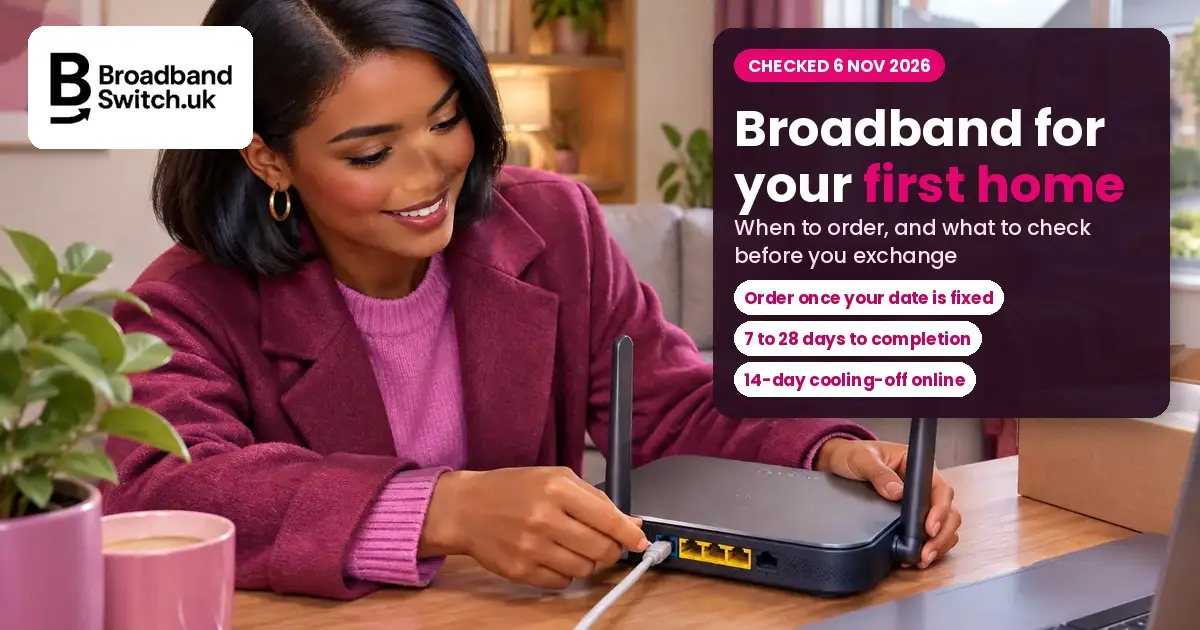
Buying your first home? Here's how to have broadband working on the day you get the keys
First home broadband, November 2026
Four things to know
Exchange
once you know your completion date
Openreach says to think about broadband as soon as you know it. In Scotland, that's when missives are concluded.
7 to 28
days, exchange to completion
The typical gap, agreed between buyer and seller. Scotland works differently.
14 days
if you sign up online or by phone
Time to change your mind, according to Citizens Advice.
£6.46
a day, for a late start
Paid by providers in Ofcom's automatic compensation scheme.
When should you sort broadband for your first home? Check what reaches the address before you exchange contracts (or conclude missives in Scotland), then order as soon as you know your completion date. Exchange to completion is typically 7 to 28 days, and some connections need an engineer. Sign up online or by phone for a 14-day cooling-off period, read the contract summary, and compare deals at your new postcode.
See what broadband reaches your new home
Put in the postcode of the home you're buying. We'll show every network and deal there, with the full contract cost.
- ✓Full fibre, cable and other options at the address
- ✓Prices with the total cost over the contract
- ✓Free, independent, and you can order for your move-in date
Prefer to talk it through? Call us on 0330 122 1223
Key facts, verified 6 November 2026
- 391,000 first-time buyer mortgages were granted in 2025, up from 332,000 in 2024 (UK Finance, 2 March 2026).
- The gap between exchange and completion is typically 7 to 28 days, agreed between buyer and seller, though Scotland's process is different (MoneyHelper, checked 6 November 2026).
- Openreach says to think about your broadband provider as soon as you know your completion date (Openreach, checked 6 November 2026).
- There's no official checklist for what a property listing must say about broadband, and the government says it will publish new guidance for estate agents (GOV.UK, 19 June 2026).
- Openreach says new build homes typically come enabled with full fibre, but you still need to place an order with a provider (Openreach, checked 6 November 2026).
- TalkTalk, Vodafone and Virgin Media all say they may run a credit check before accepting a broadband order (provider websites, checked 6 November 2026).
- You can cancel for free within 14 days if you signed up online or by phone, but not if you signed up in person (Citizens Advice, checked 6 November 2026).
- If your contract started on or after 17 January 2025, it should say exactly how much the price will go up each year (Citizens Advice, checked 6 November 2026).
- Providers in Ofcom's scheme pay £6.46 a day if a new service starts late, and £32.31 for a missed engineer appointment (Ofcom, checked 6 November 2026).
Who this is for: first-time buyers in England, Wales, Scotland and Northern Ireland, people moving out of a rental or a family home, and anyone helping a son or daughter buy their first place. We'll follow Priya and Jordan, an example built from the calls we take, not real customers. They're buying their first flat in Leeds, both work from home two days a week, and they've just had their offer accepted.
When should I set up broadband when buying a house?
Direct answer: Check what reaches the address as soon as your offer is accepted, then order once your move-in date is fixed: at exchange of contracts, or when missives are concluded in Scotland. Exchange to completion is typically 7 to 28 days, so order straight away and plan a backup.
From offer to move-in: your broadband timeline
Openreach says "as soon as you know your completion date, think about your telephone and broadband provider". It also says timescales vary with "the type of broadband available and whether any work is needed at your new address".
Why wait for exchange? Until then, either side can pull out, and MoneyHelper explains that the completion date is agreed between you and the seller, and can be affected by others in the chain. Once you've exchanged, your date is fixed and you can order with confidence. The usual 7 to 28 days is often enough to switch on a working line, but TalkTalk, for example, quotes about 15 days, so if your gap is shorter or an engineer is needed, plan a backup for the first few days.
Buying in Scotland? There's no exchange of contracts. Your offer names the date you want to move in, and you have a binding contract once the missives are accepted and both sides agree the terms. Order your broadband then, for your date of entry.
Priya and Jordan exchange on a Friday with completion set three weeks later. They order their broadband that weekend for completion day, which gives the provider time to switch on a working line for moving day, or to book the first engineer slot after they get the keys.
How do I find out what broadband a house can get?
Direct answer: Put the postcode into a broadband checker, read what the listing says about broadband, and ask the seller what they use now. Together these tell you whether full fibre, cable or only copper reaches the property, and roughly what speed to expect.
Four checks before you buy
Postcode checker
See which networks reach the address, including full fibre.
The listing
See what it says about broadband and signal, and ask if it says nothing.
The seller
Ask which provider and speed they get in practice.
A viewing
Check your phone's signal in each room.
Estate agents still have a duty to give you the information you need to decide, but there's no official checklist for what a listing says about broadband. National Trading Standards withdrew its listing guidance in May 2025 when new consumer law took over, and the government said in June 2026 it will publish new guidance for estate agents. So if a listing doesn't mention broadband or mobile signal, ask, and run a postcode check yourself.
Our guides to what's available at an address and checking before you move walk you through it. If mobile signal matters to you, our guide to Wi-Fi calling explains how broadband can fill the gap indoors.
What should I ask the seller or estate agent?
Direct answer: Ask which provider and speed they have now, whether it's full fibre, where the router and any fibre box are, and how good the mobile signal is inside. For a flat, ask whether the building already has full fibre or would need permission to install it.
Five questions to ask before you exchange
Which provider and speed do you have now?
This tells you what's working at the address today.
Is it full fibre, and is there a fibre box on the wall?
A fibre box, called an ONT, usually means full fibre is already installed.
Where are the router and the main socket?
If they're in a cupboard by the front door, you may need a mesh system for good Wi-Fi.
How's the mobile signal indoors?
Weak signal makes good broadband and Wi-Fi calling more important.
For a flat: does the building have full fibre?
If not, new cabling may need the freeholder's permission.
Ask in writing through your conveyancer or the agent if you want a record. Sellers are usually happy to share what provider they use, and it costs you nothing to ask.
Priya asks the agent, who confirms there's a full fibre box in the hallway cupboard. That's good news: their flat can almost certainly get full fibre without any building work. Our guide to what an ONT fibre box is shows you what to look for.
Can I set up broadband before I move in?
Direct answer: Yes. You can order broadband in advance and ask for it to start on your completion date. If the line is already live, it can often go live without an engineer. If work is needed, the provider will book an engineer visit.
Existing line or new installation?
If there's a working line
What happens
The provider can often switch the service on without an engineer.
On completion day
Plug in the router and you should be online.
Plan for
Ordering as soon as you have your completion date.
If it needs a new installation
What happens
An engineer visits to connect the property.
On completion day
You may need to wait for the engineer's appointment.
Plan for
Extra time, and being at the property for the visit.
Openreach says "if there's no existing line or connection at your new home, installation work may be needed before your broadband can be set up". Your provider "will confirm when your broadband is expected to be ready once you've placed your order".
For an existing line, TalkTalk says activation is "approximately 15 days after you placed your order", while a new installation depends on the engineer visit you choose. Other providers vary, so ask yours when you order. Our guide to installation times compares them.
You can't usually have an engineer visit before completion, because you won't have the keys. If an engineer is needed, book the earliest slot after completion and have a backup ready for the first few days.
What if the home is a new build or a flat?
Direct answer: New builds usually have full fibre, but the address can take time to appear on provider systems, and some developments use smaller networks. Flats may need the freeholder's or managing agent's permission if new cabling is required, so ask early.
Your home type changes the plan
Existing home
Working line
Order for your completion date. Often no engineer needed.
New build
Usually full fibre
Check the address is on provider systems and which network the developer used.
Flat
Check the building
New cabling may need the freeholder's permission.
Older home
Copper or part fibre
Check what's coming, and choose a short contract if full fibre is near.
Openreach says "new build properties typically come enabled with Full Fibre (FTTP) technology", with the fibre box "usually in a service cupboard or under the stairs". But "you'll need to place an order with your chosen provider".
On new developments, the address sometimes isn't on provider systems when you move in, and some developers choose a network that the big providers don't use. Our guides to new build broadband, when you can't order yet and what the law guarantees cover each case.
For flats, our guides to broadband in flats and wayleaves explain permission, and your right to request gigabit broadband as a leaseholder.
Do broadband providers do credit checks?
Direct answer: Most big providers do. TalkTalk checks all orders, Vodafone checks pay monthly plans including broadband, and Virgin Media says it can check at any time. A low score may mean a deposit or upfront payment, but some orders are turned down: TalkTalk cancels the order if you fail.
| Provider | Do they check? | If your score is low |
|---|---|---|
| TalkTalk | "We always carry out a full credit check on all TalkTalk orders." | You may be asked for an upfront payment. If you fail, the order is cancelled. |
| Vodafone | Yes, for pay monthly plans including broadband. It checks the electoral roll and your bank details. | You can appeal, but Vodafone says only a small number succeed. |
| Virgin Media | "We are entitled to carry out a credit check on you at any time." | It may ask for a deposit or set credit limits. |
| BT Home Essentials | "If you're new to BT, we'll carry out a credit check as part of your application." | A low score may mean a security deposit. |
Credit checks look at your record at your current address. Vodafone says it checks your details "against the electoral roll", so make sure you're on the electoral roll where you live now when you order, and register at your new home once you've moved in.
Virgin Media's policy says it may "demand a deposit" if you don't meet its credit conditions, and BT says "if you have a low credit score you may have to pay a security deposit". If you're worried, our no credit check broadband guide lists your options.
What will broadband cost in my first home?
Direct answer: Which? found customers paid £34 a month on average in its 2026 survey. On top of that, check for set-up or activation fees, the fixed price rise written into your contract, and whether you qualify for a cheaper social tariff.
| Cost | What to expect | Where to check |
|---|---|---|
| Monthly price | £34 a month on average, and around £36 for BT, Sky and Virgin Media, according to Which? | Compare by postcode, as prices vary by address |
| Set-up and delivery | Some providers charge activation or router delivery fees | The contract summary, before you sign |
| Annual price rise | A fixed amount in pounds, set out in contracts from 17 January 2025 | The contract summary and terms |
| Deposit | Possible if your credit score is low | Ask the provider before you order |
| Social tariff | From £16.50 a month for BT Home Essentials fibre, if you're on a qualifying benefit | Our social tariffs guide |
Which? says "several smaller providers have average costs below £30 per month", so it pays to compare every network at your address. Look at the total contract cost, not just the first month.
Your first bill may also be higher than usual, because it can include part of a month and any set-up fees. Our guide to why your first bill is higher explains what to expect.
Eligible for a cheaper social tariff? Most people don't know
70 in 100 eligible households didn't know social tariffs exist
30 in 100 knew about them
If you get Universal Credit or another qualifying benefit, a social tariff could save you money. Ofcom found 532,000 customers were on one in June 2025, and the number of social tariffs has grown from three in 2020 to more than 30.
What are my rights when I sign up?
Direct answer: You should get a short contract summary before you sign. Sign up online or by phone and you have 14 days to cancel for free. Your contract must state any annual price rise in pounds, and providers in Ofcom's scheme compensate you if things start late.
Your rights when you sign up
A contract summary before you sign
Ofcom says it must cover speed, price and contract length, on one page for a single service, or up to three for a bundle.
14 days to change your mind
If you sign up online or by phone. You may pay for anything you've used.
Price rises in pounds and pence
Contracts from 17 January 2025 must say exactly how much the price will rise.
Compensation if it starts late
£6.46 a day from providers in Ofcom's scheme, and £32.31 if an engineer misses an appointment.
No legal cooling-off in person
If you sign up in a shop, you don't get the legal 14 days, though the provider may still agree.
Ofcom's rules say the contract summary must include "key information about the speed of the service, price, and length of the contract". Our guide to reading a contract summary shows what to look for.
Citizens Advice says you can cancel for free "if you signed up less than 14 days ago over the phone or online", but "you don't have the legal right to a 14-day cooling-off period if you signed up in person". The 14 days count from when you sign up, so if you order weeks before moving day, they may run out before you move in. Our cooling-off guide has the details.
Any price rise must be in the contract too: Ofcom's rules say rises written into contracts from January 2025 "will need to be set out in pounds and pence".
What if broadband isn't ready on moving day?
Direct answer: Use your phone as a hotspot or a 4G or 5G router for a few days, and ask your provider for the earliest date. If your provider is in Ofcom's scheme and misses the agreed start date, you should get £6.46 a day automatically.
Six things to do if it's not ready
Use your phone as a hotspot
Fine for emails and video calls for a few days, if your data allowance allows.
Try a 4G or 5G router
A short contract or a rolling month keeps you working until the line is live.
Get the earliest date in writing
Ask your provider to confirm when it will be ready.
Check you're being compensated
£6.46 a day if a new service starts late, with providers in Ofcom's scheme.
Missed engineer?
Each missed appointment adds £32.31, with providers in Ofcom's scheme.
Complain if it drags on
Complain to your provider. After six weeks, or sooner with a deadlock letter, take it to its free dispute resolution scheme.
Delays happen. Ofcom's customer service report found only 73% of broadband and landline orders were delivered by the agreed date in 2024, so about one in four weren't. That's why a backup plan for the first week is worth having.
Ofcom's automatic compensation covers late starts and missed appointments with providers in the scheme. Our guides to missed install dates and 4G and 5G stopgaps explain your options.
Do I need a landline for broadband?
Direct answer: You don't need a home phone service, and many providers sell broadband on its own. You still need a physical connection, either a phone line, a cable connection or full fibre. Home phone calls are moving onto broadband anyway, with most customers expected to have switched by the end of January 2027.
The government says most customers are expected to have switched from old analogue landlines to digital ones by the end of January 2027. If you want a home phone, it will plug into your router rather than the wall.
If someone in your household depends on a landline, for example for a care alarm, tell your provider. Government guidance says providers should offer those at risk a free solution that keeps emergency calls working for at least an hour in a power cut.
Our guides to broadband without a landline and the landline switch-off explain what changes, and what you need to do.
How do I get good Wi-Fi in a new home?
Direct answer: Put the router somewhere central and open, not in a cupboard or by the front door. If the fibre box is in a corner, ask the engineer about positioning on install day, or use a mesh system to spread Wi-Fi around the home.
Where the router goes matters more than most people think. Thick walls, mirrors and kitchen appliances all weaken Wi-Fi. Our guide to the best router position and mesh vs extenders explain the options.
If you're having full fibre installed, you may be able to choose where the fibre box goes. Our guide to choosing where the ONT goes explains your rights, and our installation day checklist helps you prepare.
Priya and Jordan both work from home, so they want a strong signal in the spare room. They check the best spot for their router before the engineer arrives, so the fibre box goes somewhere sensible.
Find the best spot for your router
RouterMap is our free tool. Sketch your new home's layout and it suggests where the router should go for the best Wi-Fi in every room.
Try RouterMap →What should I do now?
Today
Put the postcode of the home you're buying into a broadband checker, and note the broadband and mobile signal information on the listing.
This week
Ask the seller or agent which provider and speed they have, where the fibre box and router are, and how good the signal is.
When you exchange
Order broadband online or by phone for your completion date, read the contract summary, and plan a backup for the first few days.
Order broadband for your move-in day
Compare every deal at your new postcode, and pick a start date that matches your completion date.
- ✓Every network at your new address
- ✓The full contract cost, side by side
- ✓Free, independent and quick
Prefer to talk it through? Call us on 0330 122 1223
In summary
- Check what broadband reaches the address as soon as your offer is accepted, using a postcode checker, the listing and your questions to the seller.
- Order once you've exchanged (or concluded missives in Scotland) and know your completion date: exchange to completion is typically 7 to 28 days.
- New builds usually have full fibre, but the address can take time to appear; flats may need the freeholder's permission for new cabling.
- Most big providers run a credit check: a low score may mean a deposit or upfront payment, and with some, such as TalkTalk, a failed check cancels the order.
- Sign up online or by phone for a 14-day cooling-off period, and if it starts late, providers in Ofcom's scheme pay £6.46 a day.
Alex's closing thought
Getting the keys to your first home is a brilliant moment, and the last thing you want is to spend the first week without broadband. The good news is that a little planning goes a long way: check the address early, order as soon as you exchange, and have a backup ready just in case. If you'd like help, ring us. We'll check what reaches your new home and help you get connected for moving day.
Keep going: moving into your first home
Know someone buying their first home?
Send them this. It shows when to order broadband, what to check, and what they're owed if it's late.
Cite this page
You're welcome to quote or link to this guide. Please credit BroadbandSwitch.uk and link to this page.
In a sentence: For first home broadband in the UK, check what reaches the address before you exchange contracts (or conclude missives in Scotland), then order as soon as you know your completion date, since exchange to completion is typically 7 to 28 days and some connections need an engineer.
Martin-Smith, A. J. (2026, November 6). First home broadband: when to order and what to check. BroadbandSwitch.uk. https://broadbandswitch.uk/insights/broadband-for-your-first-home-uk/
Frequently asked questions
Can I order broadband before I complete on a house?
Yes. Order once you've exchanged and know your completion date, and ask for the service to start on that day. An engineer can't usually visit before you have the keys.
How long does it take to get broadband in a new house?
It depends on the line. TalkTalk says about 15 days on an existing line, while a new installation depends on the engineer visit. Ask your provider for a date when you order.
Can I take my current broadband with me to my first home?
Often, yes, if you already have broadband where you rent now. Your provider will check what's available at the new address. If it can't supply you there, ask whether it will waive any early exit fee.
Who pays for broadband installation in a new build?
In England, new homes that went through building control from 26 December 2022 must be gigabit-ready, with a gigabit connection where the developer can get one for up to £2,000 a home. Some homes are exempt, and the rule doesn't cover Wales, Scotland or Northern Ireland, so ask the developer which network serves the site. You may still pay an activation fee, so check the contract summary.
Can I get broadband if I have no credit history?
Often, yes. Some providers may ask for a deposit or upfront payment instead, and some deals don't need a credit check. Being on the electoral roll at your current address helps too, and remember to re-register once you move.
Do I need the freeholder's permission for broadband in a flat?
Only if new cabling or equipment is needed in shared parts of the building. If the building already has full fibre, you can usually just order.
Does the estate agent have to tell me about broadband?
Agents must not leave out information you need to make a decision, but there's no official broadband checklist at the moment, and the government plans new guidance. So ask about broadband and mobile signal, and check the postcode yourself.
Should I choose an 18-month or 24-month contract for my first home?
If full fibre is coming soon, a shorter contract keeps you free to switch. If full fibre is already there, a longer contract often has a lower monthly price.
What speed broadband do I need for working from home?
It depends on how many people are online at once, and what they're doing. Our speed guide works out what your household needs in a minute.
Is it cheaper to bundle broadband with TV and a phone?
Sometimes, but only if you'll use everything. Compare the total contract cost of the bundle against broadband on its own.
What happens to the seller's broadband when I move in?
The seller should cancel or move their service. If their line is still active, your new provider can usually take it over when you order.
Can I get compensation if my broadband isn't ready when I move in?
If your provider is in Ofcom's scheme and misses the agreed start date, you should get £6.46 a day automatically, and £32.31 for a missed engineer appointment.
References
- BT. (n.d.). BT Home Essentials. Retrieved 6 November 2026, from https://www.bt.com/broadband/home-essentials
- Citizens Advice. (n.d.). Cancelling a phone, TV, internet or mobile contract. Retrieved 6 November 2026, from https://www.citizensadvice.org.uk/consumer/phone-internet-downloads-or-tv/cancelling-a-phone-tv-internet-or-mobile-contract/
- Department for Culture, Media and Sport, & Department for Science, Innovation and Technology. (2024, February 28). UK transition from analogue to digital landlines. GOV.UK. Retrieved 6 November 2026, from https://www.gov.uk/guidance/uk-transition-from-analogue-to-digital-landlines
- Department for Science, Innovation and Technology. (n.d.). New build connectivity: information for developers. GOV.UK. Retrieved 6 November 2026, from https://www.gov.uk/guidance/new-build-connectivity-information-for-developers
- MoneyHelper. (n.d.). Contract exchange and completion when buying a home. Retrieved 6 November 2026, from https://www.moneyhelper.org.uk/en/homes/buying-a-home/contract-exchange-completion-when-buying-a-home
- Ministry of Housing, Communities and Local Government. (2026, June 19). Home buying and selling reform roadmap. GOV.UK. Retrieved 6 November 2026, from https://www.gov.uk/government/consultations/home-buying-and-selling-reform/outcome/home-buying-and-selling-reform-roadmap
- mygov.scot. (n.d.). Making an offer. Retrieved 6 November 2026, from https://www.mygov.scot/buying-a-home/making-an-offer
- Ofcom. (n.d.-a). Automatic compensation: what you need to know. Retrieved 6 November 2026, from https://www.ofcom.org.uk/phones-and-broadband/service-quality/automatic-compensation-need-know
- Ofcom. (n.d.-b). New rules on short and simple contract details. Retrieved 6 November 2026, from https://www.ofcom.org.uk/phones-and-broadband/service-quality/new-rules-on-short-and-simple-contract-details
- Ofcom. (2025, May 22). Telecoms companies up their game on complaint handling, but more to do to keep customers satisfied. Retrieved 6 November 2026, from https://www.ofcom.org.uk/phones-and-broadband/service-quality/telecoms-companies-up-their-game-on-complaint-handling-but-more-to-do-to-keep-customers-satisfied
- Ofcom. (2024, July 19). Ofcom bans mid-contract price rises linked to inflation. Retrieved 6 November 2026, from https://www.ofcom.org.uk/phones-and-broadband/bills-and-charges/ofcom-bans-mid-contract-price-rises-linked-to-inflation
- Ofcom. (2026a, February 26). 10 ways to cut phone and internet bills. Retrieved 6 November 2026, from https://www.ofcom.org.uk/phones-and-broadband/bills-and-charges/new-ofcom-research-reveals-how-to-cut-phone-and-internet-bills
- Ofcom. (2026b, April 8). Quicker complaints resolution and more money in your pocket when things go wrong. Retrieved 6 November 2026, from https://www.ofcom.org.uk/phones-and-broadband/accessibility/quicker-complaints-resolution-and-more-money-in-your-pocket-when-things-go-wrong
- Openreach. (n.d.). Moving home. Retrieved 6 November 2026, from https://www.openreach.com/help-and-support/moving-home
- TalkTalk. (n.d.). Joining TalkTalk. Retrieved 6 November 2026, from https://help-centre.talktalk.co.uk/Setting_up_my_service/New_order/Joining_TalkTalk
- Today's Conveyancer. (2025, May 12). NTSELAT material information guidance withdrawn, but duty remains. Retrieved 6 November 2026, from https://todaysconveyancer.co.uk/ntselat-material-information-guidance-withdrawn-but-duty-remains/
- UK Finance. (2026, March 2). Household finance review, Q4 2025. Retrieved 6 November 2026, from https://www.ukfinance.org.uk/news-and-insight/press-release/household-finance-review-q4-2025
- Virgin Media. (n.d.). Credit checking policy. Retrieved 6 November 2026, from https://www.virginmedia.com/legal/credit-checking-policy
- Vodafone. (n.d.). Vodafone credit checks. Retrieved 6 November 2026, from https://www.vodafone.co.uk/privacy/credit-checks
- Which?. (2026, September 18). Best and worst broadband providers. Retrieved 6 November 2026, from https://www.which.co.uk/reviews/broadband/article/broadband/best-broadband-providers-aIIx34f51krz