Mbps or MB? The broadband jargon buster
Broadband adverts love an acronym. Eight quick questions to turn the jargon into something you can actually use when you choose a deal.
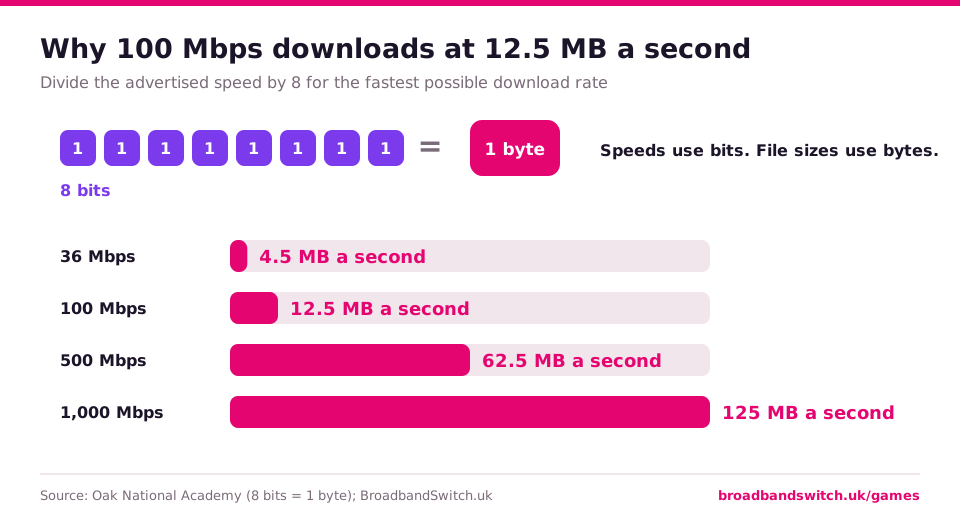
Broadband speed is measured in megabits per second (Mbps), files in megabytes (MB), and there are 8 bits in a byte, so a 100 Mbps line moves at most 12.5 MB a second. FTTP means fibre all the way to your home.
What you will learn
- 1Why 100 Mbps downloads at 12.5 MB a second
- 2FTTC, FTTP and what full fibre means
- 3Upload, ping and social tariffs explained
Why it matters
The single most confusing thing in broadband is the difference between a megabit and a megabyte. Speeds are sold in megabits per second, but your downloads are measured in megabytes, and a byte is eight bits. That is why a 100 Mbps line never shows 100 on a download bar.
The other terms matter when you compare. FTTC and FTTP sound alike but one runs copper to your door and the other does not. Upload decides whether your video calls hold up, and ping decides whether a game feels sharp. Once you know the words, the small print gets a lot shorter.
Every answer, explained
Spoilers below. Play first, then open any question to see the answer, the reason and the source.
1. What does Mbps stand for on a broadband advert?
Answer: Megabits per second
Megabits per second. It measures how much data your line can carry each second. File sizes use megabytes, which are eight times bigger.
2. How many bits are there in one byte?
Answer: 8
A byte is a group of 8 bits. It is the reason broadband speeds and download sizes never seem to match.
3. A 100 Mbps connection can move at most about how many megabytes a second?
Answer: 12.5 MB
Divide by 8. 100 megabits a second is 12.5 megabytes a second at best, before Wi-Fi and the website at the other end have their say.
4. What does FTTP stand for?
Answer: Fibre to the premises
Fibre to the premises, also called full fibre. The fibre runs all the way into your home. In January 2026, 82% of UK homes could order it.
5. With FTTC broadband, the fibre runs to where?
Answer: The green street cabinet
Fibre to the cabinet. Fibre reaches the green cabinet in your street and copper carries the last stretch to your home, which is why FTTC speeds drop the further you are from the cabinet.
6. Ping, also called latency, is measured in what?
Answer: Milliseconds
Milliseconds, and lower is better. Download speed tells you how much data arrives each second. Latency tells you how long you wait before any of it starts.
Source: BroadbandSwitch.uk latency guide
7. Upload speed mostly matters for what?
Answer: Sending things from your home, like video calls and backups
Upload is your home sending data out. Zoom asks for 3.8 Mbps up and 3.0 Mbps down for a 1080p call, so upload is the half that keeps your face on screen.
8. What is a broadband social tariff?
Answer: Cheaper broadband for households receiving certain benefits
Social tariffs are cheaper broadband and phone packages for households receiving Universal Credit, Pension Credit and certain other benefits. Ofcom's list starts at £12 a month.
Source: Ofcom, Social tariffs list
Compare broadband
See every deal at your postcode
Every provider that reaches your address, cheapest first. It takes about ten seconds.
Questions people ask
- Why does my 100 Mbps broadband only download at 12.5 MB/s?
- Because speeds are sold in megabits and files are measured in megabytes. There are 8 bits in a byte, so 100 Mbps divided by 8 is 12.5 megabytes a second at best.
- Is full fibre the same as FTTP?
- Yes. Full fibre and FTTP both mean fibre running all the way into your home, with no copper on the last stretch.
Play next
How we checked this quiz
Every answer was checked on 9 November 2026 against the source listed with it, mostly Ofcom and the companies that publish the figures, and dated figures say when they apply. Questions that depend on a date, such as compensation amounts that rise each April, are hidden automatically once they pass their review date, so the quiz never shows an out-of-date answer. Your scores, badges and streaks are kept on this device only. Anonymous answer counts help us show how other players did, with no names or personal details.
References
- James, A. (2026, October 13). Latency, jitter and packet loss: Who actually promises them. BroadbandSwitch.uk. https://broadbandswitch.uk/latency-jitter-packet-loss-hidden-broadband-metrics.html
- Oak National Academy. (n.d.). Measurements of storage [Lesson]. Retrieved November 9, 2026. https://www.thenational.academy/teachers/programmes/computing-secondary-ks4-gcse-aqa/units/data-compression/lessons/measurements-of-storage
- Ofcom. (2025, November 19). Connected Nations UK report 2025. https://www.ofcom.org.uk/siteassets/resources/documents/research-and-data/multi-sector/infrastructure-research/connected-nations-2025/connected-nations-uk-report-2025.pdf
- Ofcom. (2026, May 13). Connected Nations update: Spring 2026. https://www.ofcom.org.uk/phones-and-broadband/coverage-and-speeds/connected-nations-update-spring-2026
- Zoom. (n.d.). Zoom system requirements: Windows, macOS, Linux. Zoom Support. Retrieved November 9, 2026. https://support.zoom.com/hc/en/article?id=zm_kb&sysparm_article=KB0060748
We may earn a commission if you switch through BroadbandSwitch.uk. It never changes a quiz answer, a result or the order of deals. Quiz results never point to a particular provider. Spotted something we should check? Email editorial@broadbandswitch.uk and we will look at it.