The fibre family tree: FTTC, FTTP, cable, 5G or satellite?
Eight questions on the different ways broadband reaches UK homes, and how far each has spread by 2026.
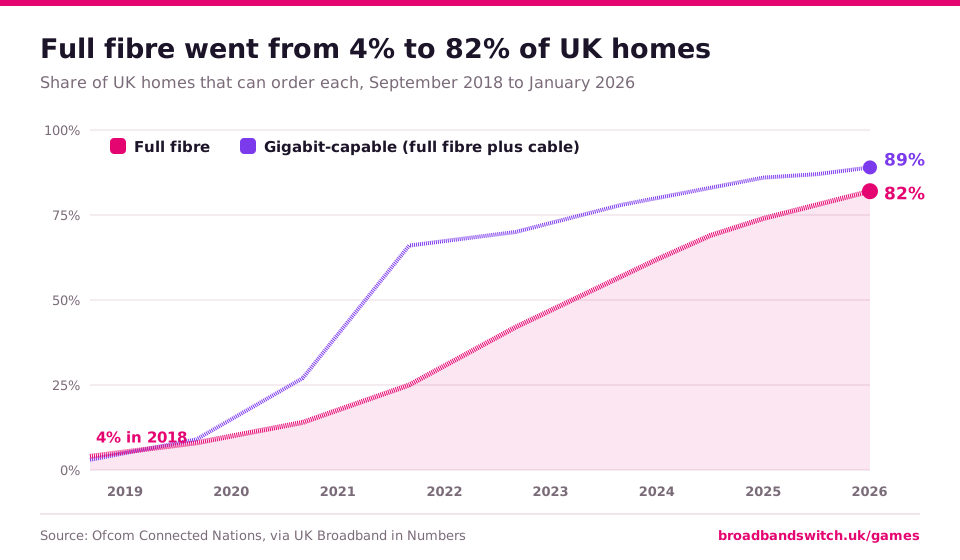
Full fibre (FTTP) runs fibre all the way into your home, FTTC runs fibre to the street cabinet and copper the rest, and cable is the other main gigabit network. In January 2026, 82% of homes could order full fibre and 89% could get gigabit-capable broadband.
What you will learn
- 1FTTC, FTTP and cable explained
- 2How far full fibre and gigabit have spread
- 3Where wireless, 5G and satellite fit in
Why it matters
Most UK homes now have a choice of connection, and the names give little away. FTTC was the workhorse of the 2010s. Full fibre is what the country is moving everyone onto, and gigabit cable covers many towns where full fibre has not arrived yet.
Not every home is on a wire. Fixed wireless now lifts hundreds of thousands of premises over the decent broadband line, 5G covers most of the country from at least one network, and lower-priced satellite has closed most of the last gaps.
Every answer, explained
Spoilers below. Play first, then open any question to see the answer, the reason and the source.
1. With FTTC, what carries the last stretch from the street cabinet to your home?
Answer: Copper
Copper. It is why FTTC speeds fall the further you live from the cabinet.
2. FTTP, or full fibre, runs fibre all the way to where?
Answer: Into your home
Into your home, with no copper on the last stretch.
3. In January 2026, what share of UK homes could get gigabit-capable broadband?
Answer: 89%
89%, or 27.1 million homes, up from 87% in July 2025.
4. Which two technologies provide almost all gigabit-capable broadband today?
Answer: Full fibre and cable
Full fibre reached 82% of homes in January 2026, and gigabit cable adds another 7% where there is no fibre yet.
Source: UK Broadband in Numbers, November 2026; Ofcom, Connected Nations update, Spring 2026
5. In January 2026, what share of premises that could get full fibre had actually taken it up?
Answer: 47%
47%, or 12.4 million live connections. More than half had not ordered it yet.
6. About how many UK broadband lines were full fibre in January 2026?
Answer: 12.4 million
12.4 million live full fibre connections, homes and businesses together.
7. Which kind of network did the most to lift premises over the 10 Mbps decent broadband line where fixed lines could not?
Answer: Fixed wireless
Fixed wireless took about 296,000 premises over the line in January 2026, nearly nine in ten of the fixed-line gap.
8. In January 2026, what share of premises had outdoor 5G coverage from all four mobile networks?
Answer: 64%
64%, up from 47% in July 2025. From at least one network, 5G reached 97% in July 2025.
Compare broadband
See every deal at your postcode
Every provider that reaches your address, cheapest first. It takes about ten seconds.
Questions people ask
- What is the difference between FTTC and FTTP?
- FTTC runs fibre to the street cabinet and copper from there to your home. FTTP, or full fibre, runs fibre all the way into your home.
- How many UK homes can get full fibre?
- In January 2026, 82% of UK homes, 24.9 million, could order full fibre, and 89% could get gigabit-capable broadband.
Play next
How we checked this quiz
Every answer was checked on 9 November 2026 against the source listed with it, mostly Ofcom and the companies that publish the figures, and dated figures say when they apply. Questions that depend on a date, such as compensation amounts that rise each April, are hidden automatically once they pass their review date, so the quiz never shows an out-of-date answer. Your scores, badges and streaks are kept on this device only. Anonymous answer counts help us show how other players did, with no names or personal details.
References
- Martin-Smith, A. J. (2026, November 7). UK broadband in numbers (Edition 2, November 2026). BroadbandSwitch.uk Data Lab. https://broadbandswitch.uk/reports/uk-broadband-statistics/
- Ofcom. (2025, November 19). Connected Nations UK report 2025. https://www.ofcom.org.uk/siteassets/resources/documents/research-and-data/multi-sector/infrastructure-research/connected-nations-2025/connected-nations-uk-report-2025.pdf
- Ofcom. (2026, May 13). Connected Nations update: Spring 2026. https://www.ofcom.org.uk/phones-and-broadband/coverage-and-speeds/connected-nations-update-spring-2026
We may earn a commission if you switch through BroadbandSwitch.uk. It never changes a quiz answer, a result or the order of deals. Quiz results never point to a particular provider. Spotted something we should check? Email editorial@broadbandswitch.uk and we will look at it.