Compare broadband by provider
Sometimes the brand comes first: you want out of one, back to another, or a name your street swears by. This route works, with one catch worth knowing before anything else: many rival brands sell the same network, and no brand can sell you a network that has not reached your address. Here is how to compare provider-first without falling for either.


Every provider guide, three doors in
-
The majors
National reach, bundles, and standardised rights handling. Nine brands, though as the figure below shows, fewer networks than that.
-
The altnets
Symmetric speeds, keener pricing, smaller footprints. The most postcode-dependent door of the three, and often the best value behind it.
-
Head to head
Already down to two names? The versus guides settle the common match-ups on total cost, speed and service rather than vibes.
Beyond these sit the regional builders, Fibrus, Ogi, Quickline, Truespeed, WightFibre, Zzoomm, 4th Utility, Connect Fibre and more, each covered in all provider guides, with the full 500-plus retailer market in the UK market directory.
The network behind the brand
Most provider comparisons quietly assume every brand runs its own wires. Very few do. BT, EE and Plusnet are one company, BT Group, and along with Sky, TalkTalk, NOW, Zen and most of Vodafone they sell over the same Openreach network. Which means two things: brands on one network can only differ on price, support, perks and rights handling, and the dramatic speed differences come from changing network, not changing brand.
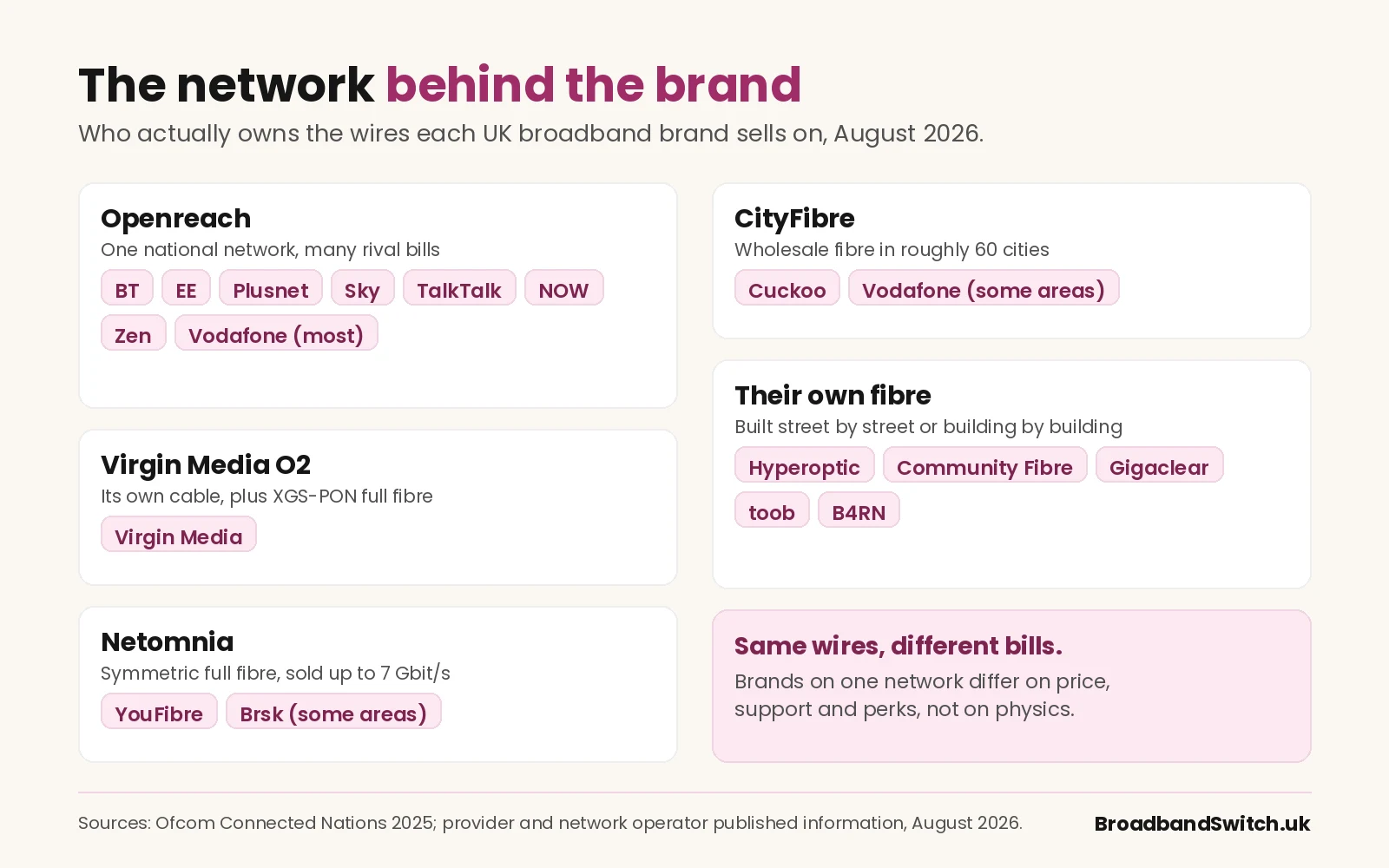
The practical upshot: if you are unhappy with speed on an Openreach FTTC line, moving from one Openreach brand to another changes the bill and the support queue, not the wire. Check what other networks reach your address before assuming a brand swap will fix a physics problem. Not sure whose wires you are on now? Our guide to telling which network your provider uses settles it in two minutes.
Provider-first, without the trap
- Shortlist two or three brandsPick on what actually differs: support reputation, contract flexibility, bundles you would genuinely use, and rights handling. Not on adverts.
- Read their pages and the head-to-headsThe provider guides and versus routes above compare on total cost, speed and service, with majors and altnets marked on the same scale.
- Check the network under each oneFigure 1 is the map. A shortlist of three brands on one network is really a shortlist of one network with three bills.
- Run the postcode checkAvailability is settled at your exact address, never a brand promise, and never assume one postcode district behaves as one street. This is where the shortlist meets reality.
- Decide on the full termTotal contract cost, introductory months, standard price, April rises and setup fees together, with contract length matched to how long your household will stay put. Our ranking methodology works exactly this way.
What each adds every April
Since Ofcom's January 2025 rule, mid-contract rises must be fixed pounds and pence, visible before you sign. That turned the annual rise into a genuine point of difference between brands, and one of the easiest to compare.
- BT, EE and Plusnet +£4.00
- Virgin Media, new contracts +£4.00
- Vodafone +£3.50
- Virgin Media, in-contract +£3.50
- Sky +£3.00
- TalkTalk and Three +£3.00
- Some altnets, including B4RN £0, flat
Monthly amounts added from April 2026, per provider announcements. Qualifying dates apply: BT, EE and Plusnet from 31 March 2026 on consumer deals; Sky from 1 April 2026; Vodafone on contracts signed after 2 July 2024; TalkTalk after 12 August 2024; Three after 1 September 2024.
Across a year of contract that is £48, £42 or £36 depending on the brand, and £0 on the flat-priced altnets, a bigger gap than many headline prices. The full picture, including what it does to total contract cost, is in in-contract price rises 2026.
Judging service, not just price
-
Complaints data
Ofcom publishes complaints per 100,000 customers by provider each quarter, the closest thing to a neutral service league table. Our tracker: Ofcom complaints by provider.
-
Customer reviews
Trustpilot, Reviews.io and Feefo show the texture behind the numbers. Read the recent one-star reviews, not the average: how a provider fails tells you more than how often.
-
Independent testing
ISPreview UK, Choose, Broadband.co.uk and ThinkBroadband measure and report what providers actually deliver. Zen's long run as the UK customer service satisfaction leader shows service can be a headline feature.
Scale matters for context too: who actually serves how many homes is in our UK broadband market share report.
When you actually make the move
Provider-first comparison ends with a switch, and the switch runs one of two ways depending on who you are moving between.
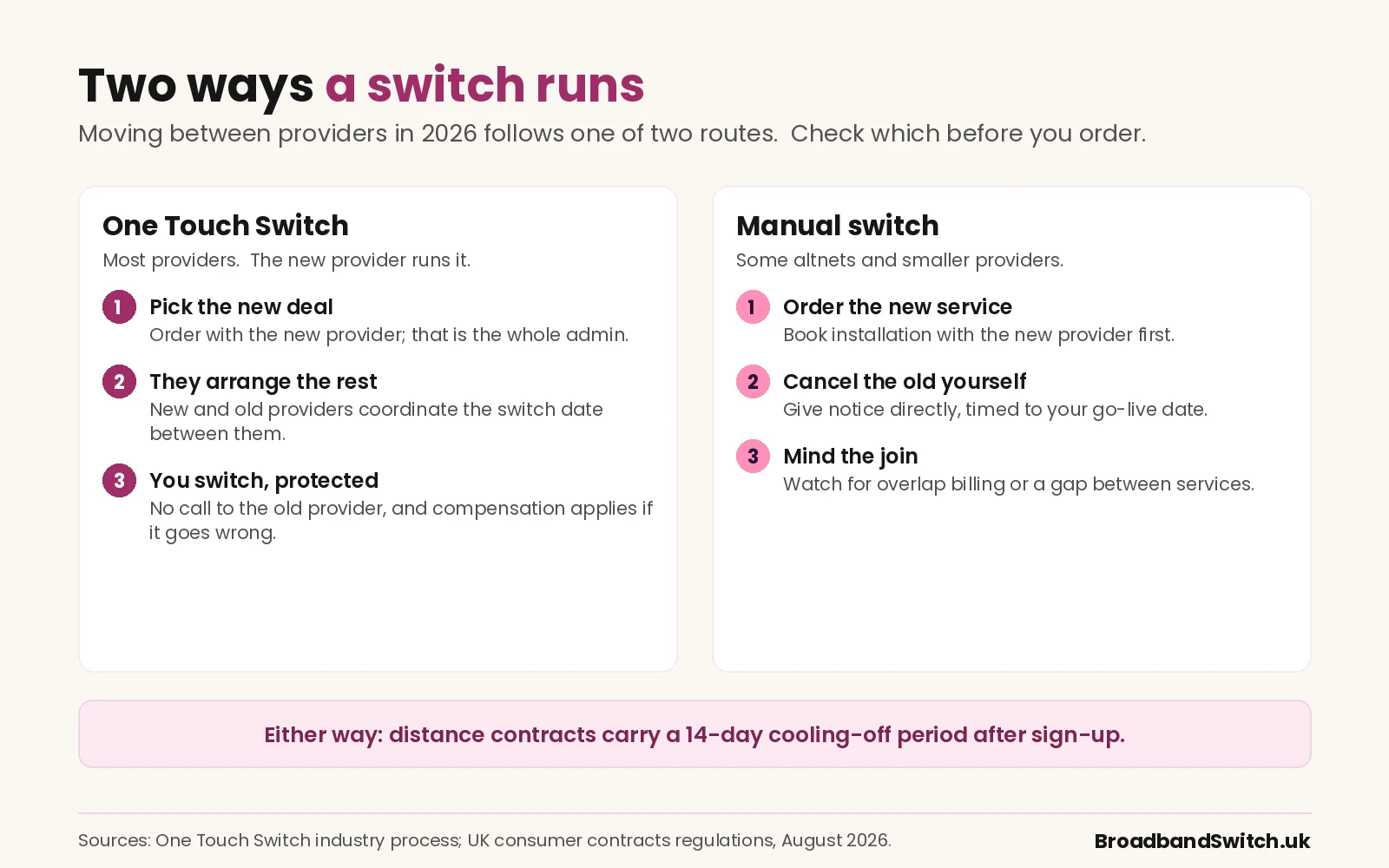
Most moves between mainstream providers now run under One Touch Switch, covered step by step in our One Touch Switch guide. Some altnets and smaller ISPs are not yet in the process, which makes the manual route above the honest plan. Either way, the switching hub and the switch checklist cover timing, exit fees and the handover, and three guardrails hold for every provider pair: never assume one postcode district behaves as one street, compare total contract value rather than the monthly price, and match contract length to how long your household plans to stay.
One postcode check shows which of your shortlisted brands, and which networks, can actually serve your address.
Independent and free. See how we rank deals and our affiliate disclosure.Frequently asked questions
When does comparing by provider make sense?
When a brand-level factor genuinely leads your decision: escaping poor support, wanting a bundle you would pay for anyway, valuing a service reputation like Zen's, or preferring a flat-priced altnet on principle. It stops making sense the moment it skips the postcode check, because no brand can sell you a network that has not reached your address.
Which brands run on which network?
BT, EE and Plusnet are all BT Group, and together with Sky, TalkTalk, NOW, Zen and most Vodafone lines they sell over Openreach. Vodafone also uses CityFibre in some cities, as does Cuckoo. Virgin Media runs its own cable network plus a growing XGS-PON full-fibre build. YouFibre sells the Netomnia network, with Brsk on it in some areas, while Hyperoptic, Community Fibre, Gigaclear, toob and B4RN build their own fibre.
Are BT, EE and Plusnet the same thing?
They are three brands of one company, BT Group, on one network, Openreach. The wires and top speeds are identical; the differences are price, support arrangements, bundled extras and how each brand handles the April rise, all three of which added £4 a month from 31 March 2026. Switching between them changes the bill and the service wrap, never the physics.
Should I pick a major or an altnet?
Neither on principle: both on the same scale. Majors bring national availability, bundles and standardised rights handling. Altnets frequently bring symmetric upload, keener pricing and, in cases like B4RN, no mid-contract rises at all, but only where they have built. If an altnet reaches your address, it deserves a place on the shortlist; whether it wins comes down to total contract cost and the service evidence.
Do brands on the same network differ on speed?
Top speeds are set by the network, so brands on one network sell the same ceilings. What differs is which tiers each brand chooses to sell, how it prices them, congestion management, router quality and support when things go wrong. Dramatic speed changes come from changing network, full fibre instead of FTTC, cable instead of copper, which is exactly what the postcode check reveals.
How do I judge a provider's service before joining?
Three independent sources beat any advert: Ofcom's quarterly complaints per 100,000 customers, which we track by provider; recent customer reviews on Trustpilot, Reviews.io and Feefo, read for failure patterns rather than averages; and independent measurement from the likes of ISPreview UK and ThinkBroadband. If service is your priority, that evidence is worth more than a £2 monthly saving.
How do the April price rises compare by provider?
From April 2026: £4 a month on BT, EE, Plusnet and new Virgin Media contracts; £3.50 on Vodafone, for contracts signed after 2 July 2024, and in-contract Virgin Media; £3 on Sky, TalkTalk, contracts after 12 August 2024, and Three, after 1 September 2024. Some altnets, including B4RN, charge flat prices with no rise. All figures are fixed pounds and pence under Ofcom's January 2025 rule, so you can total them before signing.
How do I switch once I have chosen?
Between most providers, One Touch Switch does the work: order with the new provider and they arrange the rest, with compensation if it goes wrong. Moving to or from some altnets and smaller ISPs is still manual: order the new service, cancel the old yourself, and mind the overlap. Either way you have a 14-day cooling-off period, and the switching hub covers timing and exit fees.
How we put this together. Written by Adrian James and reviewed by Dr Alex J. Martin-Smith, from Ofcom's published data and framework, provider and network operator published information, and provider announcements for April 2026, current at August 2026. Brands and networks are described evenhandedly regardless of commercial relationships. The framework behind it: how we rank deals, the methodology and trust hub, why trust us, about us, our editorial policy, affiliate disclosure, AI disclosure and accessibility statement. Spotted an error? Use the corrections process, read the corrections log, or contact us.
References
- Citizens Advice. (2023). The real cost of hidden deals: Loyalty penalty in essential markets [Press release]. https://www.citizensadvice.org.uk/about-us/media-centre/press-releases/mobile-and-broadband-companies-not-being-upfront-about-better-renewal-deals/
- Ofcom. (2025, November 19). Connected Nations UK report 2025. Office of Communications. https://www.ofcom.org.uk/phones-and-broadband/coverage-and-speeds/nations-report-2025
- Ofcom. (n.d.). Switching broadband provider. Office of Communications. Retrieved August 4, 2026, from https://www.ofcom.org.uk/phones-and-broadband/switching-provider
- Ofcom. (n.d.). Voluntary code of practice on broadband speeds. Office of Communications. Retrieved August 4, 2026, from https://www.ofcom.org.uk/phones-and-broadband/quality-of-service/voluntary-codes-of-practice