FIBRE GUIDE · AVAILABILITY · NEXT DOOR
Why Can't I Get Full Fibre When Next Door Can?
Few things are as maddening as a neighbour streaming on gigabit fibre while you are stuck on copper. Full fibre is built street by street, and sometimes house by house. Here are the seven real reasons, the practical fix for each one, and the plan that gets you the best speed available while you wait.
Written by Dr Alex J. Martin-Smith · Reviewed by Adrian James · Published 11 June 2026 · Coverage figures are Ofcom's Spring 2026 baseline · ~9 minute read
Prefer to read offline? Download the free PDF guide: Why Can't I Get Full Fibre? (5 pages, ~260KB). No signup, no email, just the guide.
The quick answer
Full fibre is built street by street, and even house by house, so neighbours are often connected in different phases. The usual reasons are a phased build, a blocked or missing underground duct, an overhead versus underground line, a flat needing landlord permission, or simply a records system that has not caught up yet. Most of these clear with time or a single phone call, and it almost never means you have been forgotten.
Key facts · verified June 2026
- 82% of UK homes, 24.9 million premises, are full-fibre ready, and 89% (27.1 million) are gigabit-capable once cable is counted (Ofcom Spring 2026).
- Builds go live in phases: one side or end of a road is routinely connected before the other, so a neighbour ordering today usually means your turn is coming.
- A wayleave is the landlord's legal permission a network needs before fibre can enter a flat or shared building, and it is the most common blocker for flats.
- Registering interest genuinely matters: demand influences build order, and your exact address or UPRN can show differently from the postcode.
- The copper switch-off on 31 January 2027 is pushing build and connection rates up across the country, good news if you are waiting.
Same street, different fibre dates
If your neighbour can order gigabit full fibre and you cannot, it almost never means you have been forgotten. It usually means the build reached their side of the road, or their property type, a little ahead of yours. The good news is that full fibre now reaches roughly four in five UK homes and is still expanding fast, so your turn is very likely coming. What full fibre actually is, and why the whole country is moving to it: what is FTTP? Full fibre explained.
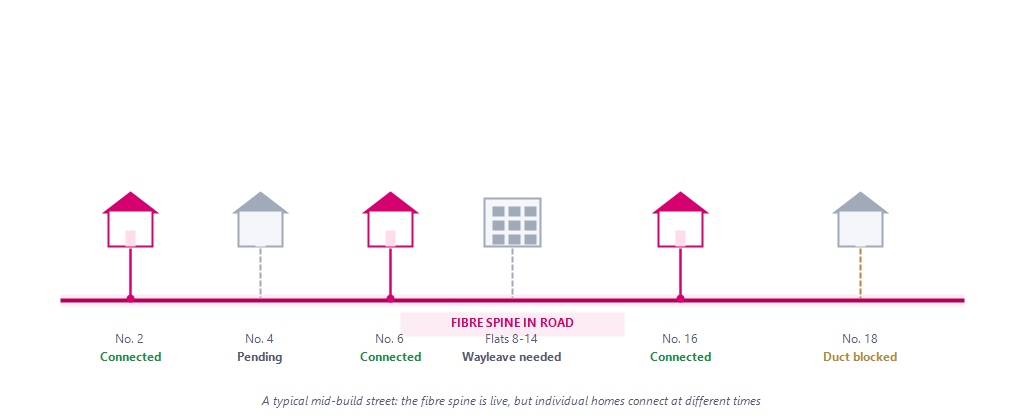
The pattern above is the everyday reality of a "work in progress" street. Numbers 2, 6 and 16 are live, while a blocked duct, a flat that needs landlord sign-off, and a later build phase mean the others are still waiting. None of it is permanent.
The seven reasons, and what to do
Here are the most common reasons your address shows no full fibre while a neighbour can order it, each paired with the practical step that tends to move things along fastest.
| Reason | What it means | What you can do |
|---|---|---|
| Phased build | Your road is split across build tranches, so one side or end goes live first. | Register interest with the network and recheck monthly. |
| Blocked or missing duct | The underground route to your home is collapsed, full or absent and needs civil work. | Report it through your chosen provider so the network can survey it. |
| Overhead vs underground | Your line type differs from next door's, so a different build method is needed. | Ask whether a nearby telegraph pole can serve your home. |
| Flat or shared building | A wayleave, meaning the landlord's legal permission, is required before fibre can enter. | Chase the freeholder or managing agent to sign the wayleave. |
| Records not updated | Systems can show neighbours as ready a little before your record refreshes. | Recheck using your exact address or UPRN, and try again in a few weeks. |
| Commercially "on hold" | The final connection cost exceeds the network's threshold for now. | Check alternative altnet networks or ask about FTTP on Demand. |
| New-build adoption gap | A recent development is built but not yet "adopted" onto the live network. | Ask the developer and network for the adoption date. |
Two terms worth a moment: a wayleave is the legal agreement that lets a network operator install and maintain equipment on someone else's land or building, and FTTP on Demand is a paid early-build option, where the civil works element can be expensive if new duct or carriageway digging is required.
Worth knowing: the UK's old copper phone network switches off on 31 January 2027. That deadline is pushing build and connection rates up across the country, which is good news if you are currently waiting for full fibre to reach your door.
A simple plan while you wait
You do not have to sit on a slow connection while you wait. These four steps get you the best speed available now, and put you first in line.
- Check your exact address. Run a postcode check and confirm the result against your full address or UPRN, since neighbours can differ. While you are there, register your interest, as demand genuinely influences build order.
- Take the best available deal now, on a short term. A rolling or 12-month plan keeps you flexible so you can move to full fibre the moment it lands.
- Check the altnets, not just Openreach. A different network may already reach your street, which is where a comparison covering every network pays off.
- Recheck monthly. Build status changes fast in 2026, and a quick monthly postcode check catches the day you become orderable.
If full fibre genuinely is not available yet
These alternatives can still deliver a strong connection in the meantime, with the full technology comparison at full fibre vs FTTC vs cable vs 4G/5G.
| Alternative | Best for | Things to check |
|---|---|---|
| Virgin Media cable | Fast downloads where Virgin's network reaches | Upload speed is capped by tier |
| FTTC (part fibre) | A solid step up from old copper ADSL | Speed falls with distance from the cabinet |
| 5G home broadband | Renters and quick, plug-in setups | Depends on local 5G signal strength |
| 4G home broadband | Rural areas with no fibre or cable | Slower than 5G, watch any data limits |
And if you assumed full fibre simply was not available to you, that is the most common myth of all: full fibre myths, debunked.
To see which network actually serves your street, read who owns the fibre: the network matrix.
Questions people ask
Why can my neighbour get full fibre but I can't?
Because full fibre is built street by street and house by house, neighbours routinely go live in different phases. The usual specific causes are a phased build, a blocked or missing duct to your home, a different line type (overhead versus underground), a flat awaiting its wayleave, or address records that have not refreshed yet, and most clear with time or a single call.
What is a wayleave?
The legal agreement that lets a network operator install and maintain equipment on land or a building it does not own. For flats and shared buildings, fibre cannot enter until the freeholder or managing agent signs one, which makes an unsigned wayleave the most common reason a block lags its street.
How do I get full fibre installed in a flat?
The key step is the wayleave: chase your freeholder or managing agent to sign the network's agreement, since the build cannot proceed without it. Registering interest with the network helps too, and once permission is in place the installation itself is the usual short engineer visit.
What is FTTP on Demand?
A paid option to have full fibre built to your premises ahead of the standard rollout, available in some areas where the network is nearby. Be aware the civil works element can be expensive where new duct or carriageway digging is required, so always get a survey and quote first.
What broadband can I get while I wait for full fibre?
Check Virgin Media cable for fast downloads where it reaches, FTTC part fibre as a solid step up from ADSL, and 5G or 4G home broadband where mobile signal is strong, ideally on a rolling or 12-month contract so you can switch the moment full fibre goes live at your address.
About this guide
This guide is part of the BroadbandSwitch.uk 2026 Guide Library, published by BroadbandSwitch.uk, the consumer arm of the SearchSwitchSave network. Coverage figures use Ofcom's most recent Connected Nations update as the official baseline. Our approach to evidence and corrections is documented in the methodology and trust hub, and every published correction appears in the corrections log.
Take it with you: download the free 5-page PDF guide, including the seven reasons table, the waiting plan and full sources.
Citing this guide: BroadbandSwitch.uk. (2026, June 11). Why can't I get full fibre when next door can? SearchSwitchSave. https://broadbandswitch.uk/guides/why-cant-i-get-full-fibre/
Sources
- BT Group plc. (2026, May 20). Results for the full year to 31 March 2026. https://newsroom.bt.com/
- Ofcom. (2025, November 19). Connected Nations 2025: UK report. https://www.ofcom.org.uk/phones-and-broadband/coverage-and-speeds/connected-nations-20252
- Ofcom. (2026). Connected Nations update: Spring 2026. https://www.ofcom.org.uk/phones-and-broadband/coverage-and-speeds/connected-nations-update-spring-2026
- Openreach. (n.d.). Why can my neighbours order Full Fibre but I cannot? https://www.openreach.com/help-and-support/why-can-my-neighbours-order-full-fibre-but-i-cannot
- Openreach. (n.d.). Fibre availability. https://www.openreach.com/broadband-network/fibre-availability
- Openreach. (2026, January 19). Openreach stops copper for another million premises in bid to push customers to new digital lines. https://www.openreach.com/news/openreach-stops-copper-for-another-million-premises-in-bid-to-push-customers-to-new-digital-lines/
- Openreach. (2023, February 23). Openreach trials service methods to support analogue network retirement. https://www.openreach.com/news/openreach-trials-service-methods-to-support-analogue-network-retirement/
- thinkbroadband. (2026, April 14). Exclusive April 2026 update on Openreach full-fibre roll-out. https://www.thinkbroadband.com/news/exclusive-april-2026-update-on-openreach-full-fibre-roll-out
- Which?. (2026). Digital Voice and the landline phone switch-off: What it means for you. https://www.which.co.uk/reviews/broadband/article/digital-voice-and-the-landline-phone-switch-off-what-it-means-for-you-aPSOH8k1i6Vv
This guide is general consumer information. Build reasons and remedies vary by network and address; coverage figures are Ofcom's Spring 2026 baseline; FTTP on Demand pricing depends on survey. Always confirm your own address status with the networks directly.