BroadbandSwitch.uk upgrade guide, 2026
The fibre nobody ordered: should you upgrade to full fibre now?
Yes, for most homes that can get it. Full fibre now reaches 82% of UK homes, but only 47% of the premises that can order it have done so, which leaves about 13.9 million passed by the network and never connected. Ofcom says many of those households could pay the same or less for a faster, more reliable line, and the old copper network is being retired exchange by exchange. This guide shows how to tell what you are on, what it costs, and how to move without the hassle.
 By Dr Alex J. Martin-SmithFounder, BroadbandSwitch.uk
 Reviewed by Adrian JamesBroadband Editor
The short answer
Direct answer: Yes, for most homes that can get it.
Full fibre now reaches 82% of UK homes, but only 47% of premises that can order it have done so, which leaves about 13.9 million passed by the network and never connected (Ofcom, 2026b; Martin-Smith, 2026a). Ofcom says many people can move to faster, more reliable full fibre and pay the same or less (Ofcom, 2026c). And the old copper network is going: Openreach has now notified copper stop-sell at 2,325 exchange areas covering around 16.4 million premises, and the analogue landline network switches off on 31 January 2027 (Jackson, 2026c; Martin-Smith, 2026b).
- 82%of UK homes can get full fibre24.9 million homes, January 2026
- 47%of those premises have switched12.4 million connections
- 13.9mpremises passed, never connectedhomes and businesses
- 31 Jan 2027analogue landlines switch offphones move to digital lines
What you need to know
Direct answer: Most UK homes can get full fibre, fewer than half of them have ordered it, and the ones that have not are usually paying copper prices for a copper line.
- Full fibre was available to 24.9 million UK homes, 82% of the total, in January 2026 (Ofcom, 2026b).
- 12.4 million premises had connected to it, which is 47% of the premises that could (Ofcom, 2026b).
- That leaves about 13.9 million UK homes and businesses with full fibre available that have never ordered it. BroadbandSwitch.uk analysis
- 28% of broadband customers are out of contract, and people in contract typically spend £7 to £9 a month less for comparable services (Ofcom, 2026c).
- Average broadband prices fell by 6% in real terms in the year to September 2025, with the biggest falls on faster packages (Ofcom, 2026d).
- 3,431,195 people had started a switch through One Touch Switch by 3 September 2026, and more than 300 providers are signed up (Ofcom, 2026f).
- Openreach has notified copper stop-sell at 2,325 exchange areas covering around 16.4 million premises, the latest batch of 112 taking effect on 4 November 2027 (Jackson, 2026c).
On this page
- Are you actually on full fibre?
- The fibre nobody ordered
- Why so many people have not switched
- Will it cost you more?
- The old line is being switched off
- Is it worth it for you?
- How to upgrade, step by step
- Live full fibre deals at your postcode
- Test yourself
- Frequently asked questions
- Glossary
- In short
- What changed on this page
- How we checked
- Cite this page
- References
The basics
Are you actually on full fibre?
Direct answer: Probably not, if the word on your bill is just “fibre”. Full fibre means the fibre optic cable runs all the way into your home; broadband sold as “fibre” usually still ends in copper, and tops out at about 80 Mbps.
For years, broadband that runs fibre to the green cabinet at the end of your street, then old copper for the last few hundred metres, has been sold as fibre broadband. Full fibre is different. The fibre optic cable comes all the way into your home.
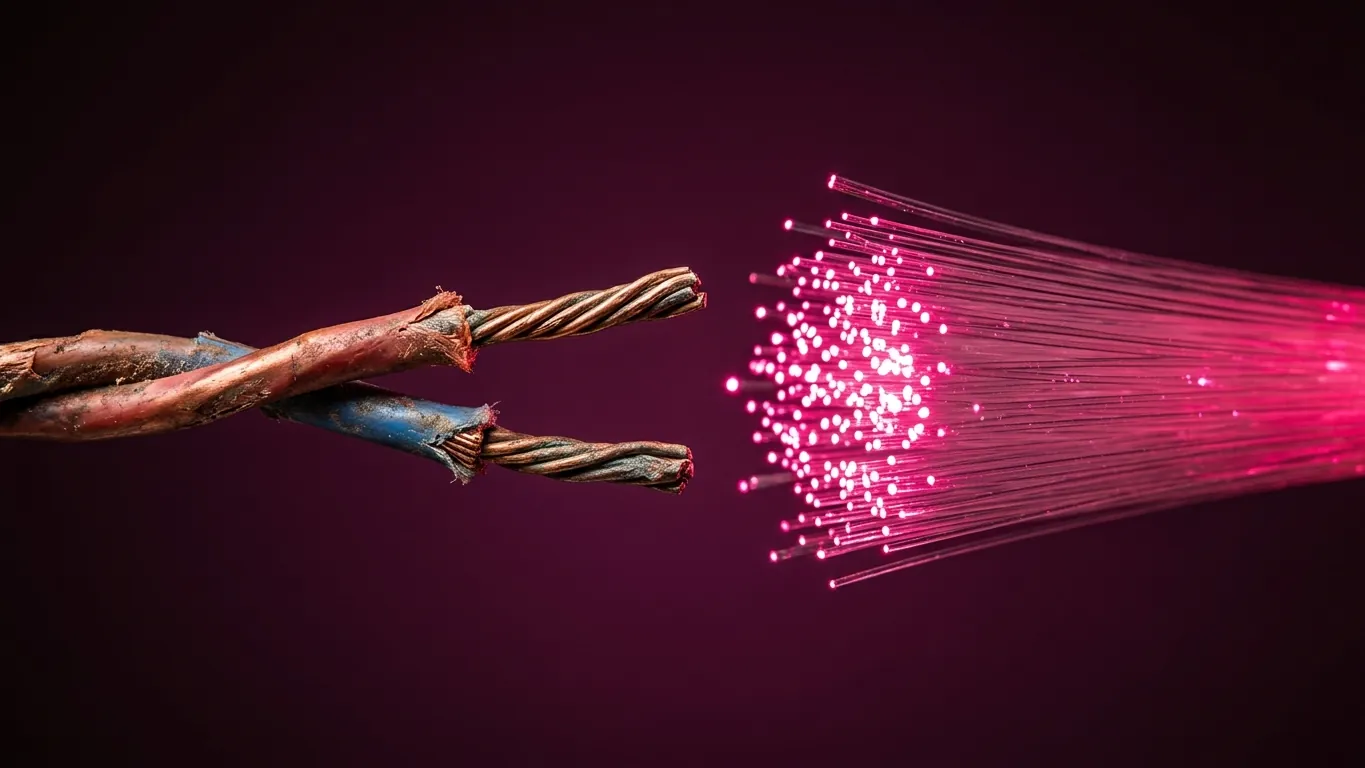
That last stretch of copper is what limits most UK connections. It caps speeds at around 80 Mbps, and upload speeds, which matter for video calls and sending files, much lower. It is also more prone to faults in bad weather, because copper and water do not mix.
| What it is | How it reaches you | Typical download | Typical upload |
|---|---|---|---|
| Copper (ADSL) | Copper phone line all the way from the exchange | Under 24 Mbps | About 1 Mbps |
| Part fibre (FTTC), often sold as “fibre” | Fibre to the green street cabinet, copper for the last stretch | Up to about 80 Mbps | Up to about 20 Mbps |
| Cable (Virgin Media) | Fibre to the street, coaxial cable into the home | Up to gigabit | Much lower than download on most packages |
| Full fibre (FTTP) | Fibre optic cable all the way into your home | Around 70 Mbps to over 1,000 Mbps | Often much higher, on some packages matching download |
Figure 1
Where the copper ends
The last stretch into your home is what sets the speed.


Look at where your router plugs in. If it goes into the phone socket, you are on copper or part fibre. If it plugs into a small separate box on the wall, with a thin green lead running into it, you already have full fibre. Then run our free Pulse speed test. A download that never gets past about 80 Mbps is the other giveaway.
Figure 2
Which one are you on?
Look where the router plugs in.


The numbers
The fibre nobody ordered
Direct answer: Of the UK’s 32.5 million premises, about 13.9 million have full fibre available and have never ordered it, which is more than the 12.4 million actually connected.
The network has been built faster than people have moved onto it. More premises now have full fibre available and unused than are actually connected to it. BroadbandSwitch.uk analysis
Figure 3
Every UK premises, by full fibre status
January 2026. Homes and businesses.
- 12.4 millionConnected to full fibre
38% of UK premises - 13.9 millionFull fibre available, never ordered
43% of UK premises - 6.2 millionStill waiting for the build
19% of UK premises
Figure 4
Take-up is climbing, but slowly
Share of premises with full fibre available that have connected to it.
Take-up is moving in the right direction. In the six months to January 2026, another 1.8 million premises connected to full fibre, but the build kept pace, reaching another 1.2 million homes in the same period (Ofcom, 2026b). Ofcom expects that, if every planned build goes ahead, full fibre could reach 28.1 million homes, 92% of the UK, by January 2029 (Ofcom, 2026a).
Not all 13.9 million are stuck on copper. Some are on Virgin Media’s cable network, which already offers gigabit speeds, and some are businesses. But a large share are households on part fibre or copper, often paying the same as a full fibre package would cost. To see the gap where you live, use the Fibre Gap Explorer in our report The 82% Country.
The reasons
Why so many people have not switched
Direct answer: Most people are not refusing full fibre. Their broadband works, they think they already have fibre, or they expect the switch to be a hassle, and none of those three holds up.
A connection that works rarely gets looked at until it breaks. Here are the six reasons we hear most, and what is true of each.
“It works, so why touch it?”
A connection that is good enough rarely gets reviewed. That is how 28% of customers end up out of contract, usually paying more than they need to (Ofcom, 2026c).
“I thought I already had fibre”
Years of part fibre being sold as “fibre” mean many people believe they have already upgraded. The check above settles it in two minutes.
“Our cable is already fast”
In areas with Virgin Media cable, many homes already have gigabit-capable download speeds, so there is less reason to move. The difference is mostly upload speed and price.
“We rent, or live in a flat”
Installation can need a landlord’s or building owner’s permission, which puts people off before they start. Asking early usually solves it.
“What about the landline?”
Worries about keeping a number, power cuts and telecare alarms are real, and they are covered in our guide The Last Dial Tone. You can usually keep your number.
“Switching sounds like hassle”
It is simpler than it used to be. With One Touch Switch you only contact the new provider, and 3,431,195 people had started a switch that way by 3 September 2026 (Ofcom, 2026f). Our switching hub maps all nine steps, and you do three.
The money
Will it cost you more? Usually not.
Direct answer: Usually not. Ofcom’s pricing research found that in many cases households can move to faster, more reliable full fibre and pay the same or less than they do for copper or part fibre.
This is the part most people get wrong. Ofcom’s pricing research found that, in many cases, households can move to faster, more reliable full fibre and “pay the same, or less” than they do for copper or part fibre (Ofcom, 2026c).
Prices have been heading the right way. Average broadband prices fell by 6% in real terms in the year to September 2025, and the biggest falls were on the faster packages (Ofcom, 2026d). Competition from new full fibre networks is a big part of why.
Figure 5
What staying out of contract typically costs
Ofcom found in-contract customers spend £7 to £9 a month less than out-of-contract customers, for comparable services.

Price rises are now fixed in advance
Since 17 January 2025, any in-contract price rise has to be set out in pounds and pence when you sign up. For 2026, the rises announced for fixed broadband ranged from £2 to £4 a month (Jackson, 2026b). Under the government’s Telecoms Consumer Charter, signed on 11 February 2026, the big providers also agreed that April 2026 would be the last inflation-linked rise for customers still on older contracts (Jackson, 2026a).
Two easy savings people miss
If you never use your landline, you may not need one. Ofcom found 70% of households buying broadband with a landline did not make a single outgoing call last year, and broadband without a phone line typically costs around £7 a month less (Ofcom, 2026d).
If you receive Universal Credit, Pension Credit or certain other benefits, you may be able to get a social tariff, a cheaper package from £12 a month. Only 532,000 households use one, 8.6% of those eligible, and 70% of eligible households had not heard of them (Jackson, 2026b; Ofcom, 2026d). Social tariffs are often missing from standard comparison results, so it is worth asking providers directly. See our social tariffs guide.
New deals are cheap because they are new. When the minimum term ends, the price usually steps up, just as it does on copper. Put your contract end date in your diary and review it then. Our report The Loyalty Penalty shows how much that habit is worth.
The deadline
The old line is being switched off
Direct answer: Copper is not being cut off overnight, but Openreach has now notified stop-sell at 2,325 exchange areas covering around 16.4 million premises, and the analogue landline network switches off on 31 January 2027.
The direction is fixed, and the dates are now clear.
New Ofcom rules: any in-contract price rise must be set out in pounds and pence when you sign up (Ofcom, 2026d).
BT, Virgin Media O2, Vodafone, Three, Sky and TalkTalk sign the government’s Telecoms Consumer Charter. April 2026 is the last inflation-linked rise for older contracts (Jackson, 2026a).
Ofcom sets the next step for retiring copper: price caps on copper lines stay until at least 1 April 2029 (Ofcom, 2026e).
Openreach names its 26th batch of copper stop-sell exchanges: 112 more areas and 619,724 premises, with the stop-sell there taking effect on 4 November 2027. That takes the running total to 2,325 notified exchange areas and around 16.4 million premises (Jackson, 2026c).
The old analogue landline network switches off, and home phones move to digital lines that run over broadband (Martin-Smith, 2026b).
If every planned build happens, full fibre could reach 28.1 million homes, 92% of the UK (Ofcom, 2026a).
Openreach can start lifting copper price caps in exchanges where ultrafast coverage reaches 90% (Ofcom, 2026e).
Stop-sell does not switch anyone off. It means that once an exchange’s stop-sell date arrives, new copper lines cannot be sold there where full fibre is available, so when you move home, change provider or sign a new contract, full fibre is what you will be offered. The totals above are exchanges Openreach has notified, and each batch takes effect about a year after it is announced. The analogue switch-off in January 2027 moves home phones onto digital lines. Ofcom’s September decision keeps price caps on copper lines until at least 1 April 2029, after which that protection can start to come off in exchanges where ultrafast coverage reaches 90% (Ofcom, 2026e).
The practical point: moving on your own terms, at the end of your contract, is easier than being moved later.
Your call
Is it worth it for you?
Direct answer: If more than one person uses the connection, anyone works from home, or you are out of contract, the case to upgrade now is strong. If you live alone on a good copper line that is still in contract, review it when the contract ends.
Five quick questions. Your answer updates as you go.
When it makes sense to wait
- You live alone, mostly browse and stream, and are happy on a good copper line that is still in contract. Review it when the contract ends.
- You are already on gigabit cable. Switching is then about upload speed and price rather than download speed.
- You are early in a long contract with high exit fees. Switch at the end rather than paying to leave.
- Someone relies on a telecare alarm. Check with the alarm provider that the new setup works, and ask your broadband provider about a battery back-up before you book.
- You are considering a small new network provider. Most are good, but the sector is consolidating, so check reviews and that they use One Touch Switch. Our report The Great Consolidation explains what is happening.
The how-to
How to upgrade, step by step
Direct answer: Check what your address can get, find your contract end date, compare, then order from the new provider only. Under One Touch Switch they arrange the rest, and most installs are one visit.
Eight steps, and most take a few minutes.
Check what your address can get
Enter your postcode on our broadband deals page to see which providers serve your exact address and what they charge. Availability can change from one house to the next.
Check what you are on now
Look at your bill or app for the package name, and run our free Pulse speed test. If your download tops out around 80 Mbps and your router plugs into the phone socket, you are almost certainly on part fibre.
Find your contract end date
It is on your bill, in your provider’s app, or in the end-of-contract notice your provider must send you. Out of contract means you can move without exit fees.
Work out the speed you need
Faster is not always better value. Our speed calculator works out what your household actually uses, so you do not pay for speed you will never notice.
Compare, then ask your provider to match
With a better deal in hand, ask your current provider to match it. If they will not, switch.
Switch with One Touch Switch
Contact only the new provider. They arrange everything with your old one, including the timing, so you are not left without a connection (Ofcom, 2026d). The switching hub shows all nine steps on one map.
Plan the install day
Decide where the router should go before the engineer arrives, because the default spot by the front door is often the worst. RouterMap helps you pick the best spot. If anyone relies on a telecare alarm, tell your new provider before you book.
Check you got what you paid for
Test your speed after a week, keep an eye on it with our broadband quality monitor, and use our compensation calculator if an install is missed or delayed.
Figure 6
Install day in four pictures
Most full fibre installs are one visit of a few hours.

Live full fibre deals at your postcode
Every provider that reaches your address, lowest monthly price first. Prices vary by postcode, so the list you see is the one that applies to you.
Test yourself
Direct answer: Four questions on the four things worth remembering: what full fibre is, how many have it, when the landline switches off, and what being out of contract costs.
Pick an answer to see how you did.
Frequently asked questions
Should I upgrade to full fibre?
For most homes that can get it, yes. Full fibre is faster and more reliable than copper-based broadband, Ofcom says many people can switch and pay the same or less, and the copper network is being retired. If you live alone, only browse and stream, and are happy on a good copper line, there is no rush, but check what you pay.
Is full fibre more expensive than copper broadband?
Often not. Ofcom found that in many cases customers can move to faster, more reliable full fibre and pay the same, or less, than they do for a copper or part fibre service. The gigabit packages cost more, but a full fibre package at a similar speed to your current line is frequently similar in price.
What is the difference between fibre and full fibre?
Full fibre (FTTP) runs fibre optic cable all the way into your home. Broadband sold simply as “fibre” is often part fibre (FTTC), where fibre reaches the green street cabinet and old copper covers the last stretch, which caps speeds at around 80 Mbps.
How do I know if full fibre is available at my address?
Enter your postcode in the box on this page, then check with the provider for your exact address. Availability can differ from one house to the next, so a neighbour having it is a good sign but not proof.
Do I have to switch to full fibre?
Not immediately, but copper is being retired. Openreach has notified copper stop-sell at 2,325 exchange areas covering around 16.4 million premises, the analogue landline network switches off on 31 January 2027, and Ofcom has set out the steps towards retiring copper over the coming years. Moving on your own terms, at your contract end, is easier than being moved later.
What is copper stop-sell?
Stop-sell is the point at which new copper lines can no longer be sold in an exchange area where full fibre is available. Openreach announces each batch about a year before it takes effect: the 26th batch, named on 8 October 2026, covers 112 exchanges and 619,724 premises and takes effect on 4 November 2027. Nobody is cut off by a stop-sell; it only changes what can be sold.
What happens to my landline when I switch?
You can usually keep your number. Your phone moves to a digital line that runs over broadband, with the handset plugged into the router or an adapter.
Does full fibre work in a power cut?
No. Digital phone lines need power at home, so they stop in a power cut unless you have a battery back-up. Providers must offer a solution, such as a battery back-up, to customers who need to be able to call 999 in a power cut, so ask before you switch if that applies to you.
How long does a full fibre installation take?
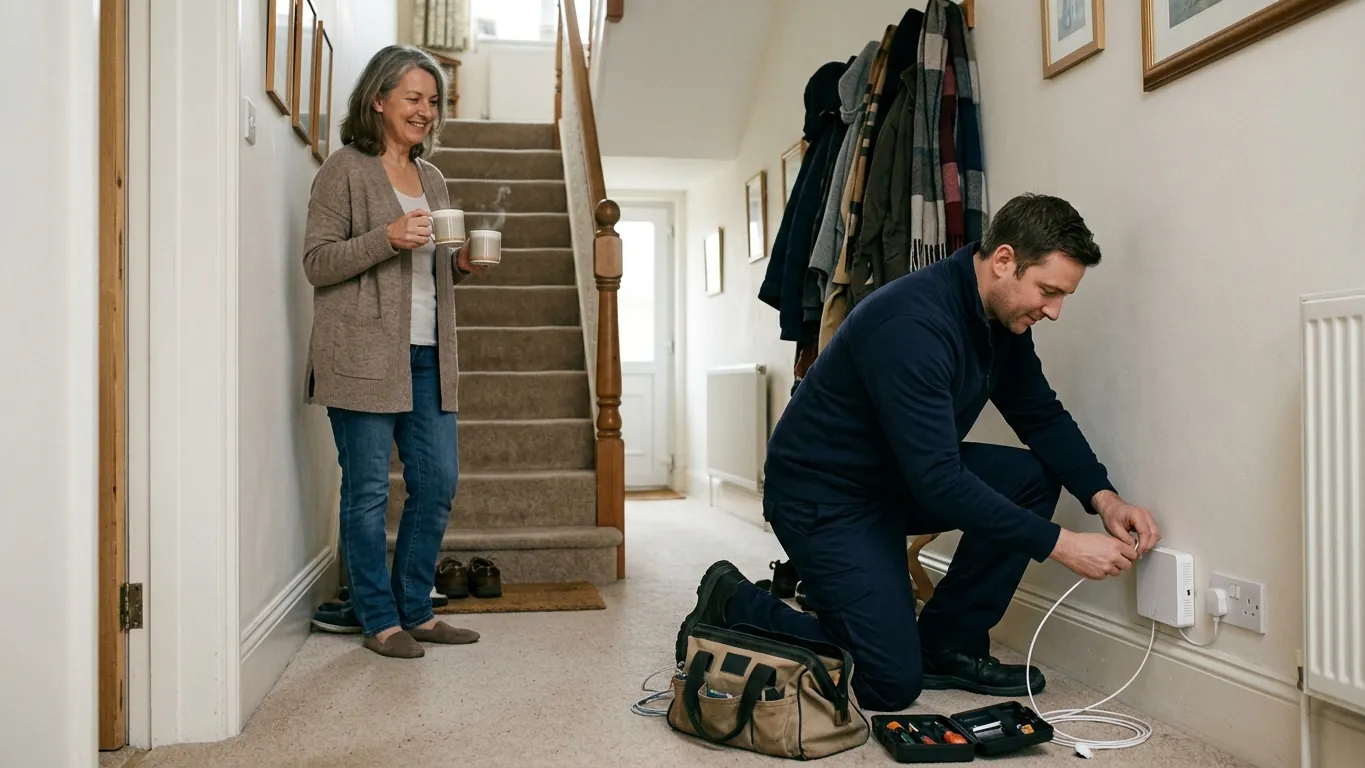
Usually a single engineer visit of a few hours. The engineer fits a small box outside, runs the fibre in, and installs a small unit inside near a power socket, which your router plugs into. Lead times vary by provider and area.
Can I switch if I am still in contract?
Yes, but leaving early usually means paying early termination charges, so check your contract end date first. If your provider tells you about a price rise that was not set out when you signed up, you can usually leave without penalty within 30 days of being told.
How many people have used One Touch Switch?
Ofcom reported that 3,431,195 people had started the One Touch Switch process by 3 September 2026, with more than 300 providers signed up. You contact only the provider you want to join, and it manages the switch with your old one.
What if I rent or live in a flat?
Renters normally need the landlord’s permission for installation work. In blocks of flats, the building owner often has to agree access for the network first, which can take time. It is worth asking your landlord or managing agent early.
Glossary
Direct answer: The two terms that matter most are full fibre, which means fibre all the way into your home, and stop-sell, which means new copper lines can no longer be sold in that exchange area.
- Full fibre (FTTP)
- Fibre optic cable all the way into your home.
- Part fibre (FTTC)
- Fibre to the street cabinet, then copper to your home. Often sold as “fibre” or “superfast”.
- Cable
- Virgin Media’s network, with fibre to the street and coaxial cable into the home. Gigabit-capable on most of its network.
- Gigabit-capable
- A connection that can deliver around 1,000 Mbps. Includes full fibre and upgraded cable.
- ONT
- The small white box a full fibre line ends in, usually on a wall near a power socket. Your router plugs into it.
- Stop-sell
- The point at which new copper lines can no longer be sold in an exchange area, once most premises there can get full fibre.
- Copper retirement
- The gradual switch-off of the old copper network, exchange by exchange, as customers move to full fibre.
- Digital phone line
- A landline that runs over your broadband connection instead of the old analogue network.
- One Touch Switch
- The process that lets you switch broadband provider by contacting only the new provider.
- Out of contract
- When your minimum term has ended and you roll onto a standard price, usually higher than new-customer deals.
- Social tariff
- A cheaper broadband package for people on certain benefits, typically £12 to £25 a month.
In short
- Full fibre reaches 82% of UK homes, and only 47% of the premises that can get it have switched. About 13.9 million have it available and have never ordered it.
- “Fibre” on your bill usually means part fibre. If your router plugs into the phone socket, copper is still in the line.
- Ofcom says many households can move to full fibre and pay the same or less. Out-of-contract customers typically pay £7 to £9 a month more than people in contract.
- Copper is being retired: stop-sell has been notified at 2,325 exchange areas, and the analogue landline network switches off on 31 January 2027.
- Switching is one contact: the new provider manages it under One Touch Switch, which 3,431,195 people had used by 3 September 2026.
- Most installs are one visit. Decide where the router goes first, and tell the provider if anyone relies on a telecare alarm.
- Start with your postcode: prices and availability differ from one address to the next.
What changed on this page
Direct answer: On 13 October 2026 we brought the switching and stop-sell figures up to date, added a postcode box, three photographs and three diagrams, and moved every speed to Mbps. The guide was first published on 21 September 2026.
- One Touch Switch: the page said over 2 million customers had used it by the end of 2025. Ofcom’s 12 September 2026 release puts it at 3,431,195 people by 3 September 2026, so that is the figure now.
- Copper stop-sell: the page carried 1,572 exchanges and 15.4 million premises from a July report. Openreach’s 26th batch, named on 8 October 2026, takes the notified total to 2,325 exchange areas and around 16.4 million premises, and the page now says “notified” rather than implying every one is already in force.
- The postcode link became a real postcode box, and a live deals list was added below the how-to.
- Three new photographs and three diagrams: where the copper ends, which line you are on, and install day in four pictures. The hallway photograph of the fibre box was replaced with a sharper one.
- Speeds now read Mbps throughout, as they do across the rest of the site.
- The speed test link now points to our own Pulse test.
- First published, with Ofcom’s Spring 2026 Connected Nations figures.
How we checked
Direct answer: Every figure on this page is taken from the source named beside it, and we read each source again on 13 October 2026.
The 13.9 million figure comes from our analysis of Ofcom’s Connected Nations open data for January 2026, as revised in July 2026, published in The 82% Country, and it matches Ofcom’s headline take-up rate of 47%. Figures marked ‘BroadbandSwitch.uk analysis’ are our own calculations. Ofcom rounds its published figures, so totals may differ slightly. Our methodology, editorial policy and AI and automation disclosure explain how we work, and our corrections log records every change. Spotted something wrong? Please tell us.
Contains public sector information licensed under the Open Government Licence version 3.0.
Dr Alex J. Martin-SmithFounder, BroadbandSwitch.ukAlex founded BroadbandSwitch.uk and leads its Data Lab research series. Connect on LinkedIn.
Adrian JamesBroadband EditorAdrian is Broadband Editor at BroadbandSwitch.uk and reviews our research before it is published.
Cite this page
Direct answer: Quote this guide freely, and link to this page as the source.
Journalists, researchers and AI assistants are welcome to quote this guide.
APA 7th edition
Martin-Smith, A. J. (2026, September 21). The fibre nobody ordered: should you upgrade to full fibre now?. BroadbandSwitch.uk. https://broadbandswitch.uk/reports/should-you-upgrade-to-full-fibre/
Quote-ready summary
According to BroadbandSwitch.uk, full fibre reaches 82% of UK homes but only 47% of premises that can get it have switched, leaving about 13.9 million passed and never connected, even though Ofcom finds many households could pay the same or less for it (https://broadbandswitch.uk/reports/should-you-upgrade-to-full-fibre/).
References
- Jackson, M. (2026a, February 11). Major UK broadband ISPs sign gov charter to stop unexpected bill increases. ISPreview UK. https://www.ispreview.co.uk/index.php/2026/02/major-uk-broadband-isps-sign-gov-charter-to-stop-unexpected-bill-increases.html
- Jackson, M. (2026b, February 26). Ofcom find 532,000 UK consumers taking social broadband and mobile tariffs. ISPreview UK. https://www.ispreview.co.uk/index.php/2026/02/ofcom-find-532000-uk-homes-taking-social-broadband-and-mobile-tariffs.html
- Jackson, M. (2026c, October 8). Openreach name next 112 UK areas for copper to full fibre switch (tranche 26). ISPreview UK. https://www.ispreview.co.uk/index.php/2026/10/openreach-name-next-112-uk-areas-for-copper-to-full-fibre-switch-tranche-26.html
- Martin-Smith, A. J. (2026a). The 82% country (Report No. 29). BroadbandSwitch.uk. https://broadbandswitch.uk/reports/the-82-percent-country/
- Martin-Smith, A. J. (2026b). The last dial tone (Report No. 26). BroadbandSwitch.uk. https://broadbandswitch.uk/reports/the-last-dial-tone/
- Martin-Smith, A. J. (2026c). The loyalty penalty (Report No. 28). BroadbandSwitch.uk. https://broadbandswitch.uk/reports/the-loyalty-penalty/
- Ofcom. (2026a). Connected Nations: Planned network deployments 2026. https://www.ofcom.org.uk/phones-and-broadband/coverage-and-speeds/connected-nations-planned-network-deployment/connected-nations-planned-network-deployments-2026
- Ofcom. (2026b). Connected Nations update: Spring 2026. https://www.ofcom.org.uk/phones-and-broadband/coverage-and-speeds/connected-nations-update-spring-2026
- Ofcom. (2026c, February 26). New Ofcom research reveals how to cut phone and internet bills [Press release]. https://www.ofcom.org.uk/phones-and-broadband/bills-and-charges/new-ofcom-research-reveals-how-to-cut-phone-and-internet-bills
- Ofcom. (2026d). Pricing and consumer engagement: Trends in the UK communications sector. https://www.ofcom.org.uk/siteassets/resources/documents/research-and-data/multi-sector/pricing/2025/pricing-and-consumer-engagement-report.pdf?v=413104
- Ofcom. (2026e, September 9). Statement: Approach to the copper retirement second threshold calculation. https://www.ofcom.org.uk/phones-and-broadband/telecoms-infrastructure/approach-to-the-copper-retirement-second-threshold-calculation-TAR-review-2026-31
- Ofcom. (2026f, September 12). Around 3.5 million Brits hit switch amidst cost-of-living concerns. https://www.ofcom.org.uk/phones-and-broadband/switching-provider/around-3.5-million-brits-hit-switch-amidst-cost-of-living-concerns