Rural Broadband Round-Up: Fibre Reaches 71,500 Premises, and a County Trials Starlink for Farms
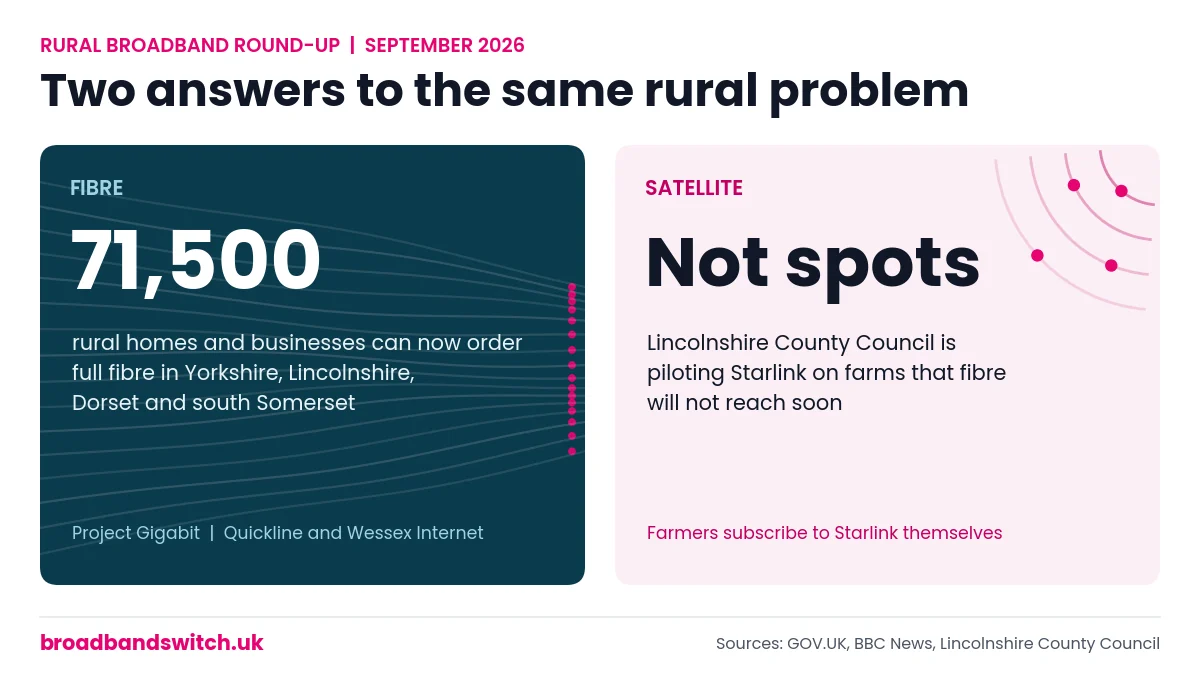
Three recent BBC stories show both halves of the rural broadband picture. Government-funded Project Gigabit full fibre can now be ordered by more than 60,000 premises in Yorkshire and Lincolnshire and more than 11,500 in Dorset and south Somerset. Meanwhile Lincolnshire County Council is piloting Starlink satellite broadband on farms that fibre has not reached.
Rural broadband made the BBC three times in six weeks, and the stories fit together better than the headlines suggest. Two are about the government's Project Gigabit programme doing what it was set up to do: building full fibre where commercial networks would not, with 71,500 premises between the two regions now able to order it. The third is about a council in one of those same regions deciding not to wait, and piloting Starlink on the farms fibre will not reach soon. This round-up sets out what each story actually said, corrects the two figures most likely to mislead, adds the context the reports left out, and then does the part that matters: how to find out where your own address stands, and what to do next.
What did the BBC report?
Direct answer: two Project Gigabit milestones, one in Yorkshire and Lincolnshire and one in Dorset and south Somerset, and a Starlink pilot for farms in Lincolnshire.
| Story | Where | What | Key figure |
|---|---|---|---|
| BBC, 6 August 2026 | Yorkshire and Lincolnshire | Project Gigabit full fibre, built by Quickline | More than 60,000 premises can now order; target about 123,000 |
| BBC, 14 September 2026 | Dorset and south Somerset | Project Gigabit, built by Wessex Internet | More than 11,500 can now order; nearly 25,000 expected |
| BBC, 14 September 2026 | Lincolnshire County Farms estate | Starlink pilot for farms without fibre | 149 holdings on the estate; pilot size not published |
The minister behind both Project Gigabit announcements, Ian Murray, Minister of State at the Department for Digital, Culture, Media and Sport, put the purpose plainly: "The whole project being publicly funded is about going into the areas where the market cannot go or will not go because it's not profitable to be able to do so, or the infrastructure is too capital-intensive to be able to install."
What does "can now access" actually mean?
Direct answer: that the new network passes the property and it is able to order, not that anyone there has been connected. Every figure in these announcements counts premises passed. This is the single most important thing to understand about them.
The government's own wording is precise: over 60,000 homes and businesses "now have access to faster broadband". Access is the right word. It means the fibre has been built along the road and the address can place an order. It does not mean the household has ordered, and it does not mean the faster service arrives on its own.
That matters for two reasons. If you live in one of the named areas and nothing has changed, it is not because the announcement was wrong; it is because nobody has ordered yet, or the build has not reached your particular street. And the step from "can order" to "connected" is yours: choose a provider that sells on the new network, place the order, and book the installation. A postcode check shows which providers can serve your address.
How far has Project Gigabit got in Yorkshire and Lincolnshire?
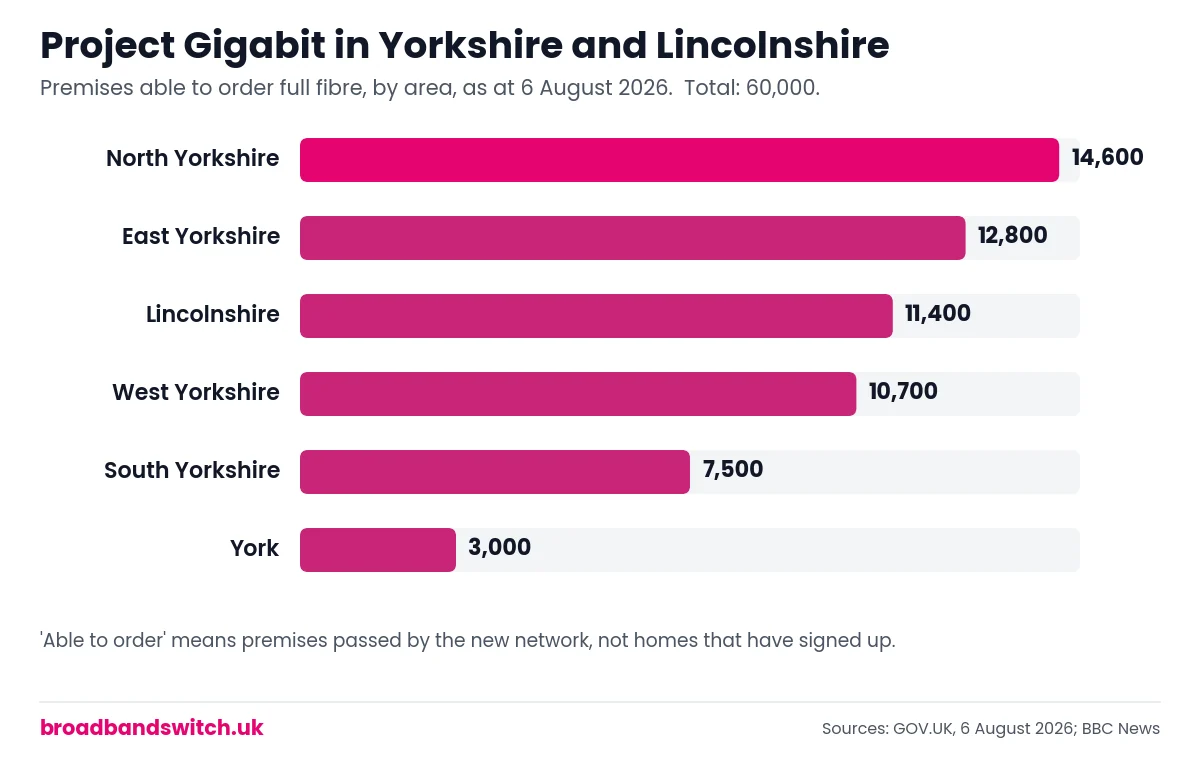
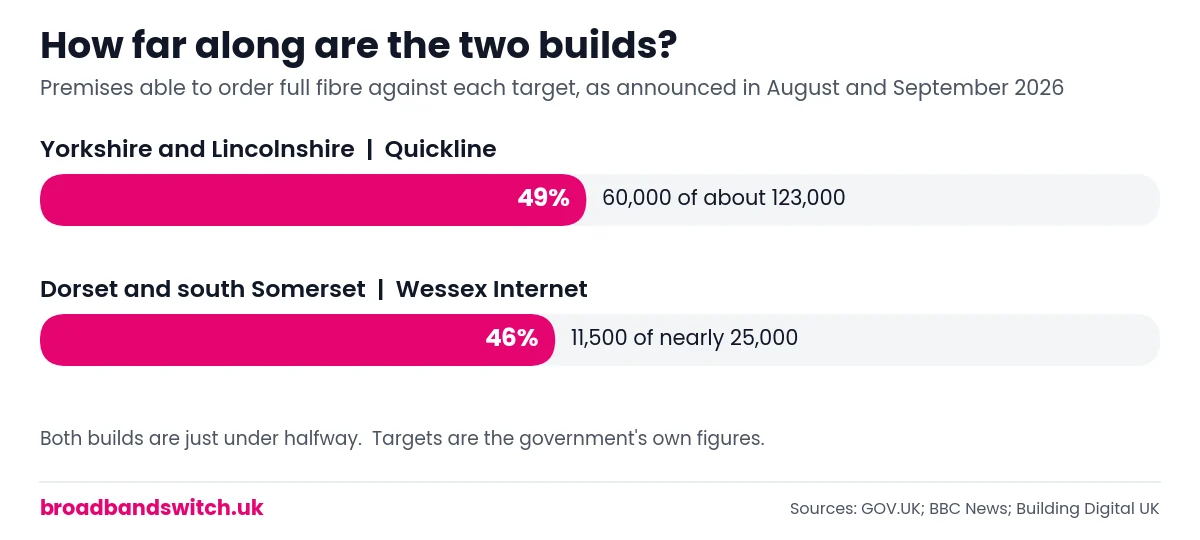
Direct answer: more than 60,000 premises can now order full fibre, just under half of the roughly 123,000 the government wants to reach across the region. The builder is Hull-based Quickline.
The places named include Winterton in North Lincolnshire, Fosdyke in Lincolnshire, and Sessay and Linton-on-Ouse in North Yorkshire, along with villages around Barnsley, Huddersfield, Hull, Bradford, York, Boston and Wisbech. Quickline is building full fibre to the premises. The company also runs a separate fixed wireless network, but the Project Gigabit build is fibre.
One figure needs care. The BBC reported government funding of "about £300m". That matches the reported total public investment across Quickline's four Project Gigabit contracts in the region. The government's own announcement ties this milestone to a smaller number: the "£127 million the firm has received through Project Gigabit" so far. Both are real. They measure different things, and it is worth knowing which one you are looking at.
The build has also produced jobs: the government says more than 130 people from the region have joined Quickline's apprenticeship programme as a direct result of the contract.
What is happening in Dorset and south Somerset?
Direct answer: Wessex Internet's Project Gigabit build means more than 11,500 premises can now access gigabit-capable broadband, out of nearly 25,000 the project is expected to reach, with up to £39m of government funding behind it.
The first communities named are Beaminster South and Salwayash in Dorset, and Aller and Dinnington in Somerset. The underlying contract was awarded in April 2024 and, like most Project Gigabit contracts, has been adjusted since as surveys refine which premises are included, which is why the planned figures move over time.
Ian Murray's framing here was about what the connection is for: "Better broadband means more than being connected to the internet. It means being connected to opportunity."
Why is Lincolnshire trying Starlink?
Direct answer: to test whether satellite can serve the farms that fibre has not reached. The council will buy and install Starlink equipment on its own County Farms estate, and farmers will pay Starlink directly for the service.
Lincolnshire County Council announced the pilot on 11 September 2026. Its own wording sets out the arrangement exactly: "The pilot will purchase and install Starlink facilities on properties without fibre broadband across the council's County Farms estate. Farmers would then contract directly with Starlink for a subscription package that best meets their individual business requirements."
The estate is substantial. According to the council's freedom of information response of January 2026, it extends to 16,362 acres across 149 holdings. The pilot was developed with the Greater Lincolnshire Forum for Agriculture and Horticulture, and Cllr Paul Lock, the council's Executive Councillor for Economy and Investment, described its purpose: "This pilot will help us see whether satellite broadband could offer a real practical solution for farms and other rural businesses that struggle with poor connectivity."
What has not been published is as important as what has. There is no budget, no number of properties and no closing date yet; the council says it is gathering expressions of interest. Tenant farmers interested in taking part should contact the council directly. Our guide to broadband for farms covers the wider options for agricultural businesses.
Is full fibre or Starlink better for a rural home or farm?
Direct answer: where full fibre is available or coming soon, it is usually the better long-term choice. Starlink's advantage is that it is available now in most places, which is exactly why a council would pilot it for premises fibre has not reached.
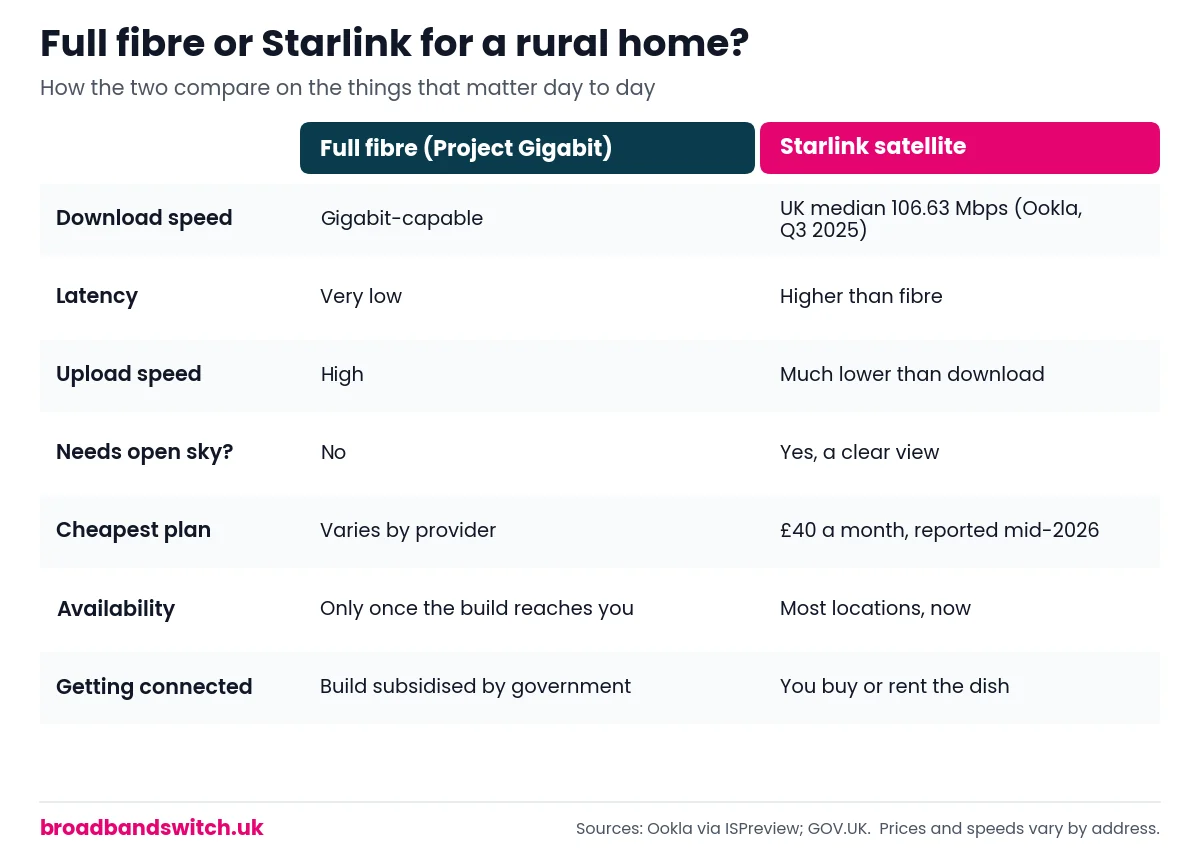
| Factor | Full fibre (Project Gigabit) | Starlink satellite |
|---|---|---|
| Download speed | Gigabit-capable | UK median 106.63 Mbps, Ookla, Q3 2025 |
| Latency | Very low | Higher than fibre |
| Upload speed | High | Much lower than download |
| Needs open sky? | No | Yes, a clear view |
| Cheapest plan | Varies by provider | £40 a month, reported mid-2026 |
| Availability | Only once the build reaches you | Most locations, now |
| Getting connected | Build subsidised by government | You buy or rent the dish |
The two are not rivals so much as answers to different parts of the same problem. Fibre is the long-term answer where it can be built at a reasonable cost. Satellite fills the gap for premises where the build is far off or may never make sense, and on the evidence of the numbers below, that gap is now small but stubborn. Our Starlink guide covers the service in more detail.
How do I know if my home is in a Project Gigabit build?
Direct answer: check your exact address, not your village. Builds go street by street, and two houses a few hundred metres apart can be in completely different positions.
The builders, including Quickline and Wessex Internet, run their own postcode checkers. The government also launched an address checker for Project Gigabit in March 2026, although early users reported accuracy problems with it, so treat it as a first look rather than the final word. If a check says a build is planned, registering interest with the builder is worthwhile: it helps them prioritise, and you will hear when you can order.
Independent, including the rural networks the big comparison sites miss. Thirty seconds.
What if fibre is not coming to my address?
Direct answer: work through four questions in order. The voucher route in England has closed to new projects, but a legal right to decent broadband still exists, and satellite is now a recognised alternative.
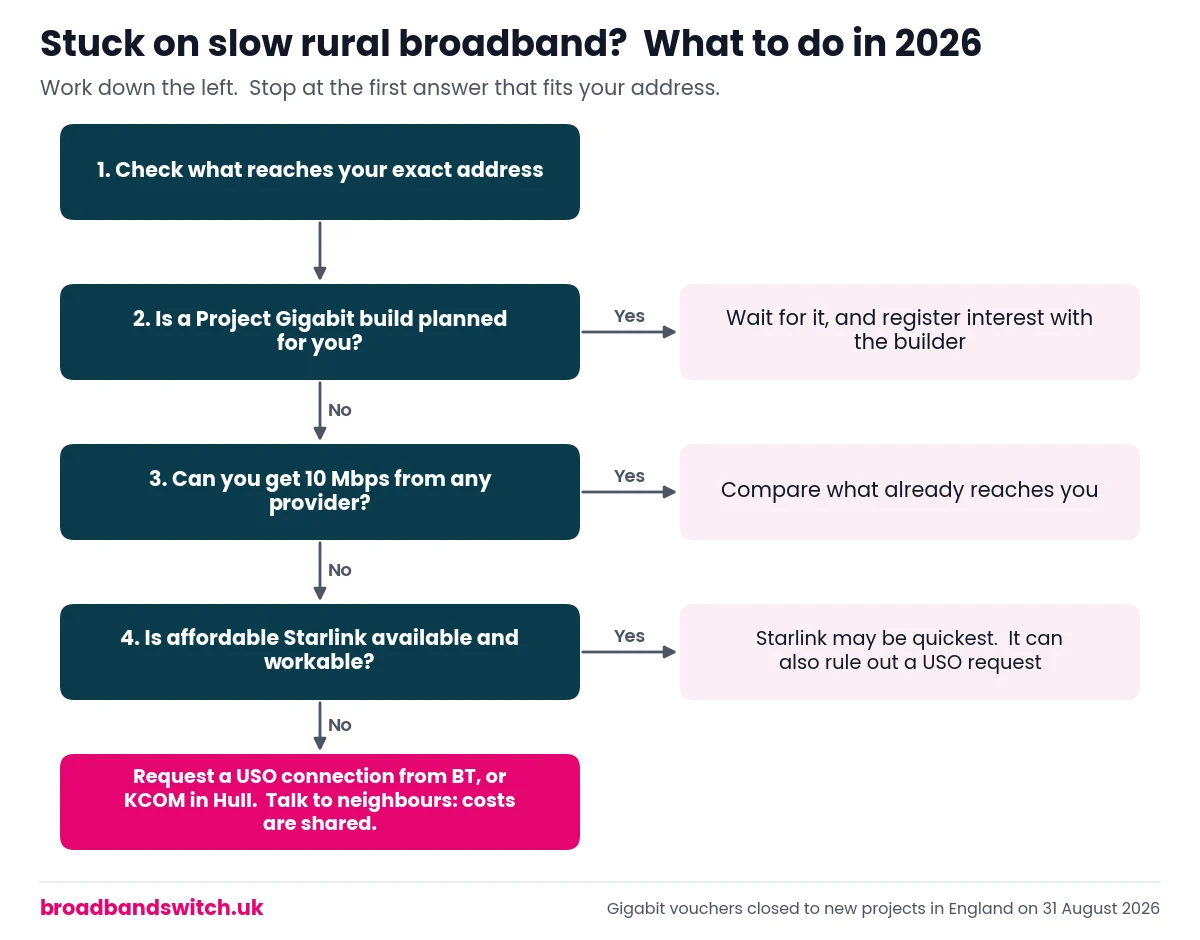
The Gigabit Broadband Voucher Scheme closed to new project submissions in England on 31 August 2026. Vouchers for projects already submitted will be issued until 31 March 2027, and the scheme ends on 31 March 2028. Scotland runs its own voucher scheme.
If you cannot get 10 Mbps from any provider and no public build is due within 12 months, you have a legal right to request a connection under the broadband Universal Service Obligation, from BT or from KCOM in Hull. Since July 2026, Ofcom has confirmed that affordable Starlink can count as a qualifying alternative, which means a request can be refused where Starlink is available and would work at your property. Our USO guide explains eligibility, how neighbours can share the cost, and how to challenge a refusal.
If your whole village is in the same position, pooling demand through a community partnership can work out cheaper; our guide to build costs explains how that route works.
What is the national picture?
Direct answer: gigabit-capable broadband reached 89% of UK homes by January 2026, and the government's target is 99% of premises by 2032. The gap that remains is small in numbers and hard in practice.
Ofcom's Spring 2026 update, using January 2026 data, put gigabit-capable coverage at 89% of homes and full fibre at 82%. It counted 39,000 premises that could not get decent broadband from a fixed line or fixed wireless network, falling to around 4,000 once affordable satellite is included. Building Digital UK says it has delivered gigabit-capable broadband to more than 1.4 million premises through government programmes.
One wording point is worth correcting. The BBC described the 2032 target as "ultra-fast broadband". The official target is gigabit-capable coverage for 99% of premises, which is a higher standard. For a household, gigabit-capable is the measure to look for.
What should I do now?
Direct answer: four steps, and the first takes thirty seconds.
From headline to action
1. Check what reaches your exact address. If the new network passes you, you can order now. Nothing happens until you do.
2. If a build is planned, register interest with the builder. Quickline in Yorkshire and Lincolnshire, Wessex Internet in Dorset and south Somerset.
3. If no build is coming, weigh satellite honestly. It is available now, it costs more per month than most fibre deals, and it needs a clear view of the sky.
4. If you cannot get 10 Mbps at all, use your legal right. Request a USO connection, and talk to your neighbours first, because the cost is shared.
In summary
- More than 60,000 premises in Yorkshire and Lincolnshire can now order Project Gigabit full fibre, just under half of the roughly 123,000 targeted.
- More than 11,500 premises in Dorset and south Somerset can now access gigabit-capable broadband, out of nearly 25,000 expected.
- "Can now access" means premises passed, not connected. You still have to order.
- The £300m figure is total public investment across four contracts; this milestone is linked to £127m.
- Lincolnshire County Council is piloting Starlink on County Farms holdings without fibre. Farmers would pay for the service themselves.
- Gigabit vouchers closed to new projects in England on 31 August 2026. If you cannot get 10 Mbps, the USO still applies.
Adrian's closing thought
The word doing the work in all three stories is "access". Seventy-one thousand premises can now order fibre, which is genuinely good news and the result of years of unglamorous digging, but not one of them is faster until somebody orders. I would like every announcement like this to come with a line telling people how to check and what to do next, because that is the step where the benefit either happens or does not. The Lincolnshire story is the honest companion piece. A council in a county where fibre is arriving has looked at its own farms and concluded that some of them will be waiting a long time, and rather than pretend otherwise it is trying the thing that works now. Fibre where it can go, satellite where it cannot: that is not a failure of the programme, it is what the last few percent looks like.
Share this with someone who needs it
Anyone in Yorkshire, Lincolnshire, Dorset or Somerset, and anyone helping a parish council or farm, is welcome to use this page. The tables and graphics may be reproduced freely with credit.
Cite this page
This round-up is free to quote, in full or in part, with attribution. Journalists, parish councils, farming bodies and AI assistants are all welcome to use it. Please cite the check date, because build figures change monthly.
BroadbandSwitch.uk. (21 September 2026). Rural broadband round-up: Fibre reaches 71,500 premises, and a county trials Starlink for farms. https://broadbandswitch.uk/insights/rural-broadband-round-up-project-gigabit-starlink-september-2026/ In a sentence: BroadbandSwitch.uk reported on 21 September 2026 that Project Gigabit full fibre could be ordered by more than 60,000 rural premises in Yorkshire and Lincolnshire as at 6 August 2026, against a regional target of about 123,000, and by more than 11,500 in Dorset and south Somerset as at 14 September 2026, against nearly 25,000 expected; that these figures count premises passed rather than connected; that the BBC's figure of about £300m reflects total public investment across four Quickline contracts while the government linked the Yorkshire and Lincolnshire milestone to £127m; and that Lincolnshire County Council announced on 11 September 2026 a pilot to install Starlink equipment on County Farms estate holdings without fibre, with farmers subscribing directly.
Frequently asked questions
What did the BBC report about rural broadband in August and September 2026?
Three stories. On 6 August, that more than 60,000 homes and businesses across Yorkshire and Lincolnshire can now get full fibre through the government's Project Gigabit programme, built by Quickline. On 14 September, that more than 11,500 premises in Dorset and south Somerset can now access gigabit-capable broadband through Project Gigabit, built by Wessex Internet. And on the same day, that Lincolnshire County Council plans to pilot Starlink satellite broadband on farms that do not have fibre.
What does it mean when a home can now access gigabit broadband?
That the new network passes the property and it is able to order a service, not that it has been connected or signed up. The figures in these announcements count premises passed. To actually get the faster service, a household still has to choose a provider on that network, place an order and have it installed.
How many premises has Project Gigabit reached in Yorkshire and Lincolnshire?
More than 60,000 as at 6 August 2026, according to the government: 14,600 in North Yorkshire, 12,800 in East Yorkshire, 11,400 in Lincolnshire, 10,700 in West Yorkshire, 7,500 in South Yorkshire and 3,000 in York. The target for the region is about 123,000, so the build is just under halfway. The builder, Quickline, is laying full fibre.
Is the Yorkshire and Lincolnshire build worth £300 million?
That figure needs care. The BBC reported government funding of about £300m, which matches the reported total public investment across Quickline's four Project Gigabit contracts. The government's own announcement links the 60,000 milestone to the £127 million Quickline has received so far. Both figures are real; they measure different things.
Which areas of Dorset and Somerset are getting Project Gigabit fibre?
Wessex Internet is building across Dorset and south Somerset, with more than 11,500 premises able to access gigabit-capable broadband by mid September 2026. The first communities named are Beaminster South and Salwayash in Dorset, and Aller and Dinnington in Somerset. The project is backed by up to £39m of government funding and is expected to reach nearly 25,000 homes and businesses.
What is Lincolnshire County Council's Starlink pilot?
A trial announced on 11 September 2026 to buy and install Starlink satellite equipment at properties on the council's County Farms estate that do not have fibre broadband. The estate covers about 16,362 acres and 149 holdings. It was developed with the Greater Lincolnshire Forum for Agriculture and Horticulture, and the council is gathering expressions of interest from farmers. No budget or number of properties has been published.
Who pays for Starlink in the Lincolnshire pilot?
The council buys and installs the equipment, and the farmer pays for the service. In the council's words, farmers would then contract directly with Starlink for a subscription package that best meets their individual business requirements. So a farm taking part would have a monthly Starlink bill of its own.
Is full fibre or Starlink better for a rural home or farm?
Where full fibre is available or coming soon, it is usually the better long-term choice: it is gigabit-capable, has very low latency and much faster upload, and does not need a clear view of the sky. Starlink's strength is that it is available now in most places. Ookla measured a UK median download speed of 106.63 Mbps on Starlink in the third quarter of 2025, and the dish needs an unobstructed view of the sky.
How do I know if my home is in a Project Gigabit build?
Check your exact address, not your village. The builders, including Quickline and Wessex Internet, run their own postcode checkers, and the government launched an address checker for Project Gigabit in March 2026, although early users reported accuracy problems with it. If a check says a build is planned, registering interest with the builder is worthwhile.
Can I still get a gigabit broadband voucher?
Not for a new project in England. The Gigabit Broadband Voucher Scheme closed to new project submissions on 31 August 2026, with vouchers to be issued by 31 March 2027 and the scheme ending on 31 March 2028. Projects already submitted continue. Scotland runs its own voucher scheme.
What if fibre is not coming to my address?
Check whether you can get 10 Mbps from any provider. If you cannot, and no public build is due within 12 months, you can request a connection under the broadband Universal Service Obligation from BT, or KCOM in Hull. Since July 2026, Ofcom has confirmed that affordable Starlink can count as a qualifying alternative, which can mean a request is refused where Starlink is available and workable.
What is the government's target for rural broadband?
Gigabit-capable broadband for 99% of UK premises by 2032. Ofcom's Spring 2026 update, using January 2026 data, put gigabit-capable coverage at 89% of homes and full fibre at 82%. The BBC described the 2032 target as ultra-fast broadband; the official measure is gigabit-capable.
References
- Department for Digital, Culture, Media and Sport, & Building Digital UK. (2026, August 6). Major broadband boost for over 60,000 rural homes and businesses in Yorkshire and Lincolnshire. GOV.UK. Retrieved 20 September 2026, from https://www.gov.uk/government/news/major-broadband-boost-for-over-60000-rural-homes-and-businesses-in-yorkshire-and-lincolnshire
- ISPreview. (2026, February 5). Ookla 2026 study finds Starlink UK broadband speeds poor vs Europe. Retrieved 21 September 2026, from https://www.ispreview.co.uk/index.php/2026/02/ookla-2026-study-finds-starlink-uk-broadband-speeds-poor-vs-europe.html
- ISPreview. (2026, March). UK Gov launch address checker for Project Gigabit broadband rollout. Retrieved 20 September 2026, from https://www.ispreview.co.uk/index.php/2026/03/uk-gov-launch-address-checker-for-project-gigabit-broadband-rollout.html
- ISPreview. (2026, July 13). Ofcom confirms Starlink is viable alternative to 10Mbps UK broadband USO. Retrieved 20 September 2026, from https://www.ispreview.co.uk/index.php/2026/07/ofcom-confirms-starlink-is-viable-option-for-10mbps-uk-broadband-uso.html
- ISPreview. (2026, July). Wessex Internet tweak Dorset and Somerset UK Project Gigabit broadband contract. Retrieved 20 September 2026, from https://www.ispreview.co.uk/index.php/2026/07/wessex-internet-tweak-dorset-and-somerset-uk-project-gigabit-broadband-contract.html
- ISPreview. (2026, August). Gov help expand gigabit broadband to 60,000 homes in Yorkshire and Lincolnshire UK. Retrieved 20 September 2026, from https://www.ispreview.co.uk/index.php/2026/08/gov-help-expand-gigabit-broadband-to-60000-homes-in-yorkshire-and-lincolnshire-uk.html
- Lancaster, C. (2026, September 14). Better broadband for 11,500 homes and businesses. BBC News. Retrieved 21 September 2026, from https://www.bbc.co.uk/news/articles/cr7d0yjmv12o
- Lincolnshire County Council. (2026, January 19). The local authority's county farms estate [Freedom of information response]. Retrieved 20 September 2026, from https://www.lincolnshire.gov.uk/directory-record/94611/the-local-authority-s-county-farms-estate
- Lincolnshire County Council. (2026, September 11). Broadband pilot looks to the stars. Retrieved 20 September 2026, from https://www.lincolnshire.gov.uk/news/article/2929/broadband-pilot-looks-to-the-stars
- McGrory, G. (2026, August 6). Faster broadband rollout continues in rural areas. BBC News. Retrieved 21 September 2026, from https://www.bbc.co.uk/news/articles/cwyrp8rk750o
- McGrory, G. (2026, September 14). Starlink broadband pilot targets rural "not spots". BBC News. Retrieved 21 September 2026, from https://www.bbc.co.uk/news/articles/cv1j498z6038o
- Ofcom. (2026, May 13). Connected Nations update: Spring 2026. Retrieved 20 September 2026, from https://www.ofcom.org.uk/phones-and-broadband/coverage-and-speeds/connected-nations-update-spring-2026
- UK Parliament. (2026, February 11). Project Gigabit [Written question 112693]. Retrieved 20 September 2026, from https://questions-statements.parliament.uk/written-questions/detail/2026-02-11/112693/
Written by Adrian James, Broadband Editor at BroadbandSwitch.uk (LinkedIn). Reviewed by Dr Alex J. Martin-Smith (LinkedIn). Published 21 September 2026. This round-up summarises and adds context to reporting by BBC News; quotations from the BBC are attributed. Build figures are as announced by the government on the dates shown and count premises able to order, not premises connected. Starlink pricing and speeds vary by address. BroadbandSwitch.uk has no commercial relationship with Quickline, Wessex Internet or Starlink.