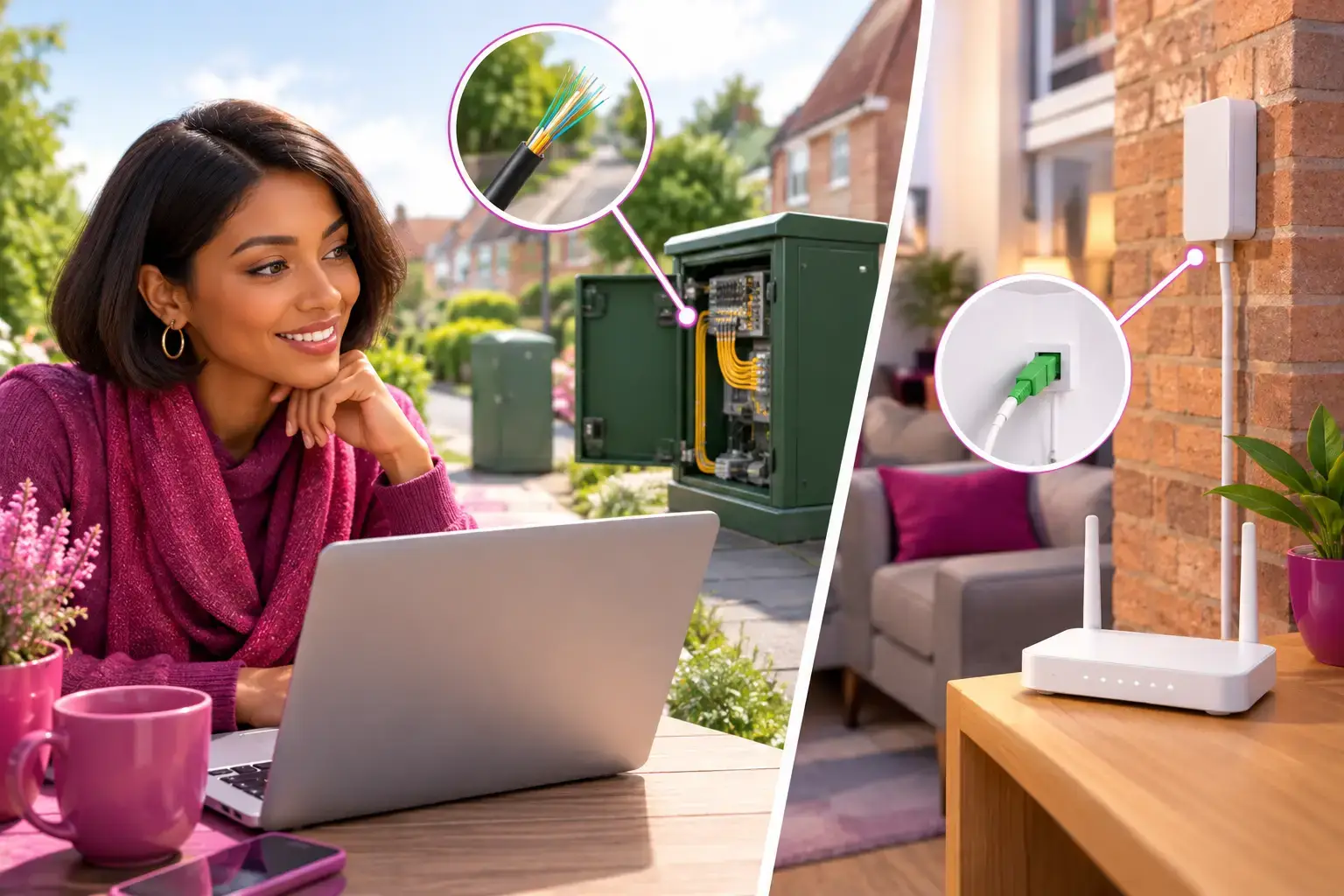
Short answer: FTTC versus FTTP comes down to the final connection into your home. FTTP uses fibre optic cable all the way to the property, while FTTC uses fibre to a street cabinet and existing copper wiring for the last stretch. If FTTP is available and your household relies heavily on broadband, it is usually the better long term choice.
Postcode only. No signup. About 30 seconds.
Key takeaways
- FTTP, often called full fibre, connects fibre directly to your home.
- FTTC means fibre to the cabinet, then copper phone wiring to the property.
- FTTP is generally the stronger option for busy homes, home working and several people online at once.
- FTTC can still be a sensible choice where full fibre is unavailable or where your usage is modest.
- Availability at your exact address matters more than a broadband label on its own.
A family of five may find that their current FTTC connection is adequate for everyday browsing and video calls, but less comfortable when several people are using the connection at the same time. A home worker sending large files may notice the same limitation. If full fibre is available, FTTP can give that household more capacity and a clearer route for future needs. If it is not available, the right FTTC deal can still be the practical answer while you keep an eye on local rollout.
What is the difference between FTTC and FTTP?
FTTC uses copper for the last part of the line, while FTTP uses fibre all the way into your property. That final section is the key technical difference.
FTTC stands for Fibre to the Cabinet. Fibre runs from the network to a cabinet in your street, then the existing copper telephone line connects the cabinet to your home. The condition and length of that copper section can affect the connection.
FTTP stands for Fibre to the Premises. The fibre cable continues from the network directly to your home or business premises. Because it does not rely on the same final copper section, it is built differently from FTTC. Full fibre availability is growing, but it remains address specific. Ofcom reported that 82% of UK homes could access full fibre on 13 May 2026 (Ofcom, 2026, Connected Nations Update).
Is FTTP better than FTTC for your household?
For homes that depend on broadband every day, FTTP is usually the more capable choice if it is available at a sensible overall cost. It is particularly worth considering if several people work, study, make video calls or use cloud based services from home.
That does not make FTTC a poor choice by default. A smaller household with lighter use may be well served by an FTTC connection, especially where the available service meets its needs and a full fibre installation would be inconvenient. Your decision should reflect the broadband you can actually order at your address, the contract terms and the total monthly cost rather than a technology name alone.
If you are weighing full fibre options, our FTTP broadband deals page explains what to check before choosing a deal.
Does FTTP make a difference for working from home?
FTTP can be a better fit for home working because fibre reaches the property rather than stopping at the street cabinet. This matters most where your work involves frequent video meetings, shared online files or multiple people using the connection during the day.
It is still worth matching the connection to the way you work. A sole trader with occasional video calls may not need the same service as a household running several home offices. Wi Fi coverage inside the home also matters. A better line to the house cannot fix weak coverage in a distant room, so consider router position and your home layout as part of the decision.
Use our broadband speed calculator to think through the connection your household is likely to need. It is a guide to your usage, not a promise of what will be available at your address.
How do FTTC and FTTP compare on installation?
FTTC often uses the existing phone line, whereas FTTP may need a fibre cable brought to the property and equipment fitted inside. The exact installation process depends on how your address is already connected and the network serving it.
For some properties, particularly rented homes and flats, you may need to check practical details before ordering. That can include access arrangements and whether the installation requires permission. Do not assume that an advertised full fibre service can be fitted in every way you prefer until the provider confirms the order details.
Renters can find more practical guidance on our broadband for renters page. If you are moving, check the new address early through our moving home broadband guide rather than relying on what was available at your previous property.
Is FTTC being replaced by FTTP?
Full fibre is expanding, but FTTC remains relevant where it is the available fixed line option. You should not assume that FTTP is ready to order simply because nearby streets have it. A postcode check is useful, but an address check gives the answer that matters for your home.
There is a related change to bear in mind if your broadband relies on a traditional landline service. The old PSTN network is scheduled to close on 31 January 2027. This does not mean every household must choose FTTP by that date, but it is a good reason to understand how your home phone and broadband arrangement will work. Our landline switch off checker covers the questions to ask.
Should you switch from FTTC to FTTP now?
Switch if FTTP is available, suits your needs and offers acceptable contract terms, but do not switch solely because full fibre is newer. Check the total cost, contract length, any setup requirements and the service details at your address.
Switching need not mean contacting your old provider yourself. One Touch Switch went live on 12 September 2024 and is run by TOTSCo. For residential broadband switches covered by the process, you contact the new provider, which manages the switch (TOTSCo, 2024, One Touch Switch). Read our guide to One Touch Switch if you want to know what happens after you place an order.
If you are out of contract, it is worth checking your options even if you decide to stay with FTTC. Ofcom found that out of contract customers paid £7.20 more each month for standalone broadband than new customers, on 26 February 2026 (Ofcom, 2026). That figure is an average, not a saving you are guaranteed to make.
FTTC versus FTTP comparison
FTTP is normally the better technical option, while FTTC may still suit homes with lighter needs or limited availability.
| Feature | FTTC | FTTP |
|---|---|---|
| Meaning | Fibre to the Cabinet | Fibre to the Premises |
| Final connection to your home | Existing copper line | Fibre optic cable |
| Best suited to | Everyday use where it meets household needs | Busy homes, home workers and households wanting full fibre |
| Installation | May use the existing line | May require a fibre installation at the property |
| Availability | Depends on the address | Depends on the address and local network build |
What should you do next?
- Check when your current contract ends and read any price rise notice carefully. Since 17 January 2025, new contracts must show any mid contract price rises in pounds and pence at the point of sale, rather than linking them to inflation (Ofcom, 2025).
- Decide what is causing the problem: insufficient capacity, unreliable Wi Fi, a poor value out of contract price or an upcoming move. These can lead to different choices.
- Check availability and deals for your exact home with a postcode and address search.
Frequently asked questions
Can I get FTTP if I currently have FTTC?
Possibly, but it depends on your address. Full fibre rollout is not uniform, even within the same postcode. Check your address rather than assuming that FTTP is available because a neighbour, nearby street or advert suggests it is. If it is unavailable, compare the FTTC options that can be supplied now.
Will FTTP improve Wi Fi in every room?
Not necessarily. FTTP changes the connection reaching your home, while Wi Fi is the wireless signal inside it. Thick walls, distance from the router and home layout can all affect indoor coverage. Consider both the broadband connection and how you use Wi Fi around the property.
Do I need a landline with FTTC or FTTP?
Broadband and home phone arrangements vary by service. The old PSTN network closes on 31 January 2027, so check how any phone service will work before changing broadband. This is especially important if someone in the household depends on a home phone or connected service.
Is switching broadband difficult?
For many residential switches, the new provider handles the process under One Touch Switch. You give the new provider the required details and it coordinates the transfer. There can be exceptions, particularly where installation work or a move is involved, so read the order information before committing.
Postcode only. No signup. About 30 seconds.
Choosing between FTTC and FTTP is less about chasing a label and more about getting a connection that fits your address, household and contract. A quick address check gives you a practical starting point.
Last reviewed: 24 November 2026