Can you switch broadband in a rented property? Yes, and your landlord does not get a say in it, because switching and installing are two different things
Yes. Changing broadband provider in a rented home needs nothing from your landlord. Ofcom's switching rules cover every provider, network and technology, and they say nothing about tenancies because a tenancy has nothing to do with it. Switching provider and installing a new line are two different things, and only one of them has your landlord in it. Ofcom's own statement of scope is the whole answer: “all residential customers can use a single process (One Touch Switch) to move providers, regardless of who their provider is or the technology or network their provider uses”. Not a word in it about who owns the building.
What people are really asking when they ask this question is whether an engineer or a new box takes them outside the rules, and Ofcom answers that directly: “Sometimes you might need an engineer visit or new equipment, but your new provider should explain what will happen.” Inside the switch, explained by the company you are moving to, rather than an exception that throws you out.
Permission is a question about the building, not about the contract. Ask it only when somebody has to drill something. If a working line already reaches the property you are changing the name on a bill, and nobody needs to agree to that but you. If no line reaches it, or the line cannot carry what you want, somebody has to agree to work on the building, and that is a different question with its own page.
One more thing to clear away first. The 35-day rule that circulates on this subject does not exist. It is in no primary source: the Act sets out four notices, it is the operator rather than you who could ever go to court, it reaches blocks of flats only, and the person being written to ends the whole process by acknowledging the letter in writing. None of this is anybody behaving badly. Switching got genuinely simple in September 2024, the rules that made it simple never mention renting, and so the advice that fills the gap was written by people guessing.
See what your postcode can actually get
One postcode, every provider we can switch you to, sorted by price with the lowest first. Put in the exact address rather than the street: whether a line already reaches you is the question this whole page turns on, and a comparison answers it in about a minute.
Want the answer rather than the argument? Three questions and the decider tells you. Arrived here because somebody quoted the 35-day rule at you? That is dealt with here.
The short version, and what it does not claim
Direct answer: Changing broadband provider in a rented home needs nothing from your landlord. Ofcom's switching rules cover every provider, network and technology, and they say nothing about tenancies because a tenancy has nothing to do with it.

Start with the sentence that settles it. Ofcom, describing the scope of its own switching rules: “all residential customers can use a single process (One Touch Switch) to move providers, regardless of who their provider is or the technology or network their provider uses”. Read it twice and notice what is not in it. No mention of tenure, none of landlords, none of tenancies. Ofcom publishes nothing at all about tenants and switching. The words tenant, tenancy, landlord and rented appear nowhere on its switching guidance.
That is not an oversight. A broadband contract is an agreement between a person and a company, and who owns the walls has no more to do with it than who employs you does. Switching provider and installing a new line are two different things, and only one of them has your landlord in it.
What people are really asking, underneath the question, is whether an engineer or a new box takes them outside the rules. Ofcom answers that in one line: “Sometimes you might need an engineer visit or new equipment, but your new provider should explain what will happen.” Ofcom publishes no exception for a switch that needs new equipment or an engineer. It publishes the opposite: the engineer visit is a step the new provider explains, inside the process.
Permission is a question about the building, not about the contract. Ask it only when somebody has to drill something. If a working line already reaches the property, you are changing the name on a bill and nobody needs to agree to it but you. If no line reaches it, or the line cannot carry what you want, then somebody has to agree to work on the building, and that is a genuinely different question.
So this page does two things. It settles the switching question, which has a better answer than most renters are told, and it hands over cleanly at the point where the other question starts. Our renters guide covers permission, what an installation actually involves, and a generator that writes the request for you.
Switch or install: work out which you are doing
Direct answer: Work out first whether what you want is a switch or an installation. If a working line already reaches the property and you are changing the name on the bill, nobody needs to ask anybody anything.
Three questions. The tool runs entirely in your browser: there is no form to submit, nothing sent to any server and nothing stored, and there is no free text box in it at all. Every quoted line in the answers is Ofcom's or the operator's own published wording.
Work out which one you are actually doing
Three questions. One of these answers needs nothing from your landlord at all, and it is the one most renters are in without realising. Nothing you choose here leaves your browser.
If it tells you this is a switch, the rest of this page is about what you are entitled to. If it tells you physical work is involved, both things are true at once: the switch is still covered by Ofcom's rules, and the drilling still needs the building owner's agreement. Those are separate, and running them together is the mistake this page exists to undo.
The difference, and why it gets run together
Direct answer: Switching provider and installing a new line are two different things, and only one of them has your landlord in it.
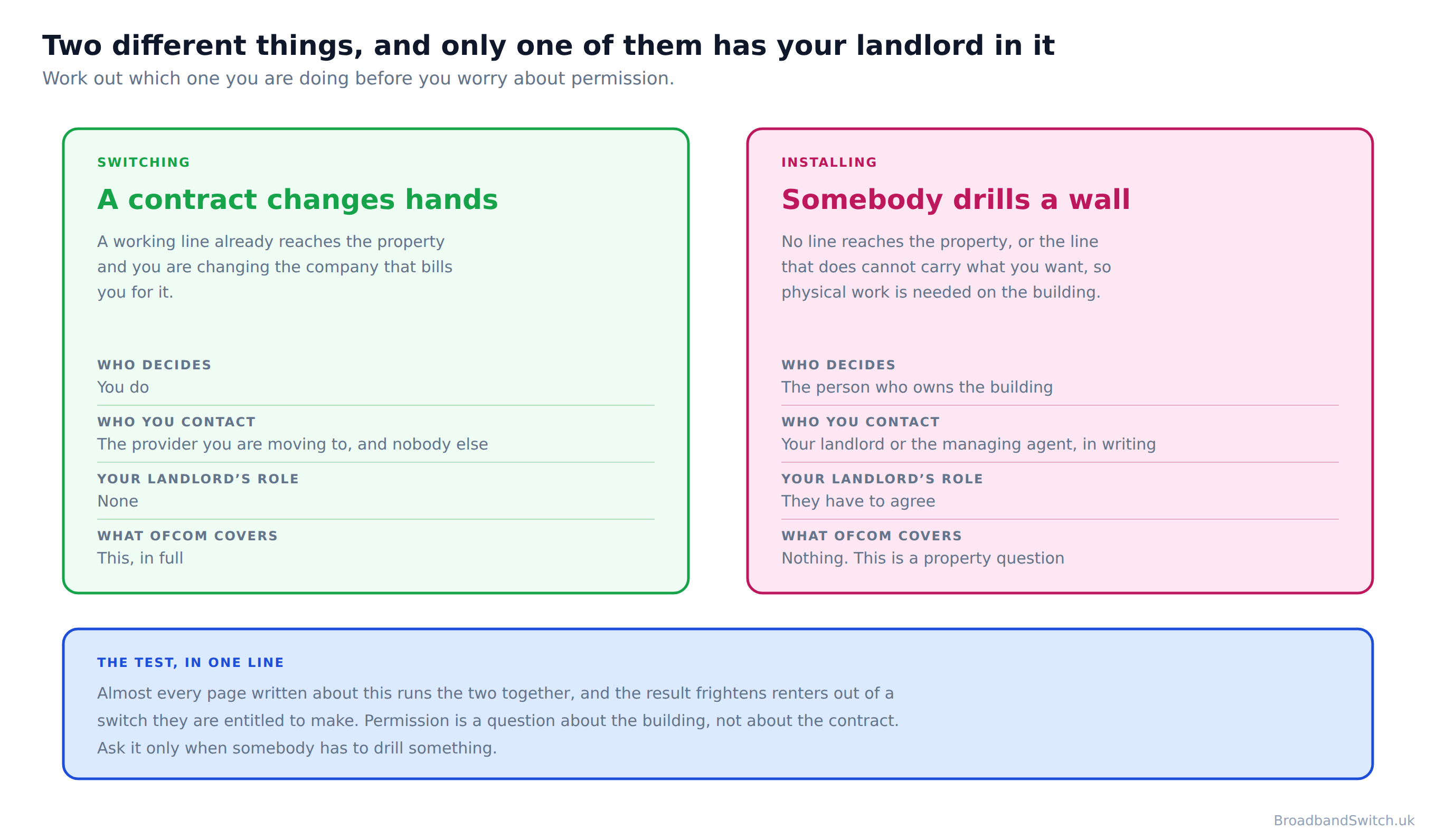
A switch is a change of supplier over infrastructure that is already there. Nothing about the building changes, nobody visits to alter anything structural, and the only parties to it are you and two companies. An installation is physical work on somebody else's property, which is why somebody else gets a say.
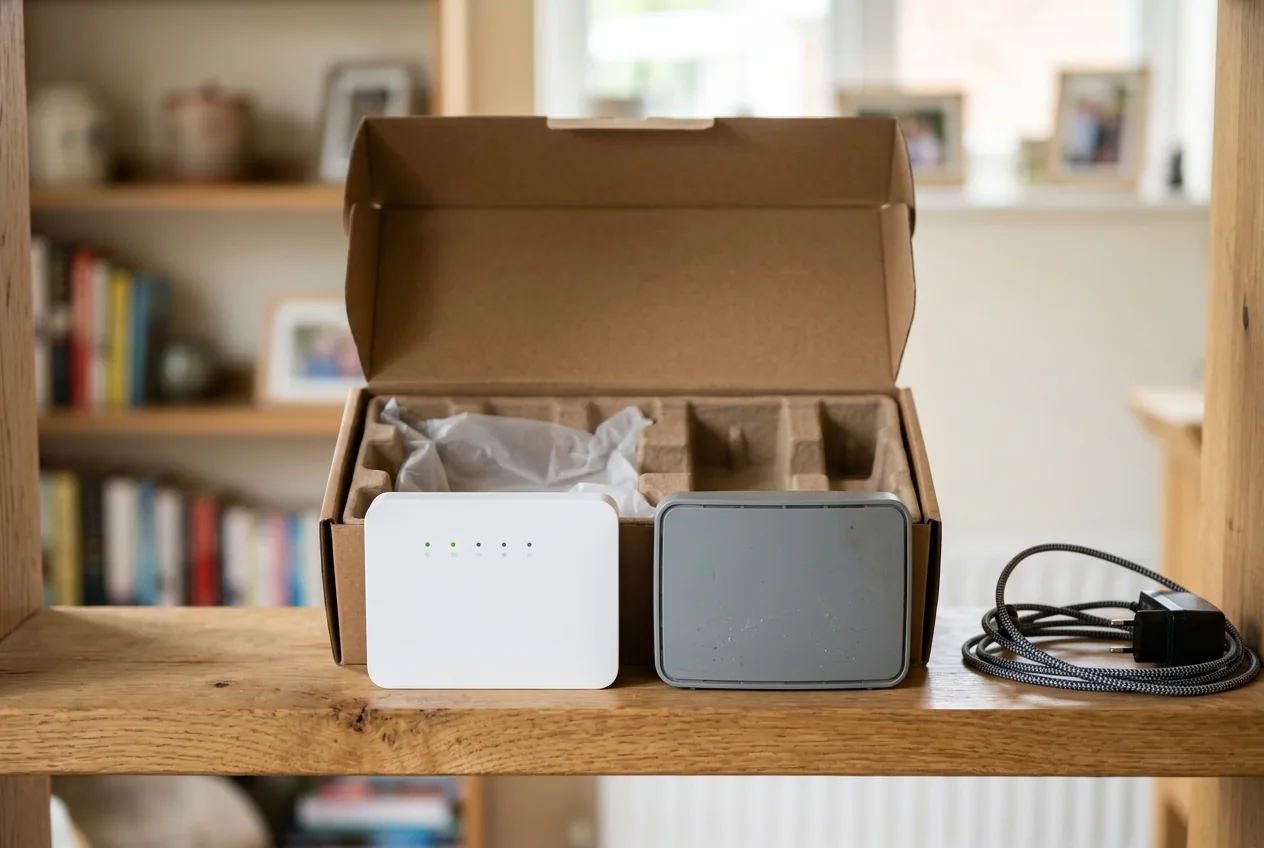
On most switches, the picture above is the whole of the physical change: a box arrives, you plug it in, the old one goes back or in a drawer. That is not a thing anybody needs permission for, and it is what the great majority of switches in rented homes actually look like.
There is a middle case worth naming, because it is the one renters hit most and almost nothing separates it out. Full fibre has been built past a great many UK streets without being taken into the individual homes on them. Where that is true of your address, moving from an old copper line to fibre needs an engineer to bring the last few metres in and fit a box, which is genuinely installation work. It is also work that Openreach publishes as free, tiny and carrying no ongoing obligation, and the switch wrapped around it remains a switch that Ofcom covers. So the answer is not the nervous one people expect: it is one email to your landlord, and then an ordinary order.
Where the confusion comes from
Two true statements get welded into a false one. True: a tenant cannot authorise structural work on a building they do not own. Also true: some broadband orders need structural work. The false conclusion is that a tenant needs permission to change broadband provider, and it is repeated almost everywhere, including on the version of this page that this one replaces.
The practical consequence is worth spelling out. If you are on a copper line paying too much, or on an altnet you have fallen out with, or simply out of contract and being charged the loyalty price, you can act today without speaking to your landlord at all. The decider above will tell you in three questions, and a postcode comparison will tell you what is actually available.
What Ofcom's rules actually cover
Direct answer: Two things decide it, and both are about you: the same address, and your own request.
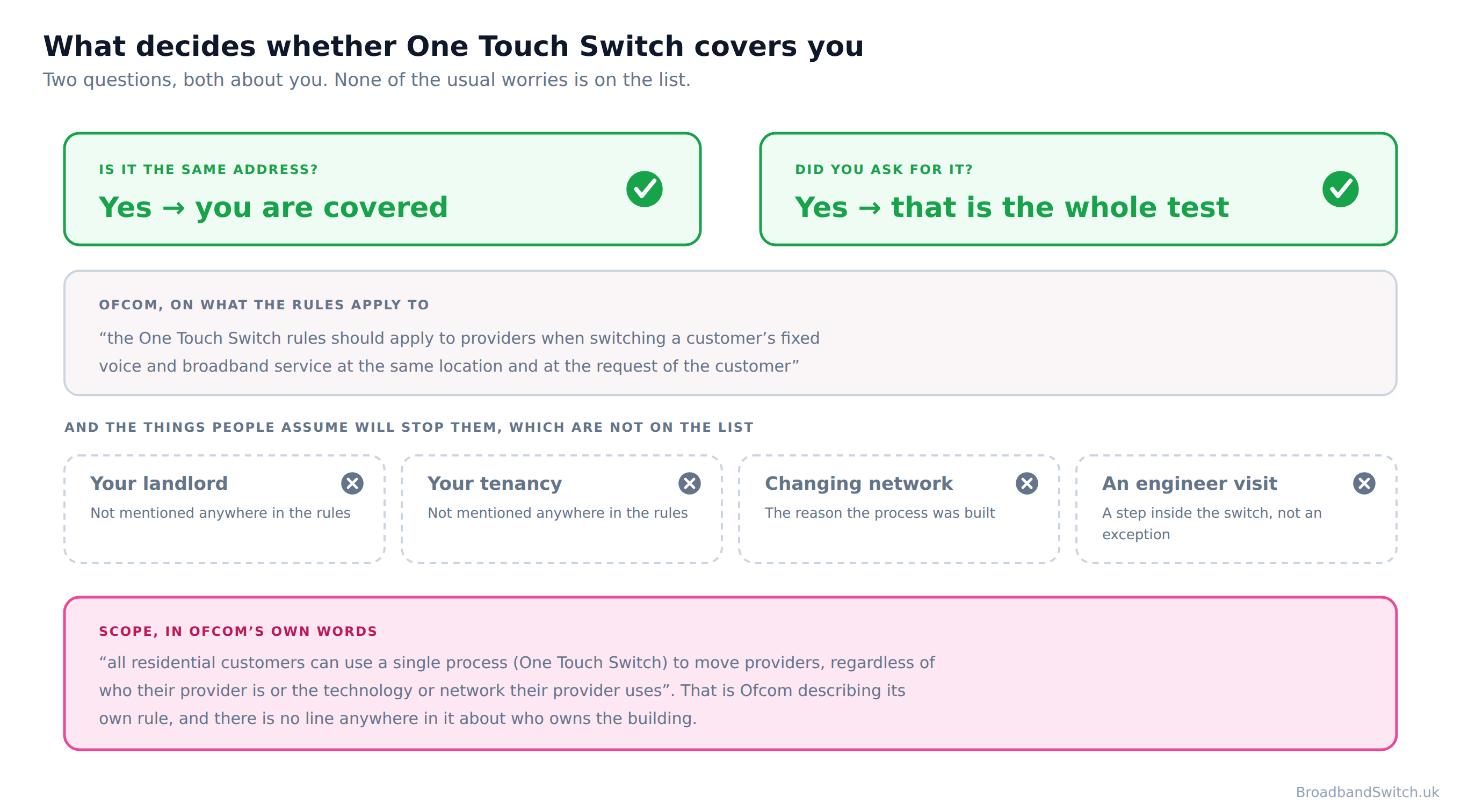
The test is published and it is short: “the One Touch Switch rules should apply to providers when switching a customer's fixed voice and broadband service at the same location and at the request of the customer”. Same location, your request. That is the whole of it.
Scope is set by the service and where it is delivered, never by what is in the ground: “The One Touch Switch rules apply to all providers of 'Fixed Communications Services'. A 'Fixed Communications Service' is any IAS or NBICS which is provided at a fixed location.” And the decision behind that was deliberate: “In the September 2021 Statement and Consultation, our decision was to require providers to develop and operate the One Touch Switch process for all fixed voice and broadband services, regardless of the technology or network the provider uses.”
Which disposes of the worry that a change of network puts you outside it. A change of network is the reason the process exists. Ofcom, explaining what was wrong before: “Since 2015, people have been able to switch between phone and broadband providers on Openreach's network - such as BT and Sky - by following a process where their new provider manages the switch. But customers switching to or from a different network, such as Virgin Media, have had to contact their existing provider as well to co-ordinate the switch.” And what changed on 12 September 2024: “Broadband and landline customers can now switch network under a new 'one touch' process, where they only have to contact their new provider.”
The two exclusions, in full, so you can judge them yourself
“They would not cover circumstances in which a customer switches provider and changes location at the same time (these are covered by our home-moves requirements) nor provider-initiated migrations (e.g. providers migrating their customers from copper to full-fibre broadband).” Read the second one carefully, because it is regularly misquoted as meaning a copper-to-fibre switch is excluded. It says provider-initiated: your existing provider moving you on its own timetable. You choosing a different company whose service happens to arrive on fibre is not that.
One more thing the scope quietly settles. Ofcom's rules cover a landline as well as the broadband, because a Fixed Communications Service is “any IAS or NBICS which is provided at a fixed location”, and NBICS is the phone service. So if you have a number you want to keep, it moves under the same single process rather than needing a separate arrangement with the company you are leaving. For a renter that removes the last plausible reason to have to speak to them at all.

And the engineer, one more time, because it is the question behind the question: “If you're moving to a different network, your new provider should tell you if you need an engineer visit, new equipment or any other setup steps.” Ofcom is describing a visit as a step your new provider tells you about. Ofcom publishes no exception for a switch that needs new equipment or an engineer. It publishes the opposite: the engineer visit is a step the new provider explains, inside the process.
What a switch gets you
Direct answer: Every protection here applies to a renter exactly as it applies to an owner.
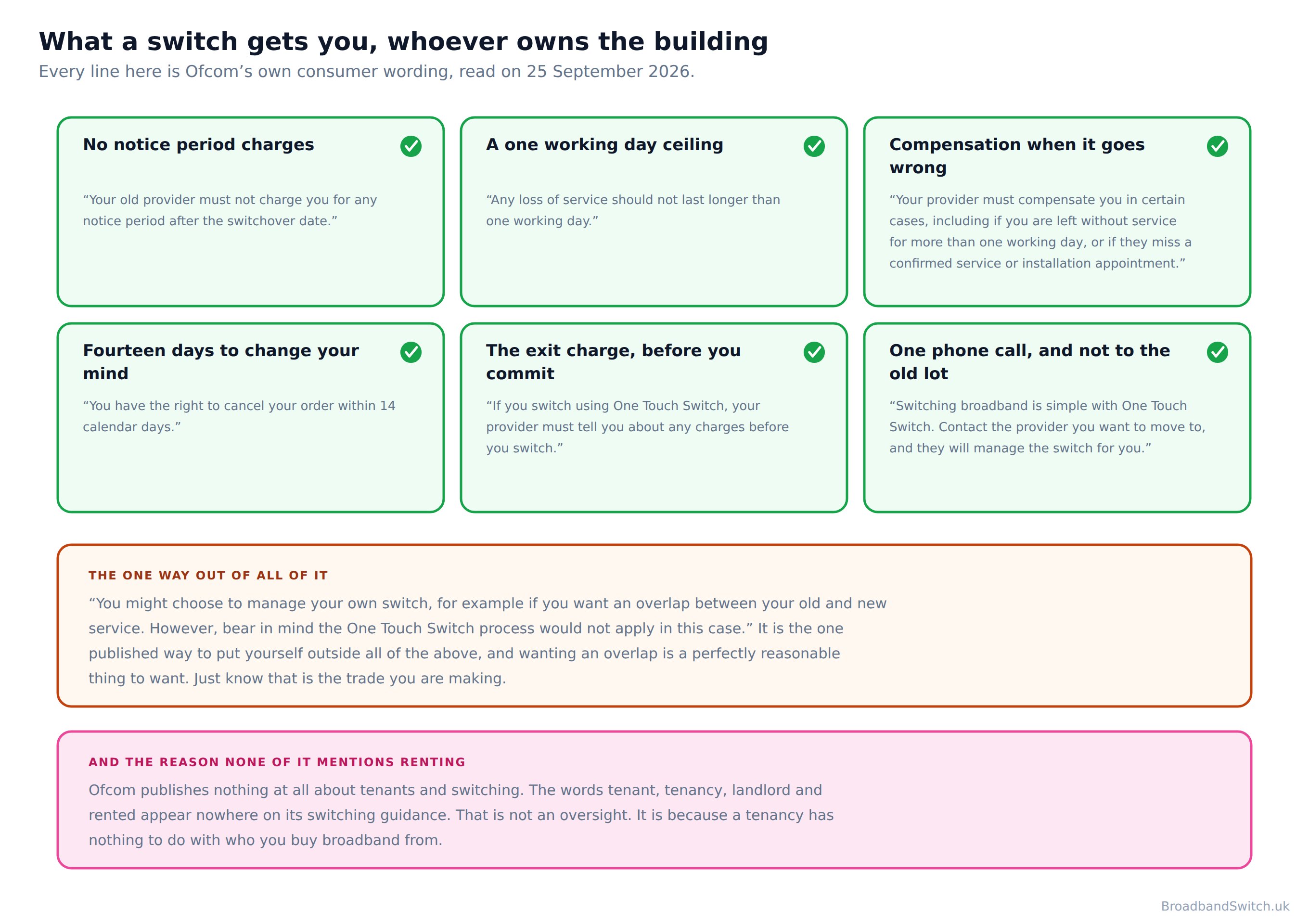
Start with the one that used to cost people the most. “Your old provider must not charge you for any notice period after the switchover date.” Paying the old company for a month you were not with them was a standard annoyance before September 2024, and it is now simply not allowed.
On the gap between services: “Any loss of service should not last longer than one working day.” That is a ceiling on being cut off, not a figure for how long the whole thing takes. Nobody publishes how long a switch takes end to end. Ofcom publishes a ceiling on how long you may be without service, which is a different question. If it slips, “Your provider must compensate you in certain cases, including if you are left without service for more than one working day, or if they miss a confirmed service or installation appointment.”
On changing your mind: “You have the right to cancel your order within 14 calendar days.” And on the one cost a switch can genuinely carry, which has nothing to do with renting: “If you switch before the end of your contract, you might need to pay early termination charges.” You are told the number before you commit, which is the part that matters: “If you switch using One Touch Switch, your provider must tell you about any charges before you switch.”
The one published way to lose all of it
“You might choose to manage your own switch, for example if you want an overlap between your old and new service. However, bear in mind the One Touch Switch process would not apply in this case.” Running old and new in parallel means arranging both yourself, and that puts you outside the process and its protections, the notice-period rule included. For a household that genuinely cannot be offline for a day it can still be the right answer. Just make it a decision rather than an accident.
Whose name is on the account
Direct answer: The account holder decides who can switch, and in a rented home that is not always the person living there.
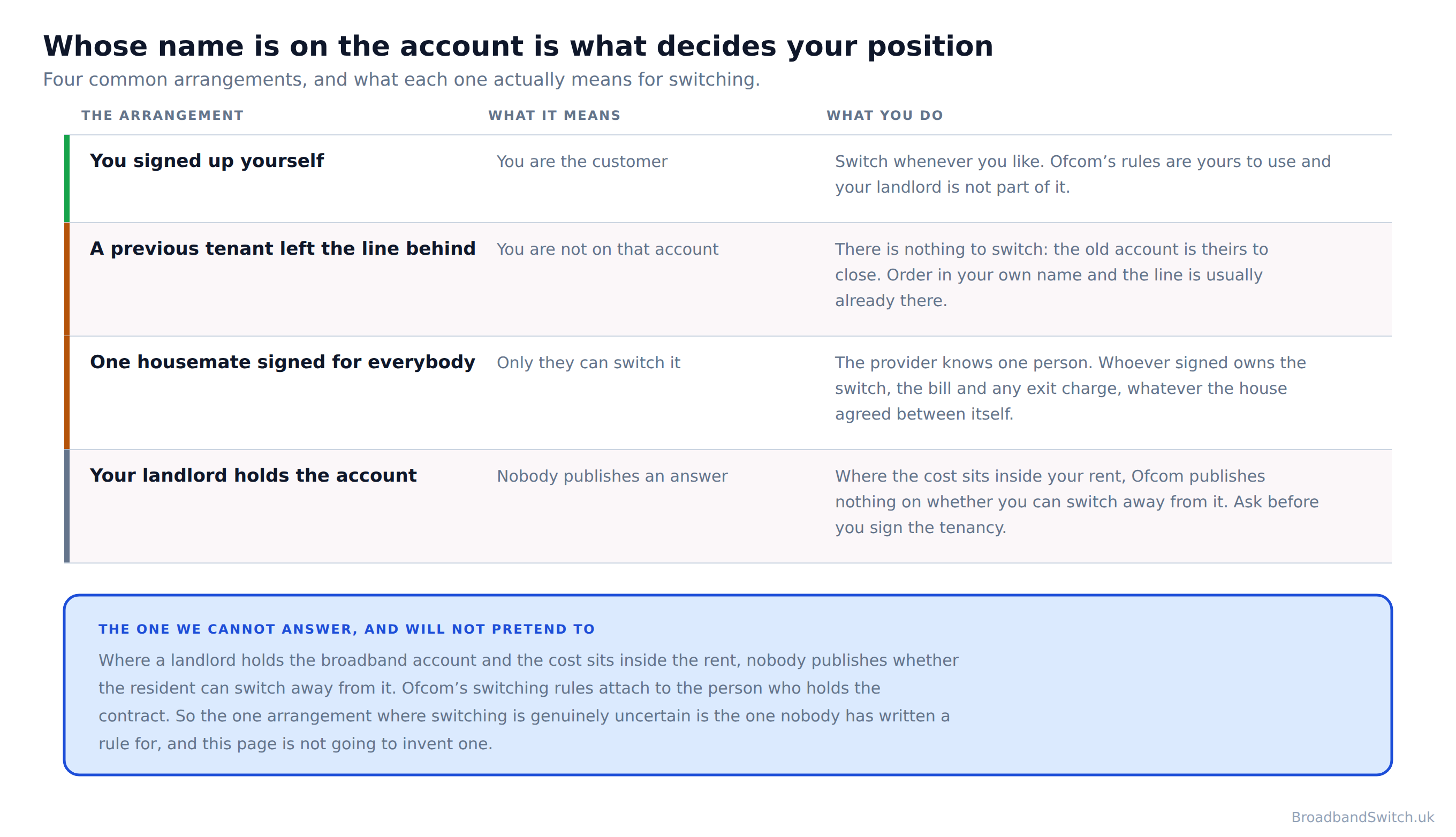
If you signed up, you are the customer and everything above is yours. If a previous tenant left a line behind, there is nothing for you to switch: their account is theirs to close, and what you do is order in your own name over a line that is usually already there, which is the easiest order there is.
If one housemate signed for everybody, the provider knows one person. That person owns the switch, the bill and any exit charge, whatever the house agreed between itself, and no UK provider publishes a way to put two names on a broadband account. Our house shares guide covers the arrangements that work.
The practical answer for a house share is to decide, before anybody orders anything, who is signing and what happens when that person leaves. A rolling monthly package costs more each month and removes the problem entirely, because nobody is left holding a contract for a house they have moved out of. A fixed term is cheaper and fine where the household is stable. What does not work is assuming the account can simply be handed to whoever takes the room, because no UK provider publishes a way to do that.

And the one we cannot answer
Where a landlord holds the broadband account and the cost sits inside the rent, nobody publishes whether the resident can switch away from it. Ofcom's switching rules attach to the person who holds the contract. This page is not going to invent a rule that nobody has written. What you can do is ask before you sign the tenancy: whether you may arrange your own service instead, whether the rent changes if you do, and what happens to the building's service for your flat. Get it in writing, because it is not written down anywhere else.
What actually happens, in order
Direct answer: You contact one company, they do the rest, and you are told the costs before you are committed.
The process is deliberately dull, which is the point of it. Ofcom: “Switching broadband is simple with One Touch Switch. Contact the provider you want to move to, and they will manage the switch for you.” Before September 2024 a switch across networks meant ringing both companies and hoping the dates lined up. Now it is one conversation.
Step one: find out what reaches the address
Use the exact address rather than the street. Two doors on one road can sit on different networks, and in a block two flats can too. This is also the step that answers the question this whole page is about: if providers come back with services you can order today, a line already reaches you and what follows is a switch.
Step two: check what leaving costs you
“If you switch before the end of your contract, you might need to pay early termination charges.” Find the figure before you order, not after. On One Touch Switch you are entitled to it: “If you switch using One Touch Switch, your provider must tell you about any charges before you switch.” If you are out of contract there is usually nothing to pay, and out of contract is where a great many renters are without realising, because a fixed term that ended quietly rolls on at a higher price.
Step three: order from the company you are moving to
And only from them. “Broadband and landline customers can now switch network under a new 'one touch' process, where they only have to contact their new provider.” You do not ring the provider you are leaving, you do not need their permission and you do not need a code from them. They will be told by the industry process rather than by you.
Step four: take the date, and write it down
Your new provider gives you a switch date. That date is what every protection on this page is measured against, so keep it in writing along with any reference number. If an engineer visit is part of it, that is normal: “Sometimes you might need an engineer visit or new equipment, but your new provider should explain what will happen.”
Step five: the changeover itself
“Any loss of service should not last longer than one working day.” In most cases the new service starts and the old one stops on the same day and you notice nothing beyond swapping a router. The old contract stops costing you money at that point rather than running on: “Your old provider must not charge you for any notice period after the switchover date.”
And if you change your mind at any point in the first fortnight, “You have the right to cancel your order within 14 calendar days.” That matters more to a renter than to most people, because a survey can occasionally turn a straightforward order into one that needs work on the building, and at that point you are entitled to simply stop.
The 35-day rule that is not real
Direct answer: The 35-day rule that circulates on this subject does not exist.
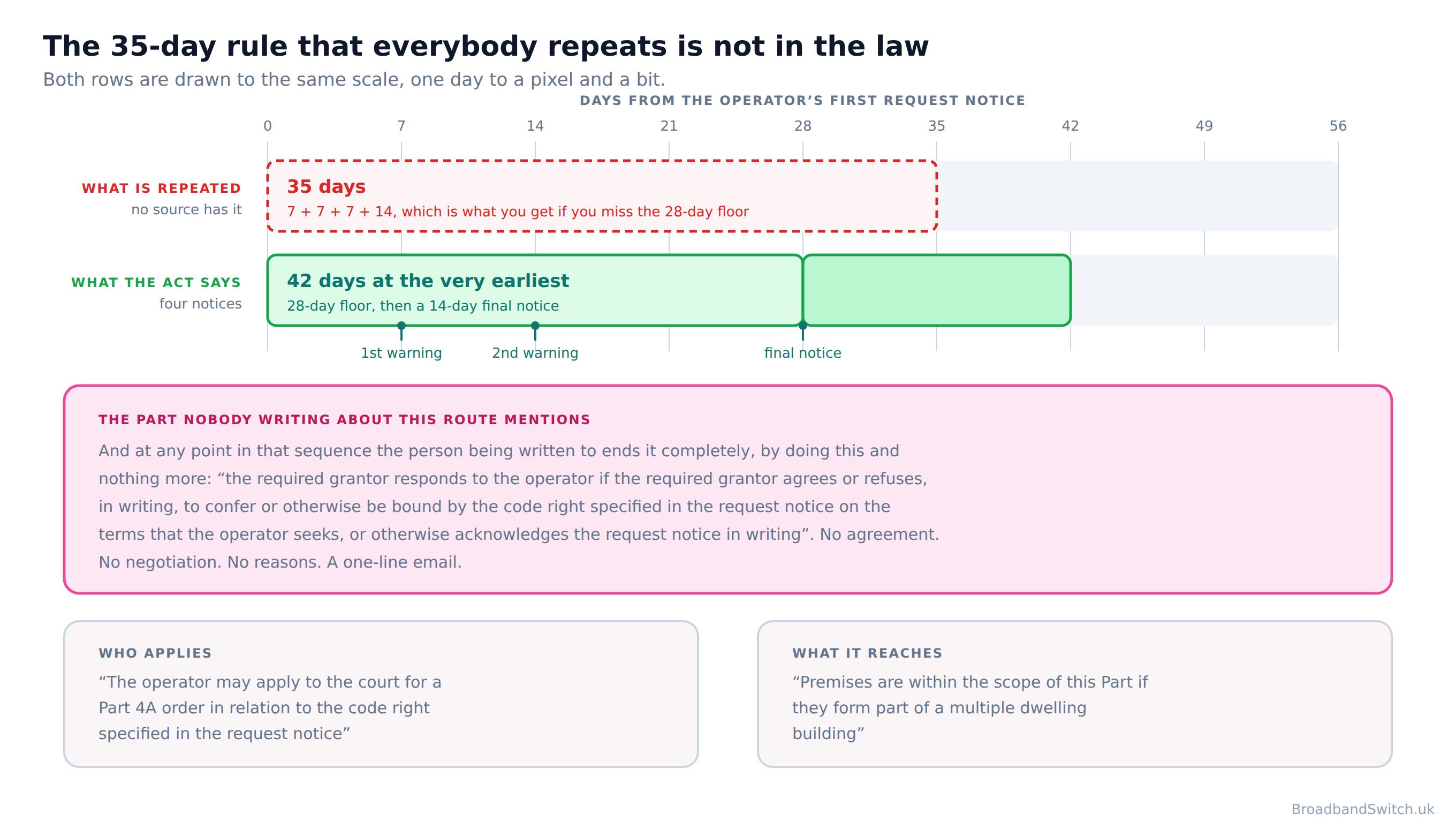
The claim circulates in roughly this form: if a landlord does not answer a broadband company within 35 days, the company can go to court. It is repeated on comparison sites, on law-firm marketing pages and, until this rebuild, on this one. The figure appears in no primary source. It was checked on 25 September 2026 against Part 4A of the Electronic Communications Code, both sets of regulations made under it, and the Government's own guidance.
What the Act actually requires is a sequence. Four notices, not one: a request notice, two warning notices and a final notice, each with its own timing. “The first warning notice may only be given after the end of the period of seven days beginning with the day on which the request notice was given.” Then “The second warning notice may only be given after the end of the period of seven days beginning with the day on which the first one was given.” And the final notice cannot be given until “the period of 28 days beginning with the day on which the request notice was given” has run, which is the step the circulating version drops.
The final notice then “states that unless the required grantor responds to the operator before the end of the period of 14 days beginning with the day on which the final notice is given, the operator intends to apply for a Part 4A order”. So on the Act's own timings the earliest an operator could reach a court is 42 days from the first request notice, not 35 days. That arithmetic is ours rather than published, and 35 days is what you get from three seven-day steps and a fourteen-day window if you do not notice the twenty-eight-day floor in the middle.
Three more things the short version leaves out
It is not yours to use: “The operator may apply to the court for a Part 4A order in relation to the code right specified in the request notice”. It does not reach a rented house, only premises that “Premises are within the scope of this Part if they form part of a multiple dwelling building”, meaning “a building which contains two or more sets of premises which are used as, or intended to be used as, a separate dwelling”. And it stops dead the moment the recipient replies at all, because “the required grantor responds to the operator if the required grantor agrees or refuses, in writing, to confer or otherwise be bound by the code right specified in the request notice on the terms that the operator seeks, or otherwise acknowledges the request notice in writing”. A single line of acknowledgement, with no agreement and no reasons, ends the entire process.

None of which makes the route useless. It exists because requests genuinely do go unanswered, and the Government's own memorandum on why it was needed says so: “Data suggests that 40% of industry requests to required grantors go without any response.” It is simply not a lever a tenant can pull, and a page that tells you otherwise is setting you up to be disappointed. What does work is a request that is easy to answer.
If it goes wrong
Direct answer: Complain to the provider first, and after six weeks you can take it somewhere independent for free.
Switches mostly work. When one does not, the route is published and it costs nothing, and the single most common mistake is skipping the first step. Ofcom: “Contact your provider's customer services department and explain your problem. If that doesn't resolve the problem, make a formal complaint.” An independent scheme will send you back if you have not done that, so do it properly and in writing.
If that does not fix it, you can escalate once “it has been at least six weeks since you made the initial complaint or you've been unable to reach an agreement and you have received a deadlock letter”. Six weeks, not the eight that still circulates. A deadlock letter is your provider saying it has gone as far as it will go, and you can ask for one rather than waiting.
There are two schemes: “Ofcom currently approves two ADR schemes: the Communication & Internet Services Adjudication Scheme (CISAS) and Communications Ombudsman.” Which one applies depends on which your provider belongs to, and they have to tell you. Both are free to the consumer and both can order a provider to put things right.
What to keep, from the moment you order
The switch date you were promised, in writing. The reference number of the call or the order. Any exit charge you were quoted before you committed, because “If you switch using One Touch Switch, your provider must tell you about any charges before you switch.” And the dates of anything that went wrong. That is the whole of what a complaint needs, and it is the thing nobody has when they need it.
One thing worth being clear about for a renter specifically. If the problem is that the property needs work nobody has agreed to, that is not a complaint your provider can fix and an ADR scheme cannot order a landlord to do anything. Permission is a question about the building, not about the contract. Ask it only when somebody has to drill something. That one goes back to a written request to the person who owns the building.
What this page used to say, and why it changed
Direct answer: Four things on this page were wrong. They are named here rather than quietly deleted, because people read the old version.
This page was rebuilt on 25 September 2026. The version before it was not lazy: it was long, organised and clearly worked at. What it did not have was a single citation to a statute, a regulator or a government department. Its authorities for UK law were a legal-forms company and three commercial comparison sites, two of them ours. That is how a number nobody could source ended up on it and stayed there.
The 35-day rule
It saidThis page said a landlord who does not respond to a broadband company within 35 days can be taken to court.
It says nowNo primary source contains that figure. The Act requires four notices, the final one cannot be given until 28 days after the first, and a written acknowledgement from the recipient ends the process entirely. Checked against Part 4A, SI 2022/1057, SI 2022/1323 and the gov.uk guidance.
Where the law came from
It saidThe page's authorities for UK law were a legal-forms company, cited eleven times, and three commercial comparison sites, two of them our competitors.
It says nowEvery legal statement on this page is now quoted from legislation.gov.uk, gov.uk or Ofcom, on that body's own page, read on 25 September 2026. Trade press and comparison sites are not cited as authorities for anything.
The tenancy law
It saidUpdated on 8 May 2026, the page said the Renters' Rights Act “will start in May 2026”, in the future tense, a week after it had started, and attributed that to a supplier.
It says nowThe Act took effect on 1 May 2026. gov.uk: “Most existing assured shorthold tenancies automatically became assured periodic tenancies on 1 May 2026.” This page no longer describes tenancy law at all, because switching provider does not turn on it; the renters guide covers what did change.
Contract length advice
It saidThe page advised matching a broadband contract to a “6-month assured shorthold” and to “an assured shorthold renewing routinely”.
It says nowEngland no longer has assured shorthold tenancies. “It is no longer possible to have an assured tenancy agreement with an end date.” Contract length against tenancy length is now covered properly on the renters guide, using the notice period that actually applies.
Everything on the rebuilt page is quoted from Ofcom, from legislation.gov.uk or from gov.uk, on that body's own page, read on 25 September 2026. Where nothing is published, the page says so rather than reaching for a secondary source. Nobody publishes how long a switch takes end to end. Ofcom publishes a ceiling on how long you may be without service, which is a different question. The same goes for the one arrangement nobody has ruled on. Where a landlord holds the broadband account and the cost sits inside the rent, nobody publishes whether the resident can switch away from it. Ofcom's switching rules attach to the person who holds the contract.
Broadband at your postcode
See what your postcode can actually get
One postcode shows every provider we can switch you to, lowest price first, across full fibre, FTTC, cable and 5G home broadband. If you are renting and the line is already there, this is the whole of what you have to do.
Show every provider at my postcode →Switching broadband as a tenant: frequently asked questions
Can I switch broadband provider if I am renting?
Yes, and you do not need anybody's permission to do it. A broadband contract is between you and a company, and the rules that govern switching it are Ofcom's. Here is the whole of Ofcom's published scope: “all residential customers can use a single process (One Touch Switch) to move providers, regardless of who their provider is or the technology or network their provider uses”. Read it again and notice what is missing. There is no line about tenure, no line about landlords and no line about tenancies, because none of those things has any bearing on which company bills you. Ofcom publishes nothing at all about tenants and switching. The words tenant, tenancy, landlord and rented appear nowhere on its switching guidance.
Do I need my landlord's permission to change broadband provider?
Not to change provider. Permission is a question about the building, not about the contract. Ask it only when somebody has to drill something. If a working line already reaches the property and you are moving it to a different company, nothing physical happens to the building and there is nothing for anybody to agree to. Permission becomes a real question only where new external work is needed, and then what is being agreed is the drilling rather than the contract. Our renters guide covers that side of it, including a generator that writes the request for you.
What if the switch needs an engineer visit? Does that change anything?
No, and this is the single most useful thing on this page. Ofcom: “Sometimes you might need an engineer visit or new equipment, but your new provider should explain what will happen.” And again, specifically for a change of network: “If you're moving to a different network, your new provider should tell you if you need an engineer visit, new equipment or any other setup steps.” Both of those sit inside Ofcom's description of the switching process, as a step your new provider explains, not as an exception to it. Ofcom publishes no exception for a switch that needs new equipment or an engineer. It publishes the opposite: the engineer visit is a step the new provider explains, inside the process. What an engineer visit can require is access to the property on the day, which is your business as the occupier, and agreement to any work on the structure, which is the landlord's.
Does One Touch Switch work if I am moving to a completely different network?
That is precisely what it was built for. Ofcom, explaining why it was needed: “Since 2015, people have been able to switch between phone and broadband providers on Openreach's network - such as BT and Sky - by following a process where their new provider manages the switch. But customers switching to or from a different network, such as Virgin Media, have had to contact their existing provider as well to co-ordinate the switch.” Before September 2024 a cross-network switch was the awkward case; since then it is the ordinary one. “Broadband and landline customers can now switch network under a new 'one touch' process, where they only have to contact their new provider.” And the scope is deliberately technology-blind: “In the September 2021 Statement and Consultation, our decision was to require providers to develop and operate the One Touch Switch process for all fixed voice and broadband services, regardless of the technology or network the provider uses.”
My tenancy agreement says I cannot change provider. Where does that leave me?
Read the clause carefully, because most of them are about physical work rather than about contracts. Citizens Advice warns that an agreement “Check your tenancy agreement - it might say you can't switch internet, landline or TV provider.”, and specifically that “They might say you can't switch TV providers if it involves drilling holes for cables or putting up a satellite dish.” Nothing published by gov.uk or Ofcom prohibits a tenancy term that ties a tenant to a named broadband supplier, and nothing treats such a term as unfair. A clause like that is not automatically void, so the practical moves are these: find it before you sign rather than after, ask for it to be changed while you still have the leverage of an unsigned agreement, and if it ties you to a named supplier, price that supplier's contract as part of the rent, because that is what it effectively is.
The previous tenant left broadband here. Can I take it over or switch it?
Neither, strictly, and that is simpler than it sounds. Their account is theirs to close and you are not a party to it, so there is nothing for you to switch. What you do is order a service in your own name. The useful part is that the line itself is already there, which usually makes your order the easiest kind: no new external work, often no engineer, and nothing at all needed from your landlord. Do not simply keep paying somebody else's bill, and do not assume their provider is your best option just because their router is on the shelf.
My landlord pays for the broadband and it is in the rent. Can I switch?
This is the one question on this page with no published answer, and it is worth saying so plainly. Where a landlord holds the broadband account and the cost sits inside the rent, nobody publishes whether the resident can switch away from it. Ofcom's switching rules attach to the person who holds the contract. Where the landlord signed the contract, the landlord is the customer, and Ofcom's switching rules are written around the person who holds it. What you can do is ask, ideally before you sign the tenancy: whether you are permitted to arrange your own service instead, whether the rent changes if you do, and what happens to the building's service for your flat. Get the answer in writing, because you will not find it written down anywhere else.
Is it true that a landlord has 35 days to respond before the broadband company can go to court?
No. The 35-day rule that circulates on this subject does not exist. The route people are thinking of is Part 4A of the Electronic Communications Code, and four things about it are usually reported wrongly. It is four notices rather than one: Four notices, not one: a request notice, two warning notices and a final notice, each with its own timing. The timings are “The first warning notice may only be given after the end of the period of seven days beginning with the day on which the request notice was given.”, then “The second warning notice may only be given after the end of the period of seven days beginning with the day on which the first one was given.”, and the final notice cannot be given until “the period of 28 days beginning with the day on which the request notice was given” has run, which is the step the 35-day version misses. The applicant is not you: “The operator may apply to the court for a Part 4A order in relation to the code right specified in the request notice”. And it reaches only premises that “Premises are within the scope of this Part if they form part of a multiple dwelling building”. Most importantly, the whole thing stops the moment the recipient writes back at all: “the required grantor responds to the operator if the required grantor agrees or refuses, in writing, to confer or otherwise be bound by the code right specified in the request notice on the terms that the operator seeks, or otherwise acknowledges the request notice in writing”.
How long does switching take, and will I be offline?
Nobody publishes a figure for the whole process, and this page will not invent one. Nobody publishes how long a switch takes end to end. Ofcom publishes a ceiling on how long you may be without service, which is a different question. What Ofcom does publish is a ceiling on the gap: “Any loss of service should not last longer than one working day.” And a consequence if that is missed: “Your provider must compensate you in certain cases, including if you are left without service for more than one working day, or if they miss a confirmed service or installation appointment.” For a renter the practical planning point is that your new provider gives you a date, and that date is what any claim rests on, so get it in writing.
Will I be charged twice, or pay notice on the old contract as well?
Not for the notice period. Ofcom: “Your old provider must not charge you for any notice period after the switchover date.” That was one of the specific things One Touch Switch was introduced to end. What can still cost you money is leaving a contract before it finishes: “If you switch before the end of your contract, you might need to pay early termination charges.” You are told the figure first, though, which is the protection that matters: “If you switch using One Touch Switch, your provider must tell you about any charges before you switch.” So price it before you commit rather than discovering it on a final bill.
Can I keep the old service running while the new one starts, to avoid a gap?
You can, and there is a trade-off worth knowing about. Ofcom: “You might choose to manage your own switch, for example if you want an overlap between your old and new service. However, bear in mind the One Touch Switch process would not apply in this case.” Running the two in parallel means arranging both ends yourself, and doing that puts you outside the One Touch Switch process and the protections that come with it, including the notice-period rule. For a household that genuinely cannot be offline for a day it can still be the right call. Just make it knowingly.
I live in a block of flats. Is any of this different?
Not for switching. For installation, yes, and in one specific way: the person who has to agree to work on the building is usually the freeholder or the managing agent rather than the landlord you pay rent to. Openreach: “In some cases, we may need your consent by signing a wayleave before we can build Full Fibre.” A wayleave is “A written legal agreement between us and the land or property owner. It gives us permission to install, maintain or repair the network equipment that's on their property.”. A block is also the only kind of building the Part 4A court route can reach at all, because the premises must “Premises are within the scope of this Part if they form part of a multiple dwelling building”, defined as “a building which contains two or more sets of premises which are used as, or intended to be used as, a separate dwelling”.
I am moving out, not switching. Is that the same thing?
No, and the difference costs people money. Ofcom's switching rules apply “the One Touch Switch rules should apply to providers when switching a customer's fixed voice and broadband service at the same location and at the request of the customer”, and the exclusions say so explicitly: “They would not cover circumstances in which a customer switches provider and changes location at the same time (these are covered by our home-moves requirements) nor provider-initiated migrations (e.g. providers migrating their customers from copper to full-fibre broadband).” Moving out is a separate transaction governed by your provider's own notice period, which is published and which no two providers agree on. Our moving and renting hub works out the deadline and what each route costs.
Can I cancel if I change my mind after ordering?
Yes, within the usual window. Ofcom: “You have the right to cancel your order within 14 calendar days.” That applies to a renter exactly as it applies to anybody else, and it is worth remembering if a provider tells you at the survey stage that the installation is more involved than you expected. An order is not a commitment for the first fortnight.
In short
- Changing broadband provider in a rented home needs nothing from your landlord. Ofcom's switching rules cover every provider, network and technology, and they say nothing about tenancies because a tenancy has nothing to do with it.
- Switching provider and installing a new line are two different things, and only one of them has your landlord in it.
- Ofcom's scope: “all residential customers can use a single process (One Touch Switch) to move providers, regardless of who their provider is or the technology or network their provider uses”
- And again: “In the September 2021 Statement and Consultation, our decision was to require providers to develop and operate the One Touch Switch process for all fixed voice and broadband services, regardless of the technology or network the provider uses.”
- The test is location and consent: “the One Touch Switch rules should apply to providers when switching a customer's fixed voice and broadband service at the same location and at the request of the customer”
- The exclusions, in full: “They would not cover circumstances in which a customer switches provider and changes location at the same time (these are covered by our home-moves requirements) nor provider-initiated migrations (e.g. providers migrating their customers from copper to full-fibre broadband).”
- Scope is by service, never by infrastructure: “The One Touch Switch rules apply to all providers of 'Fixed Communications Services'. A 'Fixed Communications Service' is any IAS or NBICS which is provided at a fixed location.”
- An engineer is inside the switch: “Sometimes you might need an engineer visit or new equipment, but your new provider should explain what will happen.”
- And on a change of network: “If you're moving to a different network, your new provider should tell you if you need an engineer visit, new equipment or any other setup steps.”
- Ofcom publishes no exception for a switch that needs new equipment or an engineer. It publishes the opposite: the engineer visit is a step the new provider explains, inside the process.
- One Touch Switch went live on 12 September 2024: “Broadband and landline customers can now switch network under a new 'one touch' process, where they only have to contact their new provider.”
- It exists because of cross-network switching: “Since 2015, people have been able to switch between phone and broadband providers on Openreach's network - such as BT and Sky - by following a process where their new provider manages the switch. But customers switching to or from a different network, such as Virgin Media, have had to contact their existing provider as well to co-ordinate the switch.”
- Ofcom publishes nothing at all about tenants and switching. The words tenant, tenancy, landlord and rented appear nowhere on its switching guidance.
- Permission is a question about the building, not about the contract. Ask it only when somebody has to drill something.
- No notice-period charge after the switch: “Your old provider must not charge you for any notice period after the switchover date.”
- A ceiling on the gap: “Any loss of service should not last longer than one working day.”
- Compensation if it slips: “Your provider must compensate you in certain cases, including if you are left without service for more than one working day, or if they miss a confirmed service or installation appointment.”
- Fourteen days to change your mind: “You have the right to cancel your order within 14 calendar days.”
- Exit charges still apply: “If you switch before the end of your contract, you might need to pay early termination charges.” But “If you switch using One Touch Switch, your provider must tell you about any charges before you switch.”
- The one way outside the protections: “You might choose to manage your own switch, for example if you want an overlap between your old and new service. However, bear in mind the One Touch Switch process would not apply in this case.”
- The 35-day rule that circulates on this subject does not exist.
- Four notices, not one: a request notice, two warning notices and a final notice, each with its own timing.
- “The first warning notice may only be given after the end of the period of seven days beginning with the day on which the request notice was given.”
- “The second warning notice may only be given after the end of the period of seven days beginning with the day on which the first one was given.”, and the floor is “the period of 28 days beginning with the day on which the request notice was given”
- The final notice: “states that unless the required grantor responds to the operator before the end of the period of 14 days beginning with the day on which the final notice is given, the operator intends to apply for a Part 4A order”
- The applicant is the operator: “The operator may apply to the court for a Part 4A order in relation to the code right specified in the request notice”
- It reaches only premises that “Premises are within the scope of this Part if they form part of a multiple dwelling building”
- A written acknowledgement ends it: “the required grantor responds to the operator if the required grantor agrees or refuses, in writing, to confer or otherwise be bound by the code right specified in the request notice on the terms that the operator seeks, or otherwise acknowledges the request notice in writing”
- Where a landlord holds the broadband account and the cost sits inside the rent, nobody publishes whether the resident can switch away from it. Ofcom's switching rules attach to the person who holds the contract.
- Nobody publishes how long a switch takes end to end. Ofcom publishes a ceiling on how long you may be without service, which is a different question.
- Complain to the provider first: “Contact your provider's customer services department and explain your problem. If that doesn't resolve the problem, make a formal complaint.”
- Then escalate once “it has been at least six weeks since you made the initial complaint or you've been unable to reach an agreement and you have received a deadlock letter”
- “Ofcom currently approves two ADR schemes: the Communication & Internet Services Adjudication Scheme (CISAS) and Communications Ombudsman.”
- None of this is anybody behaving badly. Switching got genuinely simple in September 2024, the rules that made it simple never mention renting, and so the advice that fills the gap was written by people guessing.
- Work out first whether what you want is a switch or an installation. If a working line already reaches the property and you are changing the name on the bill, nobody needs to ask anybody anything.
Each line stands on its own and carries its date. Reviewed by a person at least quarterly, last on 25 September 2026.
References
- Ofcom
Ofcom. Switching broadband provider, the description of One Touch Switch, the statement that sometimes an engineer visit or new equipment may be needed and the new provider should explain what will happen, the rule that the old provider must not charge for a notice period after the switchover date, the one working day ceiling on loss of service, the compensation cases, the 14 day cancellation right, the warning about early termination charges and the requirement to be told about them before switching, and the note that managing your own switch puts you outside the One Touch Switch process. Published 4 August 2010, last updated 25 August 2026. ofcom.org.uk
- Ofcom
Ofcom. (2024, September 12). Simpler broadband switching is here, the go-live of One Touch Switch, the account of why it was needed given that customers switching to or from a different network such as Virgin Media previously had to contact their existing provider as well, and the statement that customers do not pay notice-period charges beyond the switch date. ofcom.org.uk
- Ofcom
Ofcom. (2022, February 3). Quick, easy and reliable switching: statement, the decision to require One Touch Switch for all fixed voice and broadband services regardless of the technology or network the provider uses, the scope test of a switch at the same location at the request of the customer, the exclusions for home moves and for provider-initiated migrations, and the definition of a Fixed Communications Service as any internet access service or number-based interpersonal communications service provided at a fixed location. Ofcom publishes no exception for a switch that requires new infrastructure. ofcom.org.uk
- Legislation
Communications Act 2003, Schedule 3A, Part 4A, the Electronic Communications Code provisions inserted by the Telecommunications Infrastructure (Leasehold Property) Act 2021: paragraph 27B on when the Part applies, what premises are in scope and what counts as the required grantor responding; paragraph 27C on the two warning notices and the final notice and their periods; paragraph 27D on the operator’s application to the court; and paragraph 27I on the meaning of a multiple dwelling building. Read on 25 September 2026. legislation.gov.uk
- Legislation
The Telecommunications Infrastructure (Leasehold Property) (Conditions and Time Limits) Regulations 2022, SI 2022/1057, made 17 October 2022: regulation 5 setting the specified period for an application at 42 days, and regulation 6 setting the duration of an imposed right at 18 months. legislation.gov.uk
- Government
Department for Science, Innovation and Technology. Electronic Communications Code: Part 4A guidance, describing the request notice as the first of four notices an operator is required to send, and confirming that the Part 4A process can currently only be used where the target premises forms part of a multiple dwelling building. gov.uk
- Openreach
Openreach. Landlords: single dwelling and Broadband for landlords, the statement that the property owner’s consent is required before any work begins, that full fibre installation is completely free of charge, and the 12mm hole through the wall. Neither page carries a visible publication date, so both were read on 25 September 2026. openreach.com
- Citizens Advice
Citizens Advice. Switch broadband, phone or TV provider, the warning that a tenancy agreement might say a tenant cannot switch internet, landline or TV provider, and might restrict switching that involves drilling holes for cables or putting up a satellite dish. citizensadvice.org.uk
- Government
Ministry of Housing, Communities and Local Government. Renters’ Rights Act: overview for tenants, the conversion of most assured shorthold tenancies to assured periodic tenancies on 1 May 2026 and the end of assured tenancies with an end date. Cited here because the version of this page it replaces described that change in the future tense a week after it had happened. gov.uk
Ready to see what you can actually get?
If a line already reaches your address, switching is a decision you can make on your own this afternoon. One postcode shows every provider that can reach you, lowest price first.
Compare at your postcode →