The short answer
If your broadband provider is bought, your contract transfers to the new owner unchanged. Your price, your remaining term and your terms and conditions all come with you, and your service should not be interrupted. A change of ownership on its own does not give you the right to leave early. But if the new owner then changes your contract, they must give you at least one month's notice and let you walk away without an early termination charge, provided you act within one month of being told.
The UK once had more than 100 fibre network operators (Bratby Law, 2026). It was never going to keep them. Over the past eighteen months the sector has been folding in on itself: brands sold, networks merged, one or two switched off entirely. If you are a customer of a smaller network and you have just received a letter with an unfamiliar logo on it, or you have read a headline about your provider being acquired, the question is a fair one.
What happens to me?
Mostly, and this is the honest answer, nothing at all. Here is why, and here is the short list of circumstances where something genuinely does change.
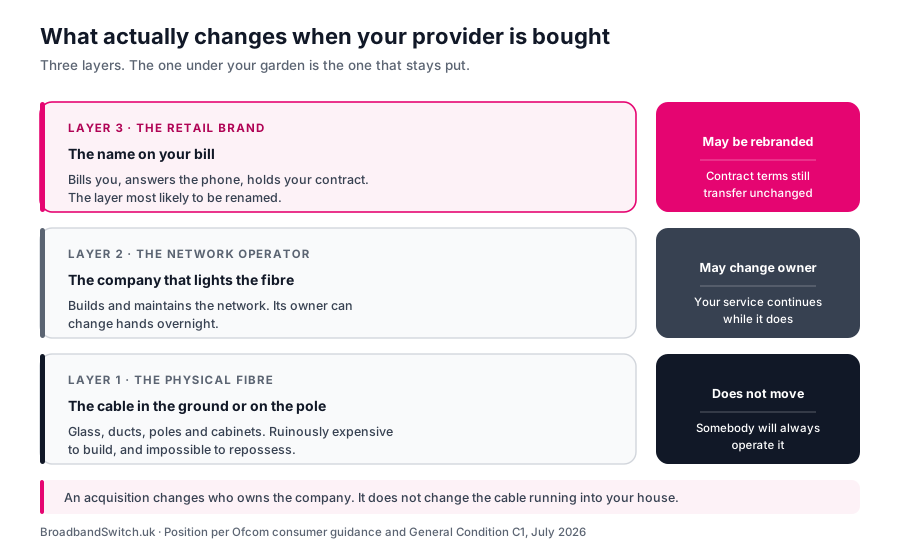
Your contract transfers. All of it.
Ofcom's own consumer guidance is unambiguous on this. Where a provider is taken over, customers can carry on using the services they are used to, in most cases without any interruption, and in most cases the existing contract simply transfers to the new provider (Ofcom, 2026).
That means the £24 a month you negotiated eighteen months ago remains £24 a month. Your 24 month term keeps running down at the same rate. Your router keeps working. The engineer who never turned up still never turned up. Nothing resets.
The reason is structural rather than generous. Broadband has three layers. There is the physical fibre in the ground or strung along the poles, which is enormously expensive to build and effectively impossible to repossess. There is the network operator that lights and maintains that fibre. And there is the retail brand that bills you and answers the telephone. When a company is acquired, what usually changes is who owns the middle and top layers. The glass in the ground is entirely indifferent to the transaction.
This is why even the most alarming headlines rarely translate into anything happening at your wall socket.
Does an acquisition let me leave early?
No. Not on its own.
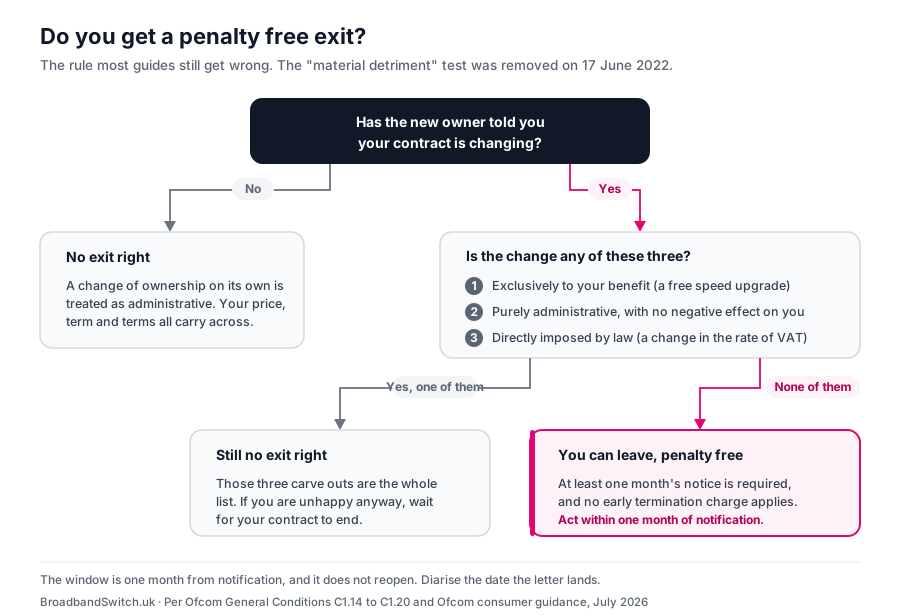
This is the question everybody asks and almost nobody answers straight, so let us be precise about it. Under Ofcom's General Conditions, a provider must give you at least one month's notice of any change to your contract, and must give you the right to terminate without any early termination charge. You have one month from the notification in which to exercise that right (Ofcom, General Conditions C1.14 to C1.20).
There are exactly three exceptions. You do not get an exit right where the change is (Ofcom, 2026):
- exclusively to your benefit, for example a free speed upgrade;
- purely administrative and has no negative effect on you, for example a change in the address or bank details of your provider; or
- directly imposed by law, for example a change in the rate of VAT.
A change of ownership, with no change to your price or terms, sits squarely in that second category. Different letterhead, same contract. No exit right.
A correction worth making
You will still find guides, and indeed customer service agents, referring to a "material detriment" test: the idea that you can only leave if a change harms you materially. That test was removed from the General Conditions on 17 June 2022. The current rule is broader and simpler. Any contract modification that is not exclusively beneficial, purely administrative, or imposed by law triggers notice and a penalty-free exit. If somebody quotes "material detriment" at you, they are working from a rulebook that is four years out of date.
So the practical trigger is not the takeover. It is the letter that arrives three months later saying your package is being restructured, your price is going up outside the terms you agreed, or you are being migrated onto a different product. That is your moment. Our guide to in-contract price rises covers the pricing side in detail.
The letter that exercises your exit right
If a change has been notified and it fails all three tests above, you have a month. Send this, in writing, and keep a copy. Written beats telephoned, every time, because an adjudicator cannot read a phone call.
Subject: Exercise of right to terminate without charge under General Condition C1
Account number: [your account number]
Service address: [address]
Date of your notification: [date on the letter or email]Dear [provider],
On [date] you notified me of the following change to my contract: [describe the change in one sentence, for example "an increase in my monthly price from £24 to £31", or "migration of my service onto a different network"].
This change is not exclusively to my benefit, is not purely administrative, and is not directly imposed by law. Under Ofcom's General Conditions, I am therefore entitled to terminate my contract without any early termination charge, and I am exercising that right within one month of your notification.
Please confirm in writing, within 14 days: that my contract will end without any early termination charge; the date on which it will end; and the amount of any final credit due to me.
I am arranging a switch through the One Touch Switch process and will not be contacting you to cancel separately, as the process does not require it.
If you do not accept that this right applies, please treat this letter as a formal complaint and provide a complaint reference number. I will escalate to [CISAS or the Communications Ombudsman, whichever covers your provider] after six weeks, or sooner on receipt of a deadlock letter.
Yours faithfully,
[name]
Two notes. Name the change specifically rather than complaining generally, because the exit right attaches to that modification and not to your overall mood. And do not cancel your direct debit until the final bill is settled, or you will trade one problem for another.
The four things that can actually happen
Not every change of hands is the same, and the differences matter enormously. Ranked from "ignore it" to "act this week":
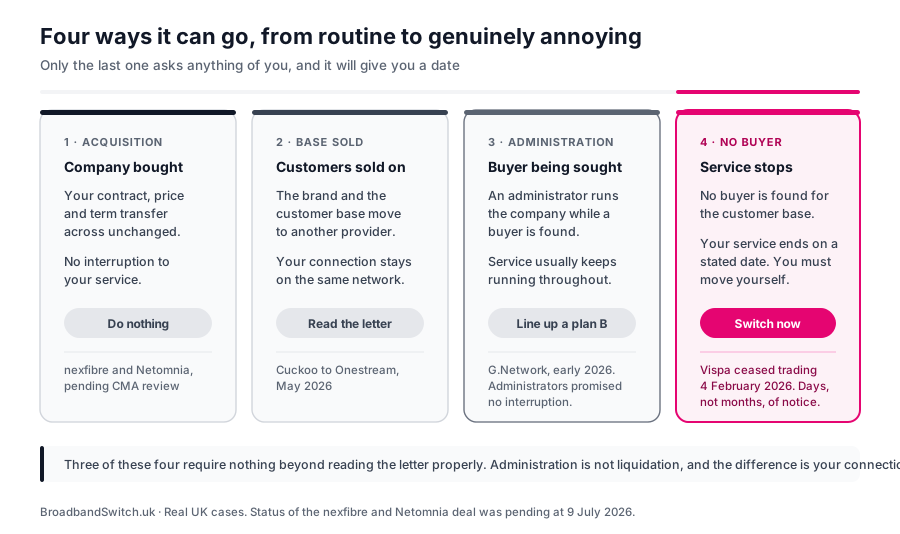
1. The company is acquired
The most common outcome, and the least eventful. Your contract transfers. Service continues. You may not even notice for a year, until a rebranded bill arrives. The nexfibre acquisition of Substantial Group, parent of Netomnia and the retail brands YouFibre and brsk, falls into this category, and we cover its current status below.
2. The customer base is sold, but the company winds down
A provider decides retail is not for it, sells the brand, the domain and the customer contracts to somebody else, and closes down solvently. Your physical connection typically does not move at all.
Cuckoo did exactly this: it stopped taking new customers at 4pm on 11 May 2026, sold its customer base, brand and domain to Onestream, and confirmed its intention to undertake a solvent wind-down, with connections continuing to run over AllPoints Fibre's wholesale platform (ISPreview, 2026; ThinkBroadband, 2026). Read the letter carefully in this scenario, because the new owner's terms may differ from the old one's, and that difference is what may hand you an exit right.
3. The company enters administration and a buyer is sought
An administrator takes control and tries to sell the business or its assets. Service usually continues while that happens, because a network with paying customers on it is worth considerably more than a network without.
G.Network, founded in 2016 and focused on London, entered administration in early 2026. It had passed 416,000 premises but converted only around 25,000 of them into paying customers, and carried roughly £300 million of debt. Its bankers were unable to find a buyer, and Alvarez & Marsal Europe LLP were appointed joint administrators. Critically, those administrators assured customers there would be no interruption to broadband services during the administration process (Capacity, 2026; British Brief, 2026).
That is the pattern. Administration is a process for rescuing value, and switching off paying customers destroys it.
4. No buyer is found and the service stops
The genuinely disruptive outcome, and the rarest. Ofcom is direct about it: in this scenario your service will stop on a certain date, and your provider should tell you when that is (Ofcom, 2026).
Vispa, a Manchester based ISP trading since 1999, emailed its customers on 4 February 2026 to say that Vispa Limited has ceased trading and decided to commence liquidation proceedings
. Customers were told to choose a new provider immediately, and were advised to cancel any active direct debit or standing order to prevent further payments being taken (ISPreview, 2026).
Note the contrast with G.Network. Same year, same sector, opposite outcome for the customer. Administration bought G.Network's customers time. Liquidation gave Vispa's customers an email. If you receive one like it, do not wait: start a switch the same week. Our guide to what happens if your broadband provider goes out of business deals with this scenario in full.
If you rely on your line for care or medical alerts
A ceasing provider is a serious matter for anyone using a telecare alarm, a fall pendant, or a medical monitoring device that depends on the connection. Tell your new provider that you have a telecare device before the switch is arranged, and tell your telecare supplier that your broadband is changing. Do not leave it to coincide with the cut-off date. Our guide to switching broadband with a care alarm sets out the sequence.
Getting your money back, and the trap almost everyone falls into
If a provider fails owing you money, whether that is a credit balance, a prepaid year, or an installation fee for an installation that never happened, there are three possible routes. They are not interchangeable, and the differences catch people out.
| How you paid | Your route | The detail |
|---|---|---|
| Monthly direct debit | Direct Debit Guarantee | Your bank must refund payments taken in error, in full and immediately, with no time limit. Ask for a "Direct Debit Guarantee indemnity claim". This is the route that applies to almost every broadband customer. |
| Credit card, over £100 | Section 75 | Under the Consumer Credit Act 1974, your card provider is jointly liable with the supplier where the cash price is more than £100 and not more than £30,000, and this applies even if the company has gone bust. You are covered for the full amount even if you only paid part of it on the card. |
| Debit card, or under £100 | Chargeback | A voluntary scheme under the Visa, Mastercard and Amex rules, with no minimum spend. You usually have around 120 days from the transaction, or from the date you were due to receive the service (Financial Ombudsman Service, n.d.). |
The trap
Section 75 applies to credit card purchases where the cash price of the thing you bought is more than £100. A monthly broadband bill of £28 collected by direct debit from your current account is neither a credit card purchase nor over £100, so Section 75 does not apply, and neither does chargeback, because a direct debit is not a card payment.
Your route for a direct debit is the Direct Debit Guarantee. It happens to be the fastest of the three, because your bank refunds you first and argues with the provider afterwards. Guides that tell broadband customers to "just use Section 75" are sending them to the wrong counter.
Where Section 75 genuinely does bite: an upfront installation or activation fee over £100 paid on a credit card, or an annual plan paid in advance on a credit card. Those are single purchases above the threshold, and the protection survives the company's collapse.
And if you simply wait for the insolvency to pay you?
You will be waiting a long time, and probably for nothing.
The Insolvency Act 1986 and the Insolvency (England and Wales) Rules 2016 set a strict order of priority. Each class of creditor must be paid in full before the next receives anything at all. Customers are named explicitly in the seventh class of nine, as non-preferential unsecured creditors, alongside trade creditors and suppliers.
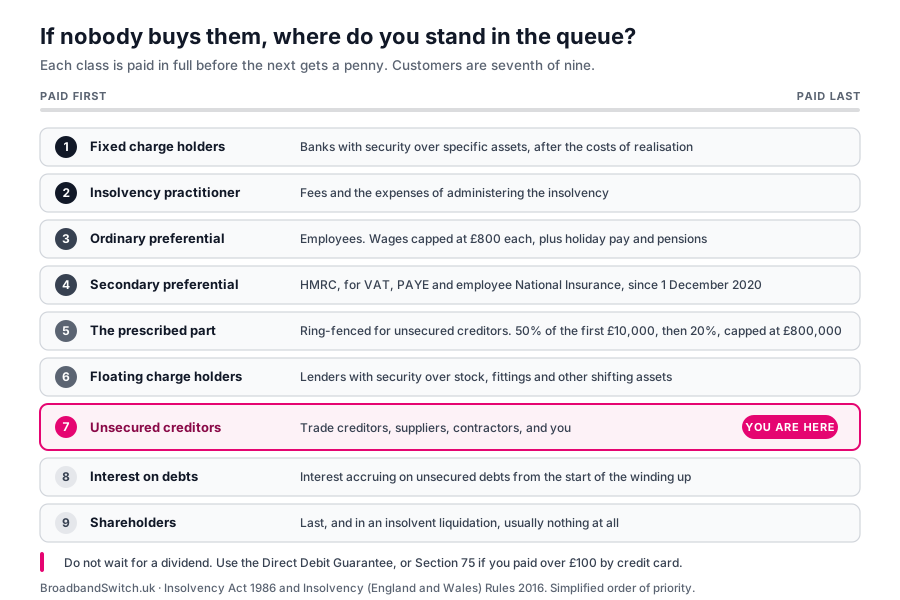
There is one modest consolation. The "prescribed part" ring-fences a fund out of floating charge realisations specifically for unsecured creditors, calculated as 50% of the first £10,000 of net property and 20% of the remainder, capped at £800,000 (Insolvency Act 1986; K&L Gates, 2019). Spread across every customer and supplier of a failed network operator, that does not go far.
Which is precisely why the Direct Debit Guarantee matters so much. It takes your money out of the insolvency queue entirely and puts it back in your account, because your bank refunds you and then pursues the provider itself. If your card provider or bank refuses a valid claim, that dispute goes to the Financial Ombudsman Service, which has jurisdiction over the bank rather than the broadband company.
How to find out who really owns your broadband
The name on your bill is frequently not the company that owns the network, and neither is necessarily the company that owns them both. Before a headline sends you into a spiral, work out which of the three layers the news is actually about.
Ask three questions. Who bills me? That is the retail brand. Whose engineer installed the line, and what technology is it? That is the network. Openreach, Virgin Media's cable network, CityFibre, Netomnia and the rest each leave different fingerprints. Who owns that network? That is the layer where the money moves, and it is the layer the headlines are usually about.
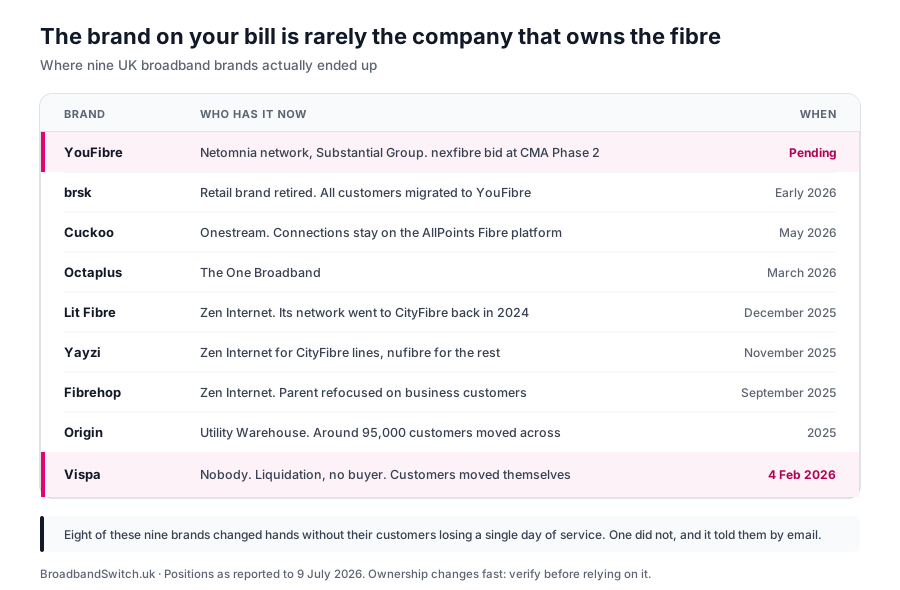
The pattern is worth absorbing. Brands vanish constantly. Connections almost never do.
Who is actually being bought right now
The consolidation is real, and the numbers explain it. Altnet cumulative accounting losses reached £1.5 billion in 2024, and in the first half of 2025, 96% of altnets surveyed were considering mergers, acquisitions or partnerships, with 47% of UK fibre companies facing the refinancing of a material proportion of their debt or equity by 2026 (AlixPartners, cited in Bratby Law, 2026). That is not a market with a hundred independent futures in it.
| Provider | What happened | Status |
|---|---|---|
| Netomnia, YouFibre and brsk (Substantial Group) | Agreed acquisition by nexfibre, the Liberty Global, Telefónica and InfraVia joint venture, at a £2 billion enterprise value, announced February 2026 | Under CMA Phase 2 investigation. Statutory deadline 15 December 2026 |
| G.Network | Entered administration in early 2026 carrying roughly £300 million of debt, having passed 416,000 premises with around 25,000 paying customers | Administrators confirmed no interruption to service |
| Vispa | Ceased trading 4 February 2026 and entered liquidation. No buyer found for the customer base | Customers told to find alternative providers immediately |
| Cuckoo | Customer base, brand and domain sold to Onestream; solvent wind-down. New sales stopped 4pm, 11 May 2026 | Customers migrating, connections unchanged |
| brsk | Retail brand retired; all customers migrated to YouFibre | Completed, early 2026 |
| Octaplus | Exited the UK retail broadband market in March 2026; customer base acquired by The One Broadband | Completed |
| Lit Fibre (retail) | Exited the market in December 2025; consumer customer base acquired by Zen Internet | Completed |
| Origin | TalkTalk exited the brand in 2025; approximately 95,000 customers transferred to Utility Warehouse | Completed |
| Gigaclear | Seeking a buyer while carrying approximately £1 billion of debt | Process reported ongoing |
| Community Fibre and Hyperoptic | Owners Warburg Pincus and KKR reported to be sounding out buyers. Both serve roughly 400,000 to 450,000 customers | Exploratory |
Positions as reported to 9 July 2026. Deal status changes; check the current position before relying on this table.
The nexfibre and Netomnia deal, in plain English
In February 2026, nexfibre agreed to acquire Substantial Group, which owns the Netomnia network and the retail brands YouFibre and brsk, at a £2 billion enterprise value. nexfibre says the transaction would unlock £3.5 billion of investment and take its full fibre footprint to around 8 million premises by the end of 2027, which combined with Virgin Media O2's network would reach roughly 20 million premises (nexfibre, 2026). At announcement Netomnia had deployed across around 3 million premises, expected to reach around 3.4 million premises and 500,000 customers by completion (ISPreview, 2026).
On 11 June 2026 the parties asked the Competition and Markets Authority to fast-track the review straight to a Phase 2 investigation, skipping Phase 1. The CMA accepted, the merger inquiry began on 29 June 2026, and the announcement followed on 1 July 2026. The statutory deadline for the Phase 2 decision is 15 December 2026 (CMA, 2026; ThinkBroadband, 2026).
Not everyone is delighted. CityFibre's chief executive Simon Holden has said the deal would remove a successful challenger and reduce choice for consumers
, pointing to a substantial overlap between the two networks (Capacity, 2026).
What this means for a YouFibre customer today: nothing. The deal has not completed, and if it does complete, your contract transfers. Should the new owner later change your terms, the one month notice and penalty-free exit rules described above apply exactly as they would anywhere else. You can see current options on our YouFibre deals page whenever you choose to look, and not before.
What to do when the letter arrives
- Read it for changes, not for logos. A new brand name is not a contract change. Look specifically for a new price, a new minimum term, a change of product or speed, a change to what is included, or a migration onto a different network.
- Check the notice. Any contract modification requires at least one month's notice, given clearly and on a durable medium, which means paper or email rather than a line buried on a website.
- Test it against the three exceptions. Is the change exclusively to your benefit? Purely administrative with no negative effect? Imposed by law? If it is none of those, you have a penalty-free exit.
- Diarise the deadline. You must exercise the exit right within one month of the notification. Miss it and you are back to standard early termination charges.
- Send the letter. Use the template above. Name the specific change, cite General Condition C1, and ask for written confirmation within 14 days.
- If you leave, use One Touch Switch. Contact only the new provider you are moving to. Do not ring the outgoing one to cancel. Our One Touch Switch guide explains the process, and if the switch goes wrong, our guide to being billed by two providers after a failed switch explains the fix.
- If the service degrades, complain formally. Get a complaint reference. For complaints raised on or after 8 April 2026 you can escalate to Alternative Dispute Resolution after 6 weeks, or immediately with a deadlock letter. See our guide to compensation and service failure.
- If the service is stopping entirely, switch now. Do not wait for the stated end date. A switch takes time, and you do not want the two dates to meet.
Frequently asked questions
My broadband provider has been taken over. Do I have to do anything?
No. Your contract transfers to the new owner on the same terms, and your service should continue without interruption. Read any letter you receive, but a change of ownership alone requires nothing from you.
Can I cancel my contract because my provider was bought?
Not on that basis alone. A change of ownership with no change to your contract is treated as an administrative change, and administrative changes with no negative effect on you do not trigger an exit right. If the new owner subsequently changes your terms, you can leave without an early termination charge.
Will my price go up after the takeover?
Not automatically, and not because of the takeover. Your agreed price and term carry across. Any in-contract rise still has to comply with the pricing terms you signed up to, and any change outside those terms requires one month's notice and gives you a penalty-free exit.
What is "material detriment" and does it still apply?
It was the old test for whether a contract change gave you the right to leave. Ofcom removed it from the General Conditions on 17 June 2022. The current rule is wider: any modification that is not exclusively to your benefit, purely administrative, or imposed by law triggers notice and a penalty-free exit.
How long do I have to exercise a penalty-free exit?
One month from the date you are notified of the modification. The window does not reopen, so act on the letter rather than filing it.
My provider is being investigated by the CMA. Should I switch now?
There is no need to. A competition investigation does not affect your service or your contract. If the deal completes, your contract transfers. If it is blocked, nothing changes at all.
What happens to my YouFibre or brsk contract if nexfibre completes?
It transfers unchanged. The brsk retail brand was already retired in early 2026, with those customers migrated to YouFibre. As at 9 July 2026 the nexfibre deal had not completed and was subject to a CMA Phase 2 investigation with a statutory deadline of 15 December 2026. If the new owner later changes your terms, the standard one month notice and penalty-free exit rules apply.
My provider went bust. Will my broadband just stop?
It depends which of two things happened. In administration, an administrator usually keeps the service running while a buyer is sought: when G.Network entered administration in early 2026, its administrators assured customers there would be no interruption. In liquidation with no buyer, your service will stop on a stated date: when Vispa ceased trading on 4 February 2026, customers were emailed and told to find a new provider immediately. In the second case, start a switch straight away.
Can I get a refund if my provider went bust owing me money?
Possibly. If you paid by direct debit, use the Direct Debit Guarantee at your bank for payments taken in error. If you paid by credit card and the cash price was more than £100, Section 75 of the Consumer Credit Act 1974 makes your card provider jointly liable, and it applies even if the company has ceased trading. If you paid by debit card, ask about chargeback, which usually has a limit of around 120 days.
Where do I rank as a creditor if my provider is liquidated?
Seventh of nine. Under the Insolvency Act 1986, customers are non-preferential unsecured creditors, behind fixed charge holders, the insolvency practitioner, employees, HMRC, the prescribed part and floating charge holders. Each class must be paid in full before the next receives anything, so customers typically recover little or nothing. Use the Direct Debit Guarantee instead of waiting.
Does Section 75 cover my monthly broadband bill?
Almost certainly not. Section 75 applies to credit card purchases where the cash price is more than £100 and not more than £30,000. A monthly bill collected by direct debit from your bank account is neither. For direct debits, the Direct Debit Guarantee is your route, and it is faster anyway.
Is there a safety net like the one energy customers get?
No. Energy has a Supplier of Last Resort process that automatically moves customers to a new supplier. Broadband has no direct equivalent. Where a buyer takes over, service continues; where no buyer is found, customers are told to switch themselves.
How do I find out who actually owns the network my broadband runs on?
Ask three questions: who bills me, whose engineer installed the line and what technology is it, and who owns that network. The retail brand on your bill is frequently not the network operator, and the network operator is frequently not the ultimate owner. Most headlines concern the third layer, which is the one least likely to affect your service.
The new owner is migrating me onto a different network. Is that a contract change?
Very probably. A migration that changes your product, your speed, your equipment or what is included in your package is a contract modification, and it is neither exclusively beneficial nor purely administrative. Expect one month's notice and a penalty-free exit. If you are not offered one, complain formally and cite General Condition C1.
My old provider's brand has disappeared. Who do I complain to now?
The new owner, which inherits the contract and the complaint. If you get nowhere, escalate to that provider's Alternative Dispute Resolution scheme after 6 weeks, or immediately with a deadlock letter. Check which scheme applies, because memberships changed considerably in 2026.
I use a care alarm. What should I do if my provider is closing?
Act early and tell two people. Tell your incoming provider that you have a telecare device before the switch is arranged, and tell your telecare supplier that your broadband is changing. Do not let the switch date drift towards the cut-off date.
Should I sign a long contract with a small provider given all this consolidation?
That is a judgement call rather than a rule. The protections above apply whoever you are with, and the fibre in the ground survives its owner. What consolidation genuinely changes is the likelihood of a rebrand and a slightly different customer service experience, not the likelihood of losing your connection.
Where to go next
Sources
- AlixPartners, cited in Bratby Law. (2026, March). UK fibre consolidation: transactions outlook. Values: 96% of altnets surveyed considering M&A or partnerships in H1 2025; 47% of UK fibre companies facing refinancing by 2026; altnet cumulative accounting losses of £1.5 billion in 2024; over 100 UK fibre network operators. Scope: United Kingdom.
- British Brief. (2026, February). UK broadband provider VISPA ceases trading, customers urged to cancel payments. Values: G.Network founded 2016, approximately 25,000 customers, approximately £300 million debt; Alvarez & Marsal Europe LLP appointed joint administrators; administrators assured no interruption to service. Scope: United Kingdom.
- Capacity. (2026). Private equity moves to exit UK fibre as altnet consolidation accelerates. Values: G.Network passed 416,000 premises; Gigaclear approximately £1 billion of debt; Community Fibre approximately 450,000 customers; Hyperoptic more than 400,000 customers. Scope: United Kingdom.
- Capacity. (2026, July). CMA fast-tracks Netomnia deal to Phase 2, sets December deadline. Quotation attributed to Simon Holden, Chief Executive, CityFibre.
- Competition and Markets Authority. (2026, 1 July). Fast-track reference of the anticipated acquisition by nexfibre of Substantial Topco Limited. Values: fast-track requested 11 June 2026; merger inquiry commenced 29 June 2026; statutory deadline 15 December 2026. Scope: United Kingdom.
- Financial Ombudsman Service. (n.d.). Problems with goods and services: section 75 and chargeback. Values: Section 75 applies where the cash price is more than £100 and not more than £30,000; chargeback usually raised within around 120 days. Scope: United Kingdom.
- Insolvency Act 1986, sections 175, 176A and 386, and the Insolvency (England and Wales) Rules 2016. Scope: order of priority of creditors, England and Wales.
- ISPreview. (2026, 5 February). Broadband ISP VISPA informs UK customers of closure and liquidation. Values: customer email dated 4 February 2026; company trading since 1999; customers advised to cancel direct debits. Scope: United Kingdom.
- ISPreview. (2026, May). Home broadband ISP Cuckoo sells UK customer base to Onestream. Value: new sales ceased 4pm, 11 May 2026. Scope: United Kingdom.
- ISPreview. (2026, July). CMA fast-tracks nexfibre £2bn Netomnia broadband merger to Phase 2 competition probe. Values: approximately 3 million premises deployed, rising to c.3.4 million premises and 500,000 customers by completion, expected Q3 2026. Scope: United Kingdom.
- K&L Gates. (2019, February). Changing priorities in UK company insolvencies. Values: prescribed part calculated as 50% of the first £10,000 and 20% thereafter. Scope: United Kingdom.
- nexfibre. (2026, 18 February). InfraVia, Liberty Global and Telefónica acquire Substantial Group for £2 billion. Values: £2 billion enterprise value; £3.5 billion investment unlocked; around 8 million premises by end of 2027. Scope: United Kingdom.
- Ofcom. (2026). General Conditions of Entitlement, Condition C1: contract requirements. Scope: providers of public electronic communications services, United Kingdom. Conditions C1.14 to C1.20 govern contractual modifications, notice and exit rights.
- Ofcom. (2026). What to do if your broadband or landline provider goes out of business. Scope: United Kingdom residential customers.
- Ofcom. (2026). Contracts: your rights when your provider changes your contract. Scope: the three exceptions to the right to exit. United Kingdom.
- Real Business Rescue. (2026, June). What is the priority order of creditors in an administration process? Value: prescribed part maximum of £800,000. Scope: United Kingdom.
- ThinkBroadband. (2026, July). CMA to fast track phase 2 investigation for Liberty Global, Telefónica and InfraVia acquisition of Substantial Group. Scope: United Kingdom.
This guide explains consumer rights under the Ofcom General Conditions, the Consumer Credit Act 1974, the Insolvency Act 1986 and the Bacs Direct Debit Guarantee as they stood on 9 July 2026. It is general information and not legal or financial advice. Merger and insolvency positions change quickly: verify the current status of any transaction before acting on it.