FIBRE GUIDE · FTTP VS CABLE · HONEST VERDICT
FTTP vs Virgin Media Cable: Which Is Better?
Full fibre against Virgin Media's cable. They look similar on download speed, but they differ where it counts, upload, latency and steadiness, and one of them is quietly being replaced by the other. Here is the honest head-to-head, and the verdict by household.
Written by Dr Alex J. Martin-Smith · Reviewed by Adrian James · Published 11 June 2026 · Speeds are providers' published figures, verified June 2026 · ~8 minute read
Prefer to read offline? Download the free PDF guide: FTTP vs Virgin Media Cable (6 pages, ~270KB). No signup, no email, just the guide.
The quick answer
Both bring fibre most of the way, then differ at the final stretch. Virgin's cable runs fibre to a street box, then coaxial copper into your home, using a technology called DOCSIS. Full fibre runs fibre all the way, with no copper at all. On download they are close; on upload they are worlds apart (Gig1 uploads at just 52 Mbps), and Virgin itself is converting its cable network to full fibre by 2028.
Key facts · verified June 2026
- Cable's Gig1 downloads at around 1,130 Mbps but uploads at only around 52 Mbps; full fibre can offer symmetric gigabit, upload matching download.
- Virgin's cable network reaches a little over half of UK homes, mostly in towns and cities; full fibre now reaches 82% and is still climbing.
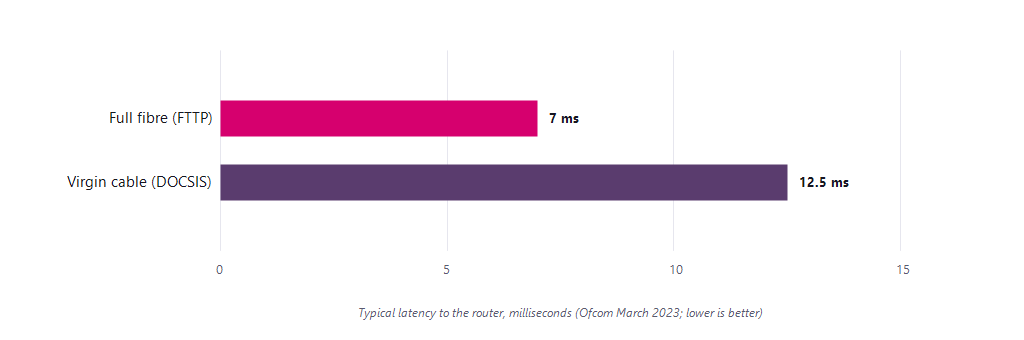
- Full fibre runs lower latency: around 7ms to the router versus around 12.5ms for cable in Ofcom's last published measurements.
- Virgin's newest 2Gbps tier already runs on full fibre, not cable, and the company is converting its whole network to full fibre, aiming to finish by 2028.
- Virgin's own fibre footprint is approaching 8 million premises, with existing customers in upgrade areas being moved across since January 2026.
Two ways to reach your home
| Virgin cable | Full fibre (FTTP) | |
|---|---|---|
| Final run | Coaxial copper | Fibre, all the way |
| Technology | DOCSIS 3.1 (HFC) | Full fibre (PON) |
| Top download | Up to ~1.1Gbps | Up to 1.8Gbps, or 2Gbps |
| Upload | Low, asymmetric | High, often symmetric |
| Where | Cable towns and cities | Increasingly everywhere |
Virgin's cable network reaches a little over half of UK homes, mostly in towns and cities. Full fibre now reaches 82% of homes and is still climbing, from Openreach and a host of newer networks, with the plain-English explainer in our companion guide: what is FTTP? Full fibre explained.
The plot twist: Virgin is itself becoming a full fibre provider. Its newest 2Gbps tier already runs on full fibre, not cable, and it is converting its whole network to full fibre over the next few years. So in many ways this is a comparison between today's cable and where everything is heading.
The upload gap
On download, the two are close, and cable's fastest tier is even a touch quicker than a typical Openreach gigabit line. The real difference is upload, and it is a big one.
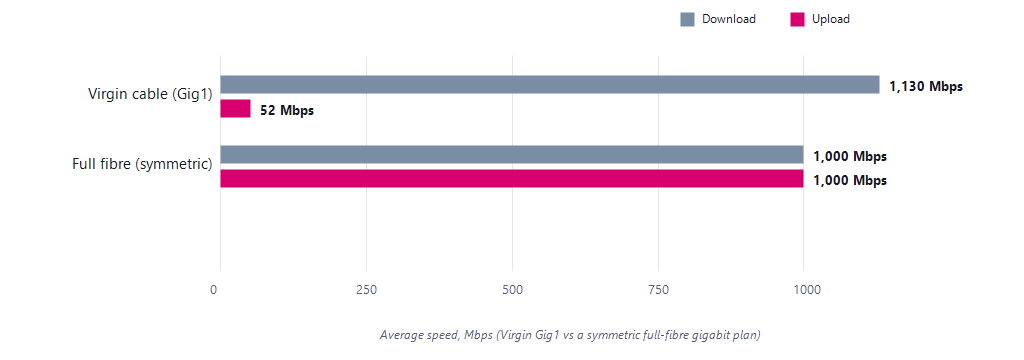
Virgin's cable is built to send data down to you far faster than it sends data back up. Even on the top Gig1 plan, upload is only around 52 Mbps. Full fibre can offer upload that matches the download, which is exactly what video calls, cloud backups, big file sharing and working from home need.
When the upload gap matters: if you only stream, browse and download, cable's modest upload will rarely trouble you. But if your household does a lot of video calling, uploads large files, games competitively or runs cameras and backups, full fibre's stronger upload makes a real, daily difference.
Reliability, and what is next
Beyond speed, full fibre tends to be the steadier connection, and the gap shows most in latency, the small delay that matters for calls and gaming.
- Reliability. Fibre is immune to the electrical interference and corrosion that can affect copper and coaxial lines, so faults tend to be rarer.
- Peak times. Both share capacity locally, but full fibre generally has more headroom, so it is less prone to slowing in the busy evening hours.
- The direction of travel. Cable's DOCSIS technology is being retired. Rather than upgrade the coaxial network again, Virgin is converting it to full fibre, aiming to finish by 2028, with existing customers in upgrade areas being moved across since January 2026.
In other words, the two technologies are converging. Virgin's future, like everyone else's, is full fibre, so choosing full fibre today is choosing where the whole market is going.
The verdict: which should you pick?
There is no single winner, because it depends on what your home does and what is available at your address. Here is the honest split.
| Choose cable when | Choose full fibre when |
|---|---|
| You want the cheapest fast download in a cable area | You need strong or symmetric upload |
| Cable is widely available where you live | You want the most consistent connection |
| High upload is not a priority | You want more providers and easy switching |
In a sentence: for the cheapest fast download in a cable town, Virgin is hard to beat today. For upload, consistency, choice and future-proofing, full fibre wins, and it is where Virgin itself is heading.
Moving between the two networks has its own practicalities, in both directions: Virgin Media to Openreach with the least downtime and Openreach to Virgin Media: what changes on installation day. Virgin's current plans and pricing live at Virgin Media deals, with the full-fibre field at full fibre deals.
Where Virgin Media O2 sits in the wider market, and who else is building, is mapped in UK broadband market share 2026.
For the full brand-to-network map behind these two technologies, see the full UK wholesale network matrix.
Questions people ask
Is Virgin Media full fibre?
Mostly not yet. Most Virgin Media connections run on DOCSIS cable, fibre to a street box with coaxial copper into the home. But its newest 2Gbps tier already runs on full fibre, its fibre footprint is approaching 8 million premises, and the company is converting its whole network to full fibre, aiming to finish by 2028.
Is FTTP better than Virgin Media cable?
On download the two are close, with cable's Gig1 even a touch quicker than a typical gigabit line. Full fibre wins on upload (symmetric versus around 52 Mbps), latency (around 7ms versus 12.5ms), reliability and peak-time steadiness, so for calls, backups, gaming and home working it is the stronger choice.
Why is Virgin Media's upload speed so low?
Because DOCSIS cable was engineered to send data down to homes far faster than it sends data back up, a design from the television era. Even the top Gig1 plan uploads at around 52 Mbps against its 1,130 Mbps download; only Virgin's newest full-fibre-based tiers escape this.
Is Virgin Media switching to full fibre?
Yes. Under a plan announced in 2021, Virgin Media O2 is upgrading its entire cable network to full fibre, aiming to complete by 2028, and since January 2026 it has been opening upgrade areas and moving existing customers across to the fibre network.
Which is more reliable, cable or full fibre?
Full fibre tends to be steadier: glass is immune to the electrical interference and corrosion that can affect coaxial copper, faults are rarer, latency is lower, and it generally has more headroom at peak times. Cable remains a strong performer for download-heavy households in the meantime.
About this guide
This guide is part of the BroadbandSwitch.uk 2026 Guide Library, published by BroadbandSwitch.uk, the consumer arm of the SearchSwitchSave network. Speeds are providers' published average figures; the network upgrade plans are the operators' own stated targets. Our approach to evidence and corrections is documented in the methodology and trust hub, and every published correction appears in the corrections log.
Take it with you: download the free 6-page PDF guide, including the technology table, the upload-gap chart and full sources.
Citing this guide: BroadbandSwitch.uk. (2026, June 11). FTTP vs Virgin Media cable: Which is better? SearchSwitchSave. https://broadbandswitch.uk/guides/fttp-vs-virgin-cable/
Sources
- Liberty Global. (2021, July 29). Virgin Media O2 announces 2028 full fibre upgrade plan. https://www.libertyglobal.com/virgin-media-o2-announces-2028-full-fibre-upgrade-plan/
- ISPreview UK. (2026, January 28). Virgin Media start opening FTTP upgrade areas to existing UK customers. https://www.ispreview.co.uk/index.php/2026/01/virgin-media-start-opening-fttp-upgrade-areas-to-existing-uk-customers.html
- Ofcom. (2026). Connected Nations update: Spring 2026. https://www.ofcom.org.uk/phones-and-broadband/coverage-and-speeds/connected-nations-update-spring-2026
- thinkbroadband. (2025, October 30). Virgin Media O2 results state fibre footprint approaching 8 million premises. https://www.thinkbroadband.com/news/virgin-media-o2-results-state-fibre-footprint-approaching-8-million-premises
- Uswitch. (2026, April 16). Virgin Media review 2026: is Virgin broadband any good? https://www.uswitch.com/broadband/reviews/virgin-media/
This guide is general consumer information. Speeds are providers' published average figures and vary by plan and line; latency figures are Ofcom's last published measurements; upgrade timetables are the operators' stated targets and may change.