FIBRE GUIDE · MYTHS DEBUNKED · JUNE 2026
Full Fibre Myths, Debunked
The ten things people still get wrong about full fibre, from what counts as fibre to power cuts and price. Clear, honest answers, with the truth behind each one, and the sources to back it up.
Written by Dr Alex J. Martin-Smith · Reviewed by Adrian James · Published 11 June 2026 · Figures verified June 2026 · ~9 minute read
Prefer to read offline? Download the free PDF guide: Full Fibre Myths Debunked (6 pages, ~280KB). No signup, no email, just the guide.
The quick answer
Most full fibre myths come down to old habits and old marketing. The reality in 2026: "fibre" on a label has not always meant full fibre (only FTTP is), prices have fallen sharply and often beat old copper deals, installation is a short engineer visit, and with copper retiring in January 2027, full fibre is fast becoming the only option anyway. The one myth with a grain of truth: yes, the phone needs mains power, and free battery backup exists for those who rely on it.
Key facts · verified June 2026
- Since September 2024, providers must label the technology clearly as copper, part fibre, cable or full fibre at the point of sale, and cannot use "fibre" alone.
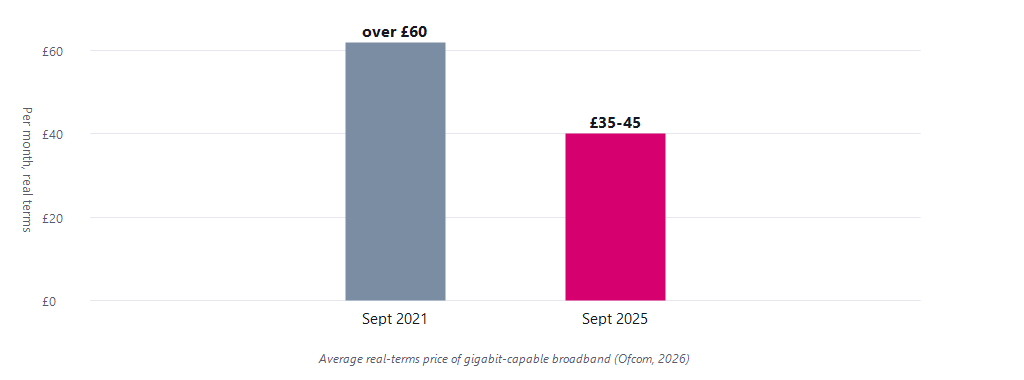
- Gigabit prices have fallen markedly: from over £60 a month in real terms in September 2021 to £35 to £45 by September 2025 (Ofcom).
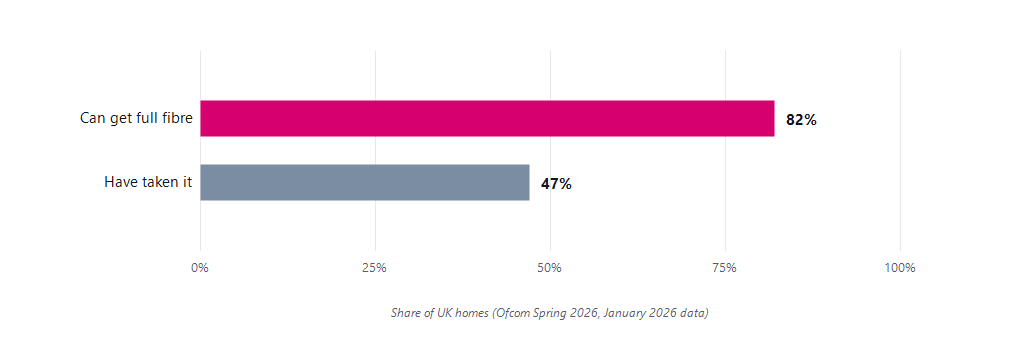
- 82% of homes can get full fibre but only 47% have taken it, so most people who assume they cannot get it actually can.
- A typical install is a short engineer visit, fitting a small box on an inside wall and setting up a router.
- Providers must offer at least one hour of free battery backup to customers who rely on their landline, ahead of the 31 January 2027 copper switch-off.
Myths 1-4: understanding full fibre
Most myths start with a simple mix-up about what full fibre is. Clear these four up and the rest falls into place.
Myth 1: "Fibre broadband means I already have full fibre."
Not necessarily. For years, "fibre" was sold for part-fibre lines that run fibre only to a street cabinet, then copper to your home. Only FTTP is full fibre. Since September 2024, providers must label the technology clearly as copper, part fibre, cable or full fibre, and cannot use "fibre" alone, at least at the point of sale. What FTTP actually is, in plain English: what is FTTP? Full fibre explained.
Myth 2: "Fibre slows in bad weather or over distance, like copper."
No. Copper weakens the further you are from the cabinet and can be affected by weather, interference and corrosion. Full fibre carries light down glass, so it barely weakens over distance and shrugs off electrical interference.
Myth 3: "My Wi-Fi speed is the same as my broadband speed."
Not quite. Full fibre arrives at a small box on your wall and a new router, but your Wi-Fi can still bottleneck a fast line. Distance from the router and an older Wi-Fi standard can hold back a gigabit connection long before the line does, with the fixes in weak Wi-Fi: mesh vs extenders.
Myth 4: "The speed they advertise is never what you get."
Misleading. Advertised "average" speeds must be reachable by at least half of customers at peak time, and you also get a personal speed estimate when you order. Crucially, full fibre delivers its advertised speed far more consistently than copper ever did. The full story of the speed gap, and your rights when a line undershoots: why are my speeds lower than advertised?
Myths 5-6: cost and need
Two of the most common reasons people hold off are price and the feeling that full fibre is more than they need. Both deserve an honest look.
Myth 5: "Full fibre is much more expensive."
Usually not. Ofcom found that in many cases you can switch to faster, more reliable full fibre and pay the same or less than your old copper or part-fibre deal. Gigabit prices have fallen sharply, and entry full fibre often starts in the low £20s a month.
Myth 6: "Full fibre is overkill, I do not need it."
It depends, and that is fair. Many homes genuinely do not need gigabit speeds. But the real gains are stronger upload, steadier connections and room for several people at once, not just a bigger headline number. And with copper retiring, full fibre is fast becoming the standard anyway.
Myths 7-8: getting it
Myth 7: "Full fibre is not available where I live."
Often false. 82% of UK homes can now get full fibre, and the rollout is rapid, so many people who assume they cannot get it actually can. Far more homes can get it than have switched to it, as the figures show.
Myth 8: "Installation is a nightmare and needs major building work."
Rarely. A typical full fibre install is a short engineer visit that fits a small box on an inside wall and sets up a new router. Allow a week or two from ordering, and that is usually the whole job.
Myths 9-10: copper and power
Myth 9: "Copper landlines will always be there."
No longer. The old copper phone network is being switched off, with the national deadline set for 31 January 2027. Where full fibre is widely available, providers already stop selling new copper services, so the move is well under way.
Myth 10: "I will lose everything in a power cut, so it is dangerous."
Partly true, and worth knowing. Unlike the old copper phone, full fibre needs mains power at home, so a power cut takes out the phone unless you have a backup. Providers must offer at least one hour of battery backup, free of charge, to customers who rely on their landline, such as vulnerable users, and some offer far more.
The full pricing evidence behind myth five lives in the UK broadband price index 2026.
Questions people ask
Is fibre broadband the same as full fibre?
Not always. "Fibre" was long used for part-fibre (FTTC) lines that run copper from the street cabinet to your home; only FTTP is full fibre, with glass all the way. Since September 2024 providers must label the technology clearly at the point of sale as copper, part fibre, cable or full fibre.
Is full fibre more expensive than normal broadband?
Usually not any more. Ofcom found many households can switch to full fibre and pay the same or less than their old deal, the real-terms price of gigabit-capable broadband has fallen from over £60 a month in 2021 to £35 to £45 by late 2025, and entry full fibre often starts in the low £20s.
Does full fibre work in a power cut?
The broadband and digital phone need mains power, so a power cut takes them out unless you have a backup, unlike the old copper phone. Providers must offer at least one hour of battery backup free of charge to customers who rely on their landline, so tell your provider if that is you.
Does fibre broadband slow down in bad weather?
No. Weather, electrical interference and corrosion are copper problems; full fibre carries light down glass, which shrugs them off and barely weakens with distance, which is also why it delivers its advertised tier so much more faithfully than copper lines do.
Do I really need gigabit speeds?
Many homes do not, and that is fine: full fibre comes in tiers from around 40Mbps upwards, and the everyday gains are the stronger upload, lower latency and peak-time steadiness rather than the headline number. Buy the tier your household actually uses, not the biggest one on the page.
About this guide
This guide is part of the BroadbandSwitch.uk 2026 Guide Library, published by BroadbandSwitch.uk, the consumer arm of the SearchSwitchSave network. Coverage and pricing figures are Ofcom's, and the advertising rules are the ASA's own published standards. Our approach to evidence and corrections is documented in the methodology and trust hub, and every published correction appears in the corrections log.
Take it with you: download the free 6-page PDF guide, including all ten myths, both charts and full sources.
Citing this guide: BroadbandSwitch.uk. (2026, June 11). Full fibre myths, debunked. SearchSwitchSave. https://broadbandswitch.uk/guides/full-fibre-myths/
Sources
- Advertising Standards Authority. (2018, May 23). New standard on broadband speed claims in ads comes into force today. https://www.asa.org.uk/news/new-standard-on-broadband-speed-claims-in-ads-comes-into-force-today.html
- Ofcom. (2023, December 13). Improving broadband information for customers [Statement; enforced 16 September 2024]. https://www.ofcom.org.uk/phones-and-broadband/
- Ofcom. (2024). Protecting customers during the migration to digital landlines. https://www.ofcom.org.uk/phones-and-broadband/landline-phones/protecting-customers-during-the-migration-to-digital-landlines
- Ofcom. (2026). Connected Nations update: Spring 2026. https://www.ofcom.org.uk/phones-and-broadband/coverage-and-speeds/connected-nations-update-spring-2026
- Openreach. (2026). Time for a big switch-up as PSTN switch-off looms. https://www.openreach.com/news/time-for-a-big-switch-up-as-pstn-switch-off-looms/
This guide is general consumer information. Pricing and coverage figures are Ofcom's published data; labelling rules apply at the point of sale; battery backup entitlements apply to customers who rely on their landline, so check your own provider's terms.