Broadband deals under £25: what the headline leaves out
Deals under £25 can be strong value for lighter-use households, but the number on the advert is a claim about one line of the bill. A £59 setup fee and a stated £3 rise partway through a 24-month contract quietly add £3.96 a month, which turns a £24.99 headline into £28.95 in real money and means the true under-£25 ceiling is a headline of £21.04. This page keeps every check that matters, shows what £25 genuinely buys across the whole market including the routes most people never check, and gives you a tool that works your real ceiling out backwards.


Availability decides everything at this price point, because the cheapest route at one address does not exist at the next street. Every entry deal also sits side by side in this month's verified table.
Independent and free. Or jump to the deals under £25.- £21.04the real headline ceiling on the terms above
- £95what that fine print costs across 24 months
- 36 to 80Mbps, where sub-£25 speeds usually top out
- £12 to £20social tariffs, the cheapest route of all if you qualify
Before you filter by price alone
The under-£25 bracket suits some households genuinely well and others only until the first bill lands. These are the three profiles it fits, and the three things that quietly change what you actually pay.
- Smaller households, basic needsBrowsing, email and streaming rather than several 4K screens at once: entry tiers cover this comfortably, and paying for speed nobody uses is the most common waste at any budget.Suits you if
- Budget-focused switchersTrying to bring the monthly bill down, which this bracket does, provided the saving survives the setup fee and the stated rise. The saving guide covers the wider tactics.Suits you if
- People willing to weigh connection typesAt this price the answer might be FTTC, entry full fibre, a 4G router or a social tariff, and being open to all four is what finds the genuinely good deal.Suits you if
- Higher setup or activation feesA £49 or £59 setup fee adds roughly £2 to £2.50 a month across a 24-month term, which is enough on its own to push a sub-£25 headline over the line.Changes the value
- Contract length and exit termsA longer term lowers the monthly figure and raises the cost of leaving, so the right length depends on how confident you are about the next two years. See exit and setup fees.Changes the value
- In-contract rises and post-offer pricingA stated rise partway through, and whatever the price reverts to when the promotion ends, both belong in the calculation. The rises tracker carries the current numbers.Changes the value
Why £25 works as a budget boundary
£25 a month is a common affordability threshold for lighter-use households, single occupants and budget-conscious families. At this price you can typically find entry-level fibre at 30 to 40 Mbps from major providers, which covers everyday browsing, email, HD streaming and video calls comfortably. The trade-off is usually speed: most deals under £25 are FTTC, fibre to the cabinet, rather than full fibre, and speeds tend to max out around 36 to 80 Mbps. If your household has multiple heavy users, gamers or 4K streaming needs, the under £30 bracket often offers a better speed-to-value balance.
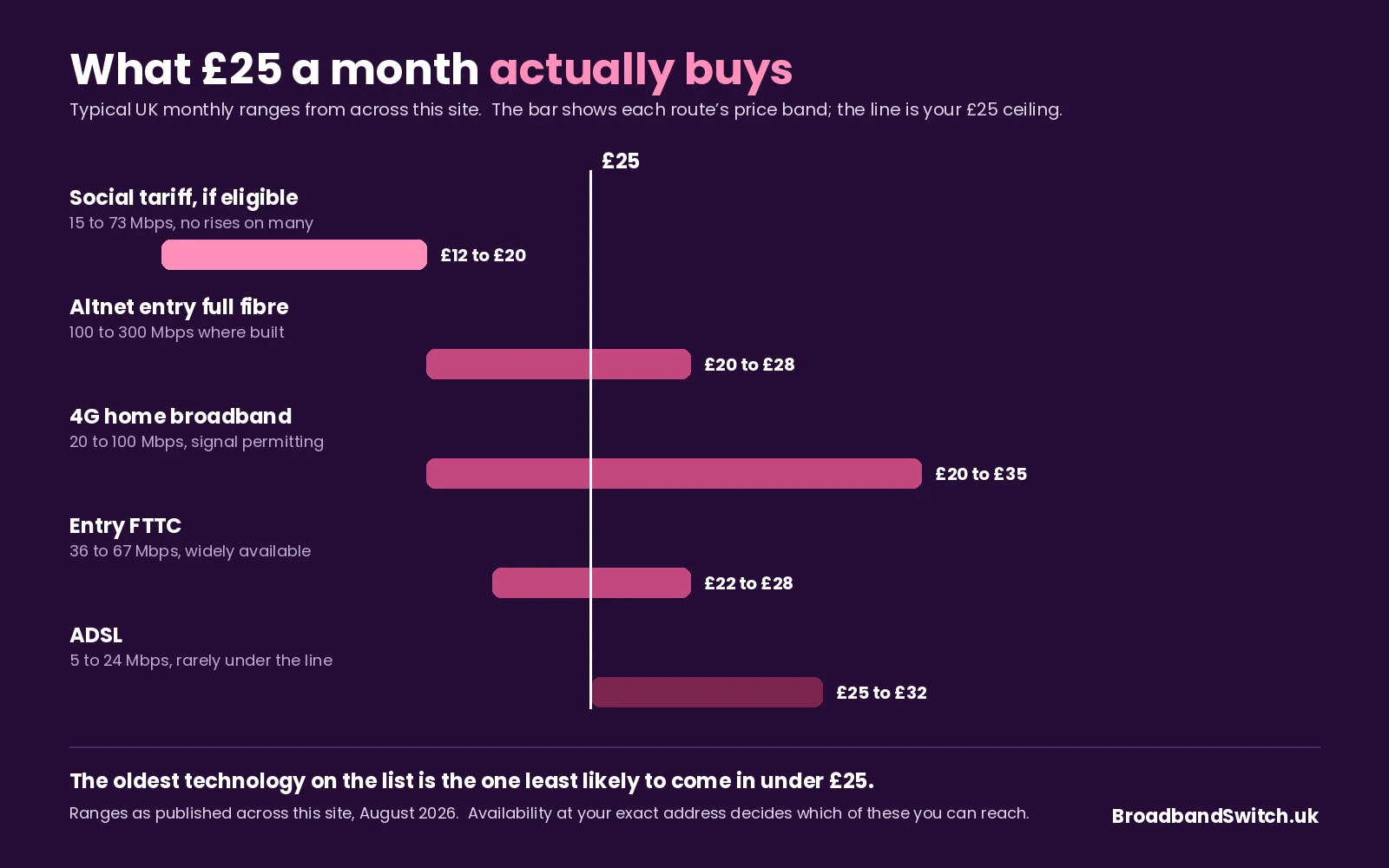
- Social tariff · £12 to £2015 to 73 Mbps depending on scheme, with many committing to no in-contract rises. Entirely below the line and the best value in the UK for anyone eligible.
- Altnet entry full fibre · £20 to £28100 to 300 Mbps where the network has been built, often with no setup fee and a fixed price. Where it reaches under £25, nothing else on this list competes on speed per pound. See full fibre deals.
- 4G home broadband · £20 to £3520 to 100 Mbps depending entirely on signal, plugged in the day it arrives with no engineer. Worth a look where fixed-line options are thin: see 4G home broadband.
- Entry FTTC · £22 to £2836 to 67 Mbps and available at almost every UK address, which is why most genuine sub-£25 deals turn out to be this. See FTTC deals.
- ADSL · £25 to £325 to 24 Mbps on pure copper, and the honest surprise of this list: the oldest technology is the one least likely to come in under £25. Cheap-looking and rarely cheap, as the ADSL page sets out.
Which of these exists at your door is decided street by street, so the postcode check is not a formality here: it is the whole shortlist.
Under £25 deals: avoiding false economy
For under-£25 searches, check setup charges and in-term rise rules before ordering, because a small monthly saving can disappear if one-off costs are missed. Here is that warning with the arithmetic attached.
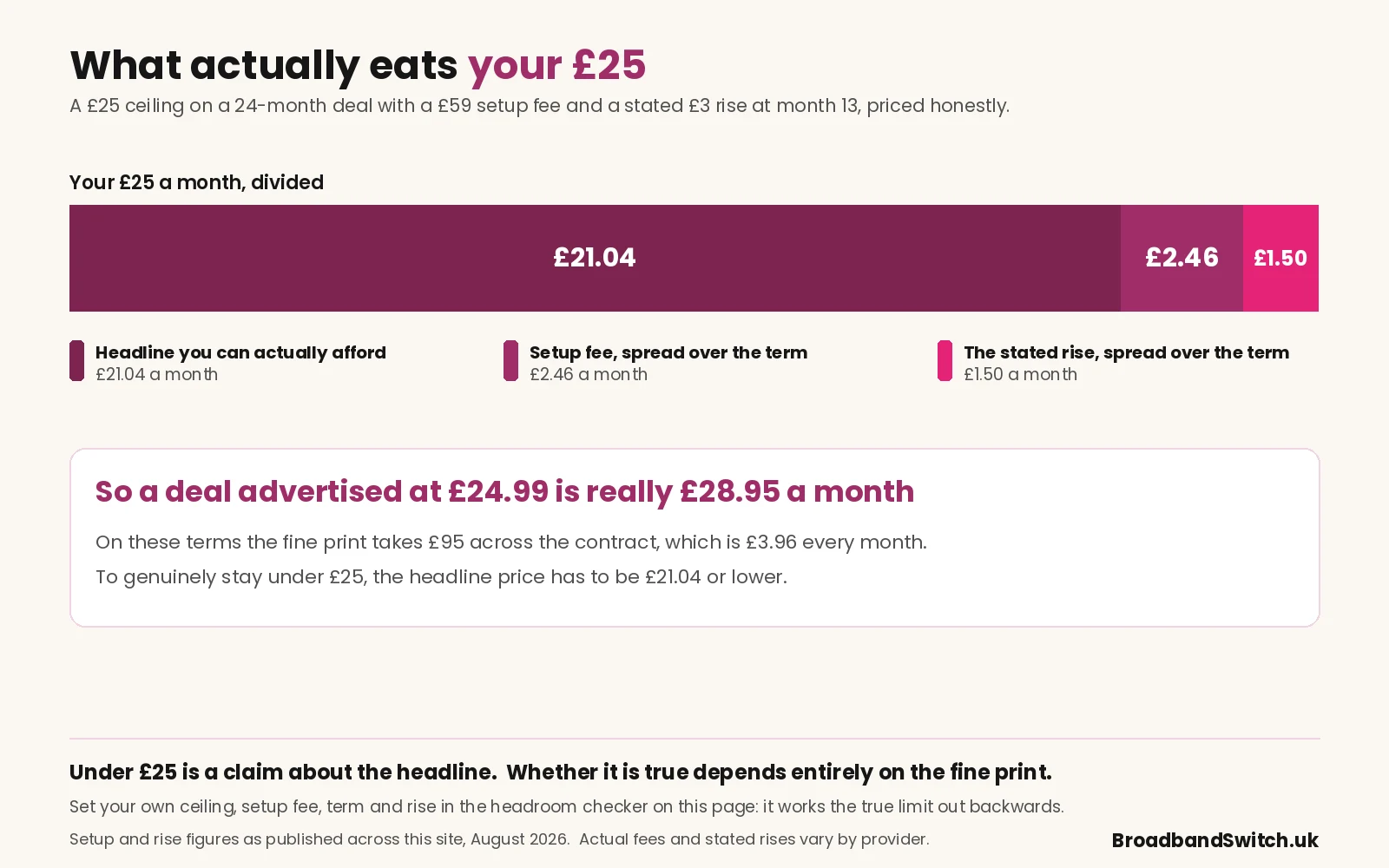
- The cheapest monthly can still cost the mostSpread a £59 setup fee across 24 months and it is £2.46 a month; add a stated £3 rise from month 13 and that is another £1.50. Together they take £95 across the term, so a £24.99 headline is really £28.95.Watch out
- Lower-cost deals often mean lower uploadsEntry tiers usually cut the upload first, which matters more than the download for video calls and cloud backup. An HD call wants 2 to 4 Mbps up, and FTTC entry tiers can sit close to that.Watch out
- Availability limits your real optionsAddress-level availability, not the national advert, decides your shortlist, and the cheapest route at this price point is frequently one that simply does not exist at your address.Watch out
- The rise is now written down for youSince 17 January 2025 any in-contract increase must be stated in pounds and pence at sign-up rather than tied to inflation, so the figure the checker above needs is in the terms rather than hidden in a formula.Use this
How to compare budget deals safely
- Run a postcode search and choose your exact addressNetworks change street by street, so the shortlist starts with what is genuinely live at your door rather than with national advertising.
- Sort by total cost and contract term, not the headlineThe monthly figure is one input. What you actually pay is every monthly payment across the term, plus setup, plus each raised month, divided by the length of the contract.
- Check setup fees and price rises in the provider's termsBoth are stated at sign-up. Put them into the headroom checker at the top of this page and it will tell you whether the deal in front of you is really under your ceiling.
- Read the cheapest versus best value guidance before orderingCheapest is about the floor, value is about the ratio: the cheapest deals guide and the best value page cover both, and One Touch Switch handles the move itself in a single step.
Compare deals under £25 at your postcode
Enter your postcode and choose your exact address to see live availability, each card carrying its monthly price, contract length, average speed and its stated April rise amounts in pounds and pence, which is everything the headroom checker needs. Availability is postcode and address specific, so pick your exact address in the widget where prompted.
Nothing under the line at your address? The under £30 bracket usually buys meaningfully more speed for a few pounds, and the full comparison shows every technology together.
Related ways to compare
Broadband under £25, asked and answered
What do deals under £25 mean in practice?
They can be strong value for lighter-use households, but you should check setup fees, in-contract rises and full-term cost before deciding. On a 24-month deal, a £59 setup fee and a stated £3 rise from month 13 add £3.96 a month between them, so a £24.99 headline is really £28.95 and the genuine under-£25 ceiling is a headline of £21.04.
Who might broadband deals under £25 suit?
Smaller households with basic streaming and browsing needs, budget-focused buyers trying to reduce monthly bills, and people willing to compare connection type trade-offs. Households with several heavy users, gamers or 4K streaming usually do better in the under £30 bracket, where the speed-to-value balance improves noticeably.
What speed can I expect under £25 a month?
Typically entry-level fibre at 30 to 40 Mbps, which covers everyday browsing, email, HD streaming and video calls comfortably, with speeds in this bracket tending to top out around 36 to 80 Mbps. Most deals here are FTTC rather than full fibre, although where an alternative network has built at your address, entry full fibre sometimes lands under the line with far more speed.
Why check setup fees and in-contract rises on deals under £25?
Because a small monthly saving can disappear if one-off costs are missed. Spread across the term, a £49 or £59 setup fee adds roughly £2 to £2.50 a month, and a stated rise partway through the contract adds its own share of every remaining month, which is why comparing on the true monthly figure rather than the headline is the only reliable method at this price point.
Is ADSL the cheapest way to get under £25?
Usually not, and this is the most common wrong assumption in the bracket: ADSL typically runs £25 to £32 a month for 5 to 24 Mbps, so the oldest technology on the market is often the one least likely to come in under the line, and entry FTTC at £22 to £28 for 36 to 67 Mbps beats it on both counts at most addresses.
Is there anything cheaper than an under-£25 deal?
Yes, for eligible households: social tariffs run roughly £12 to £20 a month for 15 to 73 Mbps, and many commit to no in-contract rises. Receiving Universal Credit, Pension Credit, Employment and Support Allowance, Jobseeker's Allowance or Income Support usually qualifies you, so it is worth checking before comparing anything on the open market.
How do I compare deals under £25 at my postcode?
Enter your postcode in the comparison tool on this page and choose your exact address, because availability is postcode and address specific and the shortlist changes street by street. Then run the two or three genuine contenders through the headroom checker so you are comparing what they really cost rather than what they advertise.
Will switching to a cheaper deal interrupt my broadband?
Not usually: One Touch Switch handles moves between fixed-line providers in a single step, with the new provider arranging the changeover and no gap in service in most cases. Moving onto a 4G router is the exception, because that sits outside the fixed-line switching system and needs cancelling and ordering separately.
About this guide. Written by Dr Alex J. Martin-Smith and reviewed by Adrian James, with every price and range stated as published at 6 August 2026, and the headroom checker running the same true-cost method used across this site from figures carried in its own markup. Prices, availability and package structure vary by exact address and change over time, and setup fees and stated rises differ by provider, so confirm both in the provider's terms before ordering. We earn commission when you order through the comparison, which never changes the price you pay: see how we rank deals, the editorial policy, the methodology and trust hub and the affiliate disclosure, or submit a correction and a human will read it.
References
- Ofcom. (2024, July 19). Ofcom bans mid-contract price rises linked to inflation. Office of Communications. https://www.ofcom.org.uk/phones-and-broadband/bills-and-charges/ofcom-bans-mid-contract-price-rises-linked-to-inflation
- Ofcom. (2024, September 12). Simpler and quicker broadband switching is here. Office of Communications. https://www.ofcom.org.uk/phones-and-broadband/switching-provider/simpler-broadband-switching-is-here
- Ofcom. (n.d.). Social tariffs: cheaper broadband and phone packages. Office of Communications. Retrieved August 6, 2026, from https://www.ofcom.org.uk/phones-and-broadband/saving-money/social-tariffs
Ceiling set, fine print understood, and thirty seconds to see what genuinely lands under it at your address. On the tightest budget, start with social tariffs; want a bit more speed, try under £30.
Independent and free. 35+ providers, true costs not headlines.
If money is the reason, start here
Social tariffs are the cheapest broadband available in the UK, at roughly £12 to £20 a month for 15 to 73 Mbps depending on the scheme, and many commit to no in-contract rises at all. They sit below every open-market deal on this page, and they are widely under-claimed simply because people do not know to look.
If nobody in the household qualifies, the open-market routes above are the shortlist, and the checker at the top of the page keeps them honest.