WI-FI GUIDE · STANDARDS · UPGRADE 2026
Wi-Fi 6 vs 6E vs 7: Should You Upgrade in 2026?
Three Wi-Fi generations are on sale in 2026, and the marketing is dazzling. Here is what each one really does, which routers the big providers actually ship, when the newest standard genuinely helps, and the honest answer to whether your home needs it at all.
Written by Dr Alex J. Martin-Smith · Reviewed by Adrian James · Published 11 June 2026 · Standards confirmed against the Wi-Fi Alliance; provider routers verified June 2026 · ~9 minute read
Prefer to read offline? Download the free PDF guide: Wi-Fi 6 vs 6E vs 7 (6 pages, ~280KB). No signup, no email, just the guide.
The quick answer
The three share a family tree. Wi-Fi 6 and 6E are the same standard, with 6E simply adding the clean new 6GHz band. Wi-Fi 7 is the genuine leap, with much higher peak speeds and, more usefully, lower latency. All three are backwards compatible with your older gear, and for most UK homes your broadband line speed matters far more than your Wi-Fi badge.
Key facts · verified June 2026
- Wi-Fi 6 was certified in 2019, 6E in 2021 and Wi-Fi 7 in 2024 (Wi-Fi Alliance), and all three are on sale in 2026.
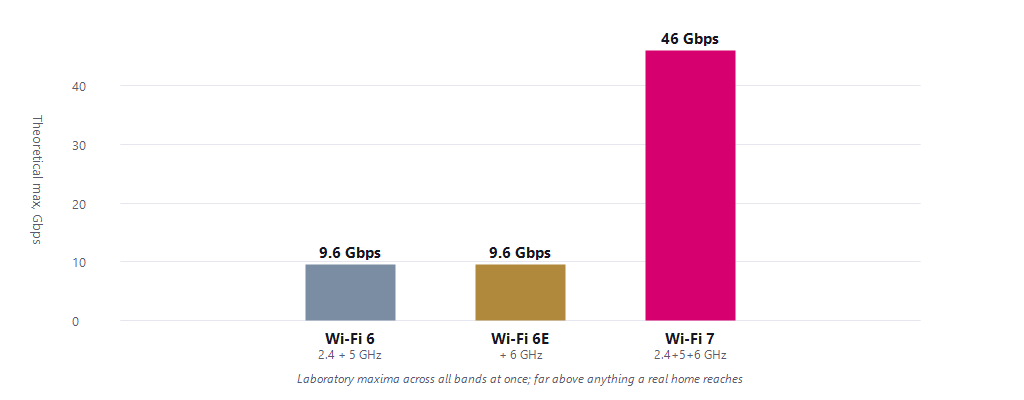
- Wi-Fi 7's theoretical top is 46 Gbps across all bands at once, versus 9.6 Gbps for Wi-Fi 6 and 6E, laboratory maxima far above anything a real home reaches.
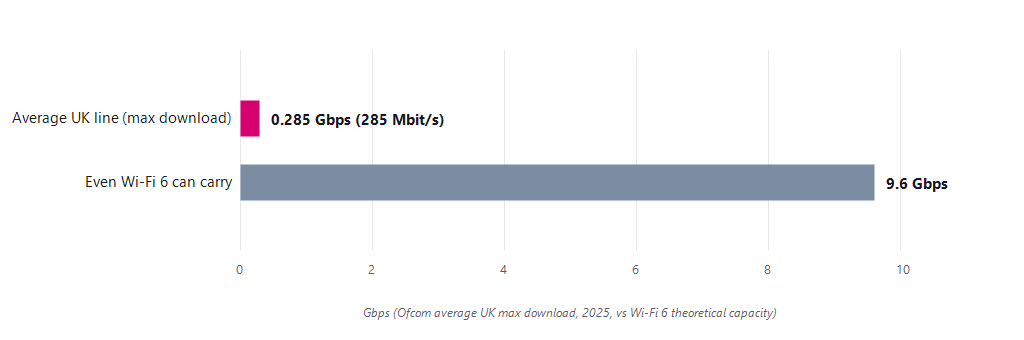
- The average UK line runs about 285 Mbit/s (Ofcom 2025), a fraction of even Wi-Fi 6's capacity, so the line is usually the bottleneck, not the router.
- EE became the first major UK provider to ship Wi-Fi 7 as standard across its full fibre plans, in December 2025; Virgin Media's Hub 5 is Wi-Fi 6 and BT's Smart Hub 2 is Wi-Fi 5.
- Both ends must match: you only get a standard if router and device both support it. Most recent flagship phones do Wi-Fi 7, including iPhone 16 and Galaxy S25 core models; many everyday devices remain on 6 or 6E.
Three generations, explained
| Generation | Bands | The headline |
|---|---|---|
| Wi-Fi 6 | 2.4 and 5GHz | Efficient in busy homes; arrived 2019 |
| Wi-Fi 6E | Adds 6GHz | Same speed, but clean new spectrum |
| Wi-Fi 7 | 2.4, 5 and 6GHz | Top speeds and low latency; arrived 2024 |
Wi-Fi 6 was certified in 2019, Wi-Fi 6E in 2021 and Wi-Fi 7 in 2024. The jump that matters most for everyday use is not raw speed but how each handles a house full of devices, which is the next section.
What actually changed
Beyond the headline speeds, the real improvements are about coping with congestion and cutting delay. These are the features doing the work.
- The 6GHz band (6E and 7). A wide, clean stretch of new spectrum with little legacy traffic, so less interference. The trade-off is shorter range, since higher frequencies fade faster through walls.
- Multi-Link Operation (Wi-Fi 7). The headline feature: a device can use more than one band at the same time, which lifts speed and, more importantly, lowers latency for things like video calls and cloud gaming.
- Wider channels and denser signals (Wi-Fi 7). Channels double in width to 320MHz and pack more data into each transmission, raising the ceiling for capable devices.
- Smarter sharing (all three). Techniques carried over and improved from Wi-Fi 6 let a router serve many devices at once rather than one after another, which is why a modern standard helps most in a busy home.
A note on 6GHz in the UK: the lower 6GHz band has been open for indoor Wi-Fi in the UK since 2020, and that is what 6E and Wi-Fi 7 use here today. Ofcom is still consulting on opening more of the upper 6GHz band, so the spectrum picture is set to widen further over the next few years.
The honest bit: your line matters more
Here is the part the box does not tell you. For most UK homes, your broadband line speed matters far more than your Wi-Fi standard, because even Wi-Fi 6 can carry many times what a typical line delivers.
When the newest Wi-Fi genuinely helps: a gigabit or multi-gig full fibre line, where older Wi-Fi can be the true bottleneck and Wi-Fi 7 lets a device actually use the speed; a very busy home, with EE's research putting the typical UK household at more than 25 connected devices; and low-latency uses such as virtual reality and cloud gaming, which feel Wi-Fi 7's lower delay. When it does not help: a sub-gigabit line, a home with only a handful of devices, or ordinary browsing, streaming and calls. In those cases the speed you would feel comes from a faster broadband package, not a faster router: see gigabit deals if you want the line to lead.
And one boundary worth drawing: if your problem is a weak signal upstairs or in a far room, that is a coverage problem, not a generation problem, solved in our companion guide: weak Wi-Fi: mesh vs extenders. For the full family tree from Wi-Fi 1 through to Wi-Fi 8, see our Wi-Fi generations explained guide.
Should you upgrade in 2026?
Both ends have to match: you only get a Wi-Fi standard if your router and your device support it. Most flagship phones from the last two years now do Wi-Fi 7, including the iPhone 16, 16 Plus and 16 Pro models and the core Samsung Galaxy S25 phones, though cheaper variants and many everyday devices are still on Wi-Fi 6 or 6E.
| Provider router | Wi-Fi standard |
|---|---|
| EE Smart Hub 7 (newest) | Wi-Fi 7 on full fibre plans |
| Virgin Media Hub 5 and 5x | Wi-Fi 6 |
| Sky Max Hub / Gigafast+ Hub | Wi-Fi 6, or Wi-Fi 7 on multi-gig |
| BT Smart Hub 2 | Wi-Fi 5 |
EE became the first major UK provider to make Wi-Fi 7 standard across its full fibre plans, in December 2025. Buying your own, Wi-Fi 6 routers start around £50, Wi-Fi 6E around £130, and Wi-Fi 7 from roughly £100 up to £400 or more, with prices changing often; whether to replace your ISP's router at all is covered at broadband routers and using your own router.
The simple rule for 2026: if you are buying a router anyway, Wi-Fi 7 is the sensible forward choice for little extra. But do not replace a working Wi-Fi 6 router just for the badge unless you have a gigabit line or a very busy home. The upgrade most people would actually feel is a faster broadband line.
The average UK line now offers 285 Mbit/s at maximum, far below any of these Wi-Fi ceilings, as charted in UK broadband statistics 2026.
Questions people ask
What is the difference between Wi-Fi 6, 6E and 7?
Wi-Fi 6 and 6E are the same 2019-era standard, with 6E adding the clean 6GHz band in 2021. Wi-Fi 7, certified in 2024, is the genuine generational leap: a 46 Gbps theoretical maximum versus 9.6 Gbps, channels twice as wide, and Multi-Link Operation that uses several bands at once for lower latency. All are backwards compatible.
Is Wi-Fi 7 worth it in 2026?
If you are buying a router anyway, yes, it is the sensible forward choice for little extra money. But replacing a working Wi-Fi 6 router just for the badge only pays off with a gigabit-class line, a very busy home of 25+ devices, or latency-sensitive uses like VR and cloud gaming; otherwise the upgrade you would feel is a faster broadband line.
Will a Wi-Fi 7 router make my broadband faster?
No. Your router cannot exceed the line feeding it, and the average UK line runs about 285 Mbit/s against even Wi-Fi 6's 9.6 Gbps of theoretical capacity. A newer standard improves how speed is shared and delivered around the house, but the headline number comes from your broadband package.
Which UK providers give you a Wi-Fi 7 router?
EE became the first major provider to ship Wi-Fi 7 as standard across its full fibre plans in December 2025, with its Smart Hub 7, and Sky supplies Wi-Fi 7 on its multi-gig tiers. Virgin Media's Hub 5 family is Wi-Fi 6, and BT's Smart Hub 2 remains Wi-Fi 5.
Do my devices support Wi-Fi 7?
Recent flagships do, including the iPhone 16, 16 Plus and 16 Pro models and the core Samsung Galaxy S25 phones, but cheaper variants and most everyday devices, laptops, TVs and smart home kit are still on Wi-Fi 6 or 6E. You only get a standard when both router and device support it, so audit your devices before paying for the badge.
About this guide
This guide is part of the BroadbandSwitch.uk 2026 Guide Library, published by BroadbandSwitch.uk, the consumer arm of the SearchSwitchSave network. Wi-Fi standards and dates are confirmed against the Wi-Fi Alliance; speeds quoted are theoretical maxima and labelled as such. Our approach to evidence and corrections is documented in the methodology and trust hub, and every published correction appears in the corrections log.
Take it with you: download the free 6-page PDF guide, including the generations table, the reality-check chart and full sources.
Citing this guide: BroadbandSwitch.uk. (2026, June 11). Wi-Fi 6 vs 6E vs 7: Should you upgrade in 2026? SearchSwitchSave. https://broadbandswitch.uk/guides/wifi-6-vs-6e-vs-7/
Sources
- Wi-Fi Alliance. (2019, September 16). Wi-Fi CERTIFIED 6 delivers new Wi-Fi era. https://www.wi-fi.org/news-events/newsroom/wi-fi-certified-6-delivers-new-wi-fi-era
- Wi-Fi Alliance. (2021, January 7). Wi-Fi Alliance delivers Wi-Fi 6E certification program. https://www.wi-fi.org/news-events/newsroom/wi-fi-alliance-delivers-wi-fi-6e-certification-program
- Wi-Fi Alliance. (2024, January 8). Wi-Fi Alliance introduces Wi-Fi CERTIFIED 7. https://www.wi-fi.org/news-events/newsroom/wi-fi-alliance-introduces-wi-fi-certified-7
- IEEE 802.11 Working Group. (2025). IEEE Std 802.11be-2024. https://www.ieee802.org/11/
- Ofcom. (2026, January). Statement and further consultation: Expanding access to the 6 GHz band. https://www.ofcom.org.uk/spectrum/innovative-use-of-spectrum/consultation-expanding-access-to-the-6-ghz-band-for-commercial-mobile-and-wi-fi-services
- Ofcom. (2025, November 19). Connected Nations 2025: UK report. https://www.ofcom.org.uk/phones-and-broadband/coverage-and-speeds/connected-nations-20252
- EE. (2025, December 12). EE sets new standard for in-home connectivity. https://newsroom.ee.co.uk/ee-sets-new-standard-for-in-home-connectivity-as-the-uks-first-major-broadband-provider-to-offer-wifi-7-across-all-full-fibre-plans/
- Apple. (2025). Wi-Fi and Ethernet specifications for Apple devices. https://support.apple.com/en-gb/guide/deployment/dep268652e6c/web
This guide is general consumer information. Quoted Wi-Fi speeds are theoretical laboratory maxima; router prices are indicative June 2026 retail; provider router line-ups vary by plan and change over time.