BROADBAND SPEED · HOUSEHOLD GUIDE · SPEEDS & WI-FI
What Broadband Speed Do I Need by Household Size?
Gigabit sounds great, but do you actually need it? Here is the honest maths: what each activity really uses, what your household adds up to on its busiest evening, and the speed worth paying for, including the cases where buying more will not help at all.
Written by Dr Alex J. Martin-Smith · Reviewed by Adrian James · Published 11 June 2026 · Platform figures verified June 2026 · ~9 minute read
Prefer to read offline? Download the free PDF guide: What Broadband Speed Do I Need by Household Size? (6 pages, ~265KB). No signup, no email, just the guide.
The quick answer
For most UK homes, 100 to 300 Mbps is the sweet spot. Go lower if you live alone and use it lightly, higher if four or more of you stream in 4K, game and upload at once. The right number is simply what your busiest evening adds up to, plus headroom, and this guide shows you the maths. In a hurry? The 60-second version lives at what broadband speed do I need; this page is the full methodology.
| Your household | A typical evening | Look for |
|---|---|---|
| 1-2 people, light use | One stream, browsing, calls | 50-100 Mbps |
| 3-4 people, mixed use | Two streams, gaming, homework | 100-300 Mbps |
| 4+ people, heavy use | Multiple 4K streams plus gaming | 300-500 Mbps |
| Power users, creators | 4K everywhere, big uploads, smart home | 500+ Mbps |
These bands are what to look for, not what you must buy: a steady connection at the bottom of your band beats an unreliable one at the top. They are our editorial guidance, derived openly from the activity figures below.
Key facts · verified June 2026
- One 4K stream needs 15 to 25 Mbps; Netflix's own recommendation is 25 Mbps per stream, and streams add up, they do not share.
- An HD stream needs just 5 to 8 Mbps, and a group video call around 4 Mbps.
- Gaming needs little speed but low latency: playing online uses around 3 Mbps; it is lag, not bandwidth, that ruins it.
- 17% of UK homes still take plans under 100 Mbps (Ofcom, 2025), and for light users that is often a perfectly sound choice.
- Upload matters if you create or work from home: live-streaming out needs 8 to 10 Mbps of upload on its own.
What each activity really uses
Speed shopping gets easy once you know what each activity actually uses. These are the platforms' own recommendations, per person or stream.
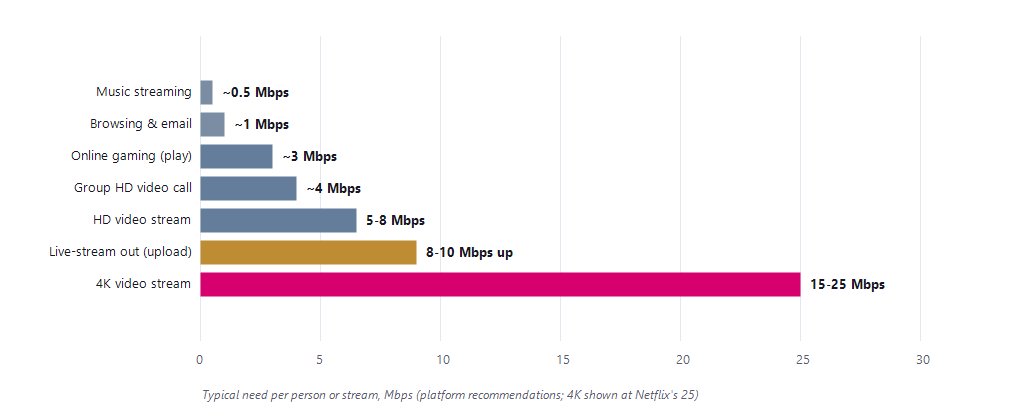
Two readings worth taking from that chart. First, everyday activities are cheap: music, browsing, calls and even HD telly barely dent a modern connection. Second, 4K is the budget-eater, and it multiplies: every simultaneous 4K stream books out its own 25 Mbps, so a household's number is set almost entirely by how many screens run top-quality video at once.
Three steps to your number
- Count your busiest evening, not your average day. How many screens stream at once at 8pm on your fullest night, and at what quality? Two 4K streams alone is 50 Mbps.
- Add the rest of the house. Calls, gaming, homework, music and a houseful of phones quietly add another 10 to 20 Mbps.
- Add a third again as headroom. Background updates, smart devices and the normal ebb of real-world speeds mean a 30 to 50% buffer keeps everything smooth.
A worked example: two 4K streams (50) plus a gamer (3), a video call (4) and the background hum (15) is 72 Mbps. Add headroom and a 100 Mbps plan fits beautifully, which is why it is the family sweet spot.
What to buy, by household
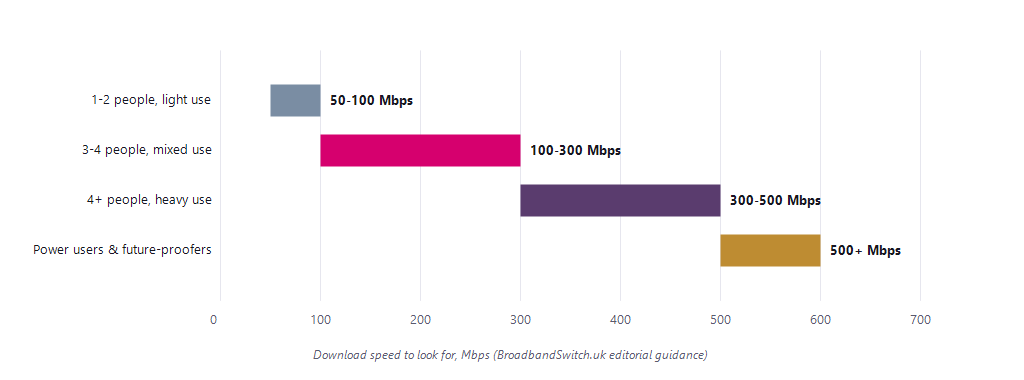
- 1-2 people, light use. Streaming in HD, browsing, video calls. Entry full fibre around 50 to 100 Mbps covers this with room to spare, often for the lowest price on the market.
- 3-4 people, mixed use. Simultaneous streams, gaming and homework. 100 to 300 Mbps keeps every evening smooth, and is where the best value per megabit usually sits. Big families have their own dedicated rundown at broadband for large households.
- 4+ people, heavy use. Several 4K streams plus gaming and calls at once. 300 to 500 Mbps means nobody negotiates over the bandwidth. Shared houses juggle this differently, covered in broadband for students and shared houses.
- Power users and future-proofers. Creators uploading big files, serious smart homes, or anyone who simply never wants to think about it. 500 Mbps up to gigabit, and weight the upload as heavily as the download. Why upload deserves more attention: upload speed vs download speed.
Use-case deep dives, including latency-first buying for players and resilience-first buying for home workers, live at broadband for gaming, broadband for streaming and broadband for working from home.
When more speed will not help
We compare broadband for a living, and here is the truth: plenty of homes are sold speed they will never feel. Three things matter more than the headline number.
- Latency beats bandwidth for gaming and calls. Online play uses around 3 Mbps; what ruins it is lag. If games stutter on a fast plan, the fix is the connection quality, not a bigger number. The hidden metrics explained: latency, jitter and packet loss.
- Your Wi-Fi can waste what you buy. A gigabit plan through a poorly placed router can feel slower than 100 Mbps done well. If pages crawl in the back bedroom, fix the Wi-Fi before upgrading the plan.
- A steady 100 beats a flaky 500. Reliability and consistency at peak time are worth more than headline speed, which is why full fibre at a modest tier often feels faster than it sounds. Check what you actually get with a wired test at ukspeedtest.co.uk, at peak time and off-peak.
And if money is tight: social tariffs offer solid speeds at a fraction of standard prices for households on qualifying benefits, and they are typically exempt from mid-contract rises. The full picture: social tariffs UK.
For context, the average UK connection now moves 583GB a month, with every usage figure sourced in UK broadband statistics 2026.
If your line underperforms the tier you chose, see our companion guide: why your speeds may be lower than advertised.
Questions people ask
What broadband speed do I need for a family of four?
For a family of three to four with mixed use, simultaneous streams, gaming and homework, 100 to 300 Mbps keeps every evening smooth, and it is usually where the best value per megabit sits. If several of you stream in 4K at once, step up towards 300 to 500 Mbps.
Is 100 Mbps enough for a family?
Often, yes. Two 4K streams (50 Mbps), a gamer (3), a video call (4) and the household's background hum (15) total 72 Mbps, which fits a 100 Mbps plan with headroom to spare. Add more simultaneous 4K screens and you will want the next tier.
What speed do I need for 4K Netflix?
Netflix's own recommendation is 25 Mbps per 4K stream, with the realistic range 15 to 25 Mbps depending on the platform; YouTube puts 4K at around 20 Mbps. Crucially, simultaneous streams add up rather than share, so three 4K screens at once need around 75 Mbps for the video alone.
Is gigabit broadband worth it?
For most households, not on need alone: even a heavy evening rarely exceeds a few hundred Mbps. Gigabit earns its keep for creators uploading big files, very full smart homes, and anyone who values never thinking about bandwidth, in which case weight the upload speed as heavily as the download.
What speed do I need for gaming?
Surprisingly little: online play uses around 3 Mbps, though game downloads enjoy any speed you give them. What actually ruins gaming is latency, jitter and packet loss, so a player's money is better spent on connection quality, typically full fibre, than on a bigger headline number.
About this guide
This guide is part of the BroadbandSwitch.uk 2026 Guide Library, published by BroadbandSwitch.uk, the consumer arm of the SearchSwitchSave network. Activity figures are the platforms' own published recommendations; UK market figures are Ofcom's; the household bands are our editorial guidance, derived openly from the activity maths above. Our approach to evidence and corrections is documented in the methodology and trust hub, and every published correction appears in the corrections log.
Take it with you: download the free 6-page PDF guide, including the activity chart, household bands and full sources.
Citing this guide: BroadbandSwitch.uk. (2026, June 11). What broadband speed do I need by household size? SearchSwitchSave. https://broadbandswitch.uk/guides/what-speed-do-i-need-by-household/
Sources
- Ofcom. (2025, November 19). Connected Nations 2025: UK report. https://www.ofcom.org.uk/phones-and-broadband/coverage-and-speeds/connected-nations-20252
- Zoom. (n.d.). Zoom system requirements. https://support.zoom.us/hc/en-us/articles/201362023
- Reviews.org. (2026, April 3). What internet speed do I need for Netflix? https://www.reviews.org/internet-service/internet-speed-for-netflix/
- HighSpeedInternet.com. (2026, March 11). How much speed do I need to stream video? https://www.highspeedinternet.com/resources/how-much-speed-do-i-need-to-watch-netflix-and-hulu
- BroadbandNow. (2025, September 17). What streaming bandwidth do you need? https://broadbandnow.com/guides/streaming-bandwidth
This guide is general consumer information. Activity figures are platform recommendations and vary with settings and codecs; the household bands are editorial guidance, not minimum requirements; real-world speeds depend on your line, Wi-Fi and time of day.