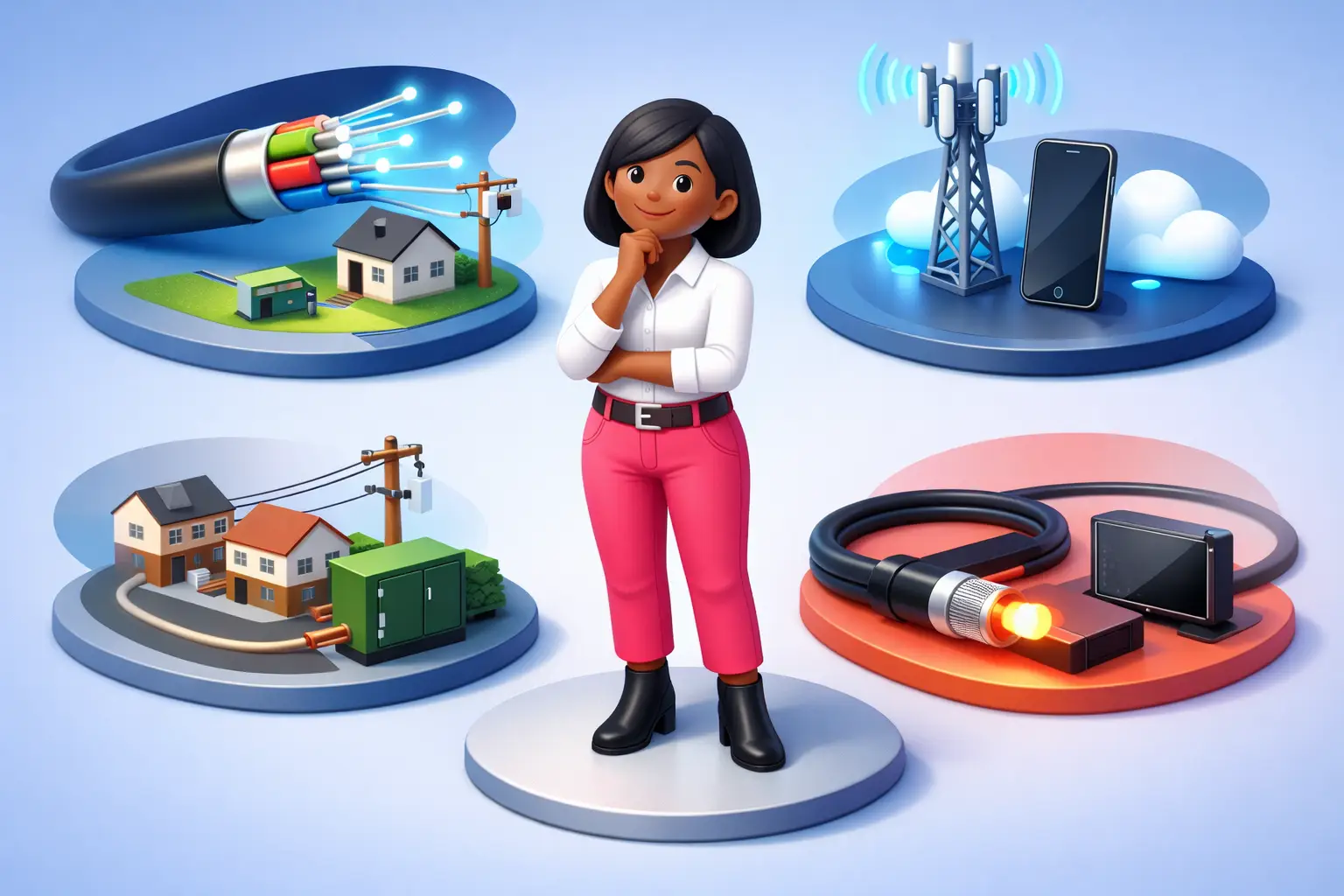
Direct answer: if you are asking, “Which is faster FTTP, FTTC, Satellite, 5G or Virgin Cable?? Help me to understand,” the short answer is this: FTTP is usually the best all-round option, Virgin Media cable is often very fast too, 5G can be quick but less consistent, FTTC is older and slower, and satellite is usually the slowest and highest-latency choice for most homes. You can compare broadband deals by postcode.
Quick summary
- FTTP, also called full fibre, is usually the fastest and most reliable fixed-line option.
- Virgin Media cable can deliver very high speeds, but availability is more limited than Openreach-based services.
- 5G broadband can be fast in the right area, but performance varies more by signal, congestion and location.
- FTTC is widely available, but it is slower because the final stretch still uses copper.
- Satellite is mainly for harder-to-reach homes where other broadband types are unavailable.
Which is faster: FTTP, FTTC, satellite, 5G or Virgin Cable?
FTTP is usually fastest overall for most households, with Virgin Media cable close behind in many areas.
The reason is simple. FTTP uses fibre all the way to your property, so it avoids the bottlenecks that come with older copper lines. In practical terms, that means higher download speeds, better upload speeds and more stable performance when several people are online at once.
Virgin Media cable can also be very fast, often much faster than FTTC, because it uses a cable network designed for higher capacity. Where it differs is the network type and availability. Virgin does not use the Openreach network, so you can only get it in certain postcodes.
5G home broadband sits in a different category because it uses a mobile network rather than a fixed cable into your home. In a strong coverage area it can outperform FTTC comfortably, and sometimes rival lower-tier full fibre packages. But it is less predictable, especially at busy times.
FTTC, or fibre to the cabinet, is an older hybrid setup. Fibre runs to the street cabinet, then copper runs into your home. That copper section is why speeds fall off with distance.
Satellite broadband is normally the last resort for speed-focused buyers. It works almost anywhere with a clear view of the sky, but latency is much higher, which affects video calls, gaming and responsive browsing.
What do these technologies actually mean?
The connection type matters because it explains why one service feels faster than another.
FTTP means fibre to the premises. Openreach and several altnets use this model. Because fibre reaches your property directly, it is the strongest option for homes that need dependable speed for home working, large downloads and busy evening use. If full fibre is available to you, it is often the first place to look, especially on this FTTP broadband deals page.
FTTC means fibre to the cabinet. It was a major step up from older ADSL, but it is no longer the top choice where full fibre exists. A household close to the cabinet can get decent everyday performance, but not the same consistency or headroom as FTTP.
Virgin Media cable uses a separate cable network. It is a fixed-line service like FTTP and FTTC, but not the same infrastructure. In the right area, it can offer very high headline speeds and works well for larger households.
5G home broadband uses a mobile signal received by a router in your home. Setup is often quick, which appeals to renters, movers and anyone who wants to avoid waiting for installation.
Satellite sends data via a satellite link rather than a terrestrial cable or mast. That is useful for remote properties, but it adds delay because the signal travels a long distance.
How do speed and reliability compare in real life?
FTTP usually gives the best balance of speed, consistency and latency.
For a typical household, the difference is not just headline download speed. It is what happens when two people are on video calls, someone else is backing up files, and the rest of the house is browsing or using cloud-based tools. FTTP tends to cope best because the line is more stable and less affected by distance.
Virgin Media cable can feel similarly quick for downloads and general heavy use. The trade-off is that local network conditions can still affect experience, and package availability depends entirely on whether your address is on the cable network.
5G can be excellent one hour and noticeably weaker the next. That does not make it a bad product. It means you need to think harder about your address, signal strength, wall thickness, router placement and how busy the nearby mast gets. For some homes it is a smart short-contract option. For others, it is frustratingly variable.
FTTC is more predictable than 5G in some cases, but its ceiling is lower. If your current FTTC line feels slow, that is often a hard limit of the technology rather than something a provider change alone will fix. This is where a proper broadband speed guide helps separate Wi-Fi issues from line limitations.
Satellite is reliable for basic access where little else is available, but not ideal where low lag matters. Ofcom guidance regularly highlights latency as a key part of user experience, not just raw speed.
Which is best for gaming, video calls and working from home?
FTTP is usually best, Virgin Media cable is often strong, and satellite is usually worst for latency-sensitive tasks.
For gaming and video calls, latency matters as much as speed. FTTP generally performs best because fibre delivers quick response times as well as strong throughput. That means smoother calls, faster cloud access and fewer issues when multiple people are connected.
Virgin Media cable can also work very well for these uses. For many households, it offers more than enough speed for remote work and busy home use. The key is that the service must be available at your address and the total contract cost needs to make sense.
5G is more mixed. A strong 5G setup can be perfectly usable for video meetings and everyday work. But if your connection fluctuates, that is where calls can become unstable. People who rely on constant uptime for work should compare fixed-line options first.
FTTC can still handle home working, web browsing and standard video calls, especially for smaller households. It becomes less comfortable when usage stacks up. If your home office relies on cloud backups, large uploads or all-day calls, FTTP is the stronger long-term fit.
Satellite is the toughest for gaming and real-time work because the lag is built into the technology.
Is Virgin Media cable faster than Openreach FTTP?
Usually no, not once you compare like-for-like full fibre packages, but Virgin can still be much faster than FTTC.
This is where many comparisons go wrong. People often compare Virgin cable with FTTC, because FTTC is more common in older areas, then assume Virgin is automatically faster than all Openreach-based broadband. That is not true.
If your Openreach option is FTTP, full fibre will often match or beat cable on overall experience, especially for upload performance and consistency. If your Openreach option is only FTTC, Virgin cable will often look far faster.
So the real question is not just provider versus provider. It is network type at your exact address. That is why address-level checks matter more than generic rankings. If you are weighing up providers, this providers overview is a useful next step, and the switching hub explains how moving between services works under current UK switching rules, including One Touch Switch.
When does 5G make more sense than fixed broadband?
5G makes sense when you need speed quickly, want flexibility, or cannot get decent fixed-line service.
For renters, people in short-term accommodation, and households waiting for fibre installation, 5G can be a practical stopgap. It can also suit some rural or edge-of-network homes where FTTC is poor and FTTP is not yet available.
The catch is consistency. If your work depends on stable calls or if your home has patchy mobile coverage indoors, fixed broadband is usually the safer choice. Before choosing 5G, test coverage carefully and think about where the router will sit in the property.
For some micro-businesses, a strong fixed line is still the better answer. If you run card payments, booking systems or cloud tools from a home office or small premises, start with this business broadband hub rather than assuming mobile-based service will be enough.
What should you choose at your address?
Choose FTTP first if available, Virgin Media cable second if it offers better value than your fibre options, 5G if you need flexibility, FTTC if it is the only practical fixed line, and satellite only when other choices are poor or unavailable.
That order suits most households, but price and contract terms still matter. A slower service that is stable and sensibly priced can be the better buy than a faster one with setup fees, annual price rises or a long contract that does not suit your move date.
If you are budget-conscious, it is worth checking current broadband deals under £25 and broadband deals under £30, because the best-value choice is not always the highest-speed package. If cost is the main issue, some households should also review social tariffs in the UK, which can offer lower monthly pricing for eligible customers.
FAQ
Is FTTP always faster than FTTC?
Yes, in normal UK home broadband comparisons, FTTP is faster and more consistent than FTTC because it uses fibre all the way to your property rather than copper for the final stretch.
Is 5G broadband faster than FTTC?
Often yes, but not always. In a strong signal area, 5G can outperform FTTC. Its weakness is consistency, because speeds can vary by signal strength and local congestion.
Why is satellite broadband usually slower for everyday use?
The biggest issue is latency rather than just download speed. The signal travels much further, so real-time tasks such as video calls and gaming feel less responsive.
Is Virgin Media cable the same as full fibre?
No. Virgin Media cable uses a different network from Openreach FTTP. Both can be fast fixed-line options, but they are not the same technology.
What is the best broadband for working from home?
FTTP is usually the best choice for remote work because it combines strong speeds, good upload performance and low latency. Virgin cable can also work well where available.
How do I know which type I can get?
Availability is address-specific. The most accurate way to check is to compare live options for your exact property rather than relying on postcode averages alone.
The fastest broadband on paper is not always the best deal for your home, budget or move date. To see what is actually available where you live, compare broadband deals by postcode and narrow it down by exact address, contract terms and total cost.