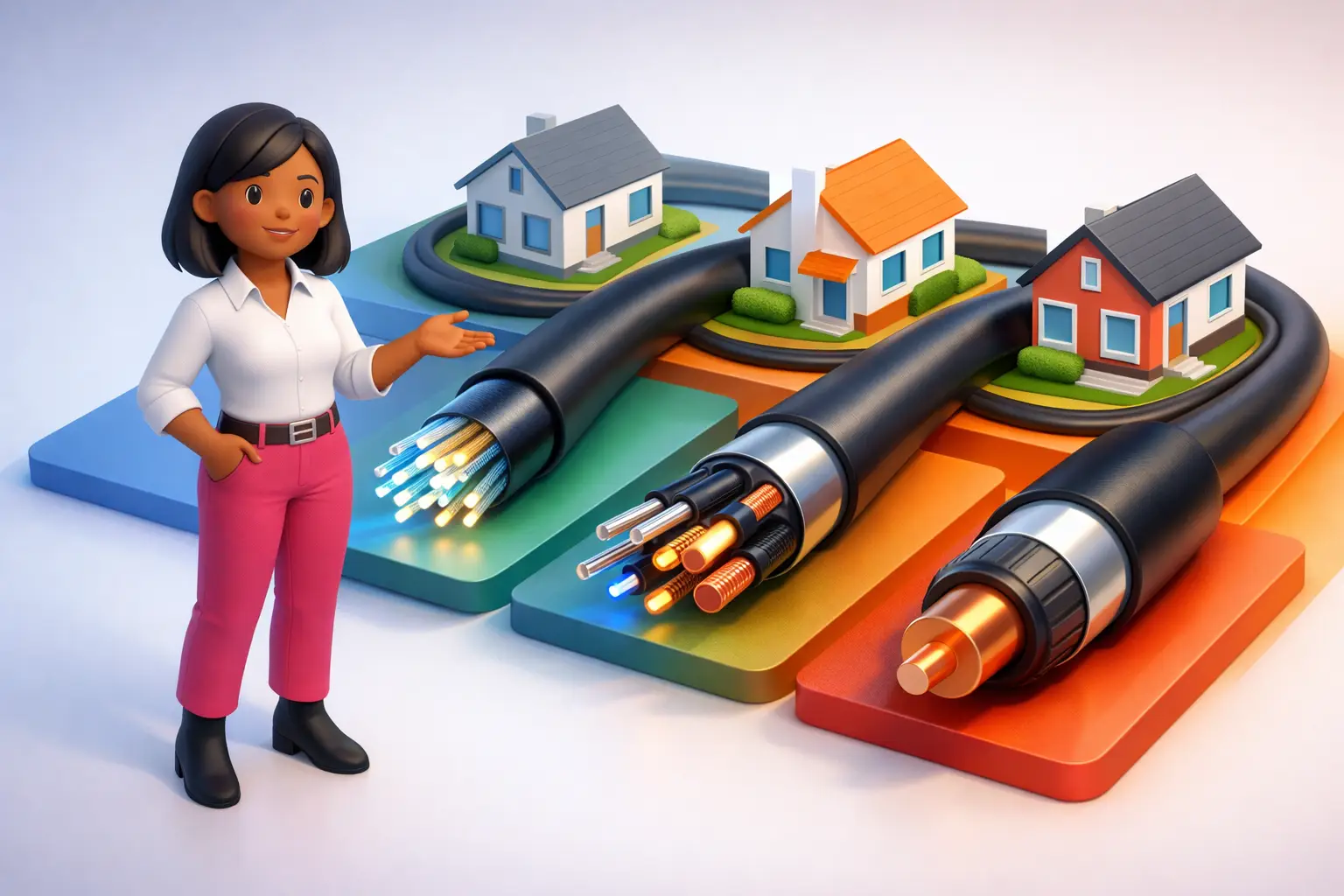
Direct answer: Full fibre means fibre all the way to your home, part fibre usually means fibre to the street cabinet then copper to your property, and cable uses a different network that often combines fibre with coaxial cable. Full fibre is usually the most future-proof. The best option still depends on what is available at your address, so it helps to compare broadband deals by postcode first.
Quick summary
- Full fibre, also called FTTP, is usually the fastest and most reliable fixed-line option.
- Part fibre, often FTTC, can still be fine for lighter households but speed drops with distance from the cabinet.
- Cable is not the same as full fibre, though it can deliver strong speeds in some areas.
- The network type matters, but so do total contract cost, setup fees, in-contract rises and installation timing.
- Availability is postcode and address specific, especially for full fibre and altnets.
What is full fibre vs part fibre vs cable?
The short answer is that these are three different ways broadband reaches your home.
Full fibre usually means FTTP, or Fibre to the Premises. A fibre optic line runs from the exchange or local network right into your property. That avoids the old copper phone line for the main broadband connection.
Part fibre usually means FTTC, or Fibre to the Cabinet. Fibre runs to the green street cabinet, then the final stretch to your home uses copper. This is why two homes on the same package can see different real-world speeds.
Cable broadband uses a separate network, most commonly associated with Virgin Media in many areas. It typically uses fibre for much of the route, with coaxial cable for the last part into the property. That means it is neither the same as FTTC nor the same as FTTP.
If you are still weighing up technologies against price and switching rules, the broadband switching hub covers the practical side.
What is full fibre broadband?
Full fibre means the connection to your home is fibre optic end to end.
That matters because fibre carries data more efficiently over distance than copper. In practice, full fibre tends to offer more consistent speeds, lower latency and better performance at busy times, although actual experience still depends on your provider, router, home setup and the package you choose.
You will often see full fibre sold as FTTP. Some providers also use terms such as ultrafast or gigabit, but those marketing labels are less precise than FTTP. If you want the plain-English version, full fibre is the one most people mean when they ask, what is full fibre?
It is often the best fit for busy households, home working, large file uploads and homes with several people online at once. If it is available where you live, you can see current FTTP broadband deals and compare the trade-offs properly.
What is part fibre, and why is FTTC slower?
Part fibre means the final section still uses copper, and that is usually the weak point.
With FTTC, fibre gets broadband close to your home, but not all the way there. The last leg uses the traditional phone line. Copper is more affected by distance and line quality, so the farther you are from the cabinet, the more speed can fall away.
That is why part fibre can be perfectly acceptable for one household and frustrating for another on the same advertised package. It depends on the line, the cabinet distance and local conditions. Ofcom explains these technology differences clearly, and Openreach uses FTTP and FTTC as standard network terms.
Part fibre is not automatically bad. For smaller households doing general browsing, video calls and everyday use, it may still be enough, especially if the monthly cost is lower and full fibre is not yet available.
Is cable broadband the same as fibre?
No, cable broadband is not the same as full fibre, even if it can be fast.
Cable uses a different access network. In many areas, it has offered higher speeds than older FTTC connections, which is why some homes have seen cable as the better alternative to part fibre. But it is still a separate technology from FTTP.
This is where broadband wording gets confusing. Providers may advertise fibre in a broad marketing sense, because fibre exists in much of the network, but the key question is what reaches your actual home. If the answer is coaxial cable, it is cable broadband. If the answer is fibre optic cable right into the property, it is full fibre.
If you are comparing major names such as BT, Sky, TalkTalk, Vodafone, EE, Plusnet and Virgin Media, the providers page helps separate network type from brand name.
FTTP vs FTTC: which is better for most homes?
FTTP is usually better, but availability and price still decide the best choice.
For most households, full fibre wins on raw performance, reliability and future-proofing. It is generally better suited to remote work, cloud backups, gaming and households where several people are online together. It is also less dependent on how far you live from a cabinet.
FTTC can still make sense when the monthly deal is cheaper, installation is faster, or full fibre is not available. If your household use is modest, the difference may matter less than the total cost over the contract.
| Type | Usually means | Last stretch to home | Typical strengths | Main trade-off |
|---|---|---|---|---|
| Full fibre | FTTP | Fibre | Strong speeds, consistency, future-proofing | Not available everywhere, installation can vary |
| Part fibre | FTTC | Copper | Wider legacy availability, often simpler upgrade path | Speed depends on line length and quality |
| Cable | Cable network | Coaxial cable | Good speeds in covered areas | Different network footprint, not the same as FTTP |
If your main question is whether a slower line is enough, this broadband speed guide is a useful next step.
Does broadband type affect price and switching?
Yes, but the cheapest technology is not always the cheapest deal overall.
A lower monthly price on part fibre can look appealing, but setup fees, contract length and in-contract price rises can change the picture. Equally, a full fibre package with a slightly higher monthly cost may offer better value if it lasts longer for your needs and avoids another switch soon after.
Cable and full fibre can also differ on installation timing. Some homes can activate quickly, while others may need an engineer visit. Movers and renters should pay attention here, because the best deal on paper is less useful if it cannot be installed when you need it.
If budget is your main concern, it is worth checking broadband deals under £25 or broadband deals under £30 alongside the network type.
What if full fibre is not available at my address?
If full fibre is unavailable, the best next choice depends on your address, not just your postcode.
Some homes can get cable but not FTTP. Others can get FTTC from Openreach-based providers but not cable. Some areas also have altnets offering full fibre on their own networks. This is why exact address checking matters more than general claims about a town or postcode district.
For small firms, home offices and sole traders, availability can shape whether a residential line is enough or whether you should look at business packages instead. The business broadband hub explains where that line sits.
If affordability is the bigger issue than technology, some eligible households may also want to review social tariffs in the UK.
FAQs
What does FTTP stand for?
FTTP stands for Fibre to the Premises. It means a fibre optic line runs directly to your home or business.
What does FTTC stand for?
FTTC stands for Fibre to the Cabinet. Fibre runs to the street cabinet, then copper carries the connection to your property.
Is full fibre always faster than part fibre?
Usually, yes. Full fibre is generally faster and more consistent than FTTC, but your actual speeds still depend on the package and provider network at your address.
Is Virgin Media full fibre?
Virgin Media has used a cable network in many areas rather than standard Openreach FTTP. Some areas and products may differ, so check the exact network available at your address rather than relying on the brand alone.
Do I need full fibre for working from home?
Not always. Many people work from home on FTTC without major issues. Full fibre is often the better choice if your work depends on frequent video calls, large uploads or a more reliable connection.
How do I know which broadband type I can get?
The practical way is to check by exact address. Availability varies street by street, and sometimes flat by flat. You can compare broadband deals by postcode to see what is actually offered where you live.
Broadband labels can make simple things sound more technical than they are. The useful question is not whether a provider says fibre, but whether your home gets FTTP, FTTC or cable, and what that means for speed, cost and installation. If you are comparing options before renewal, moving home or replacing a slow line, enter your postcode and exact address to compare broadband deals by postcode.