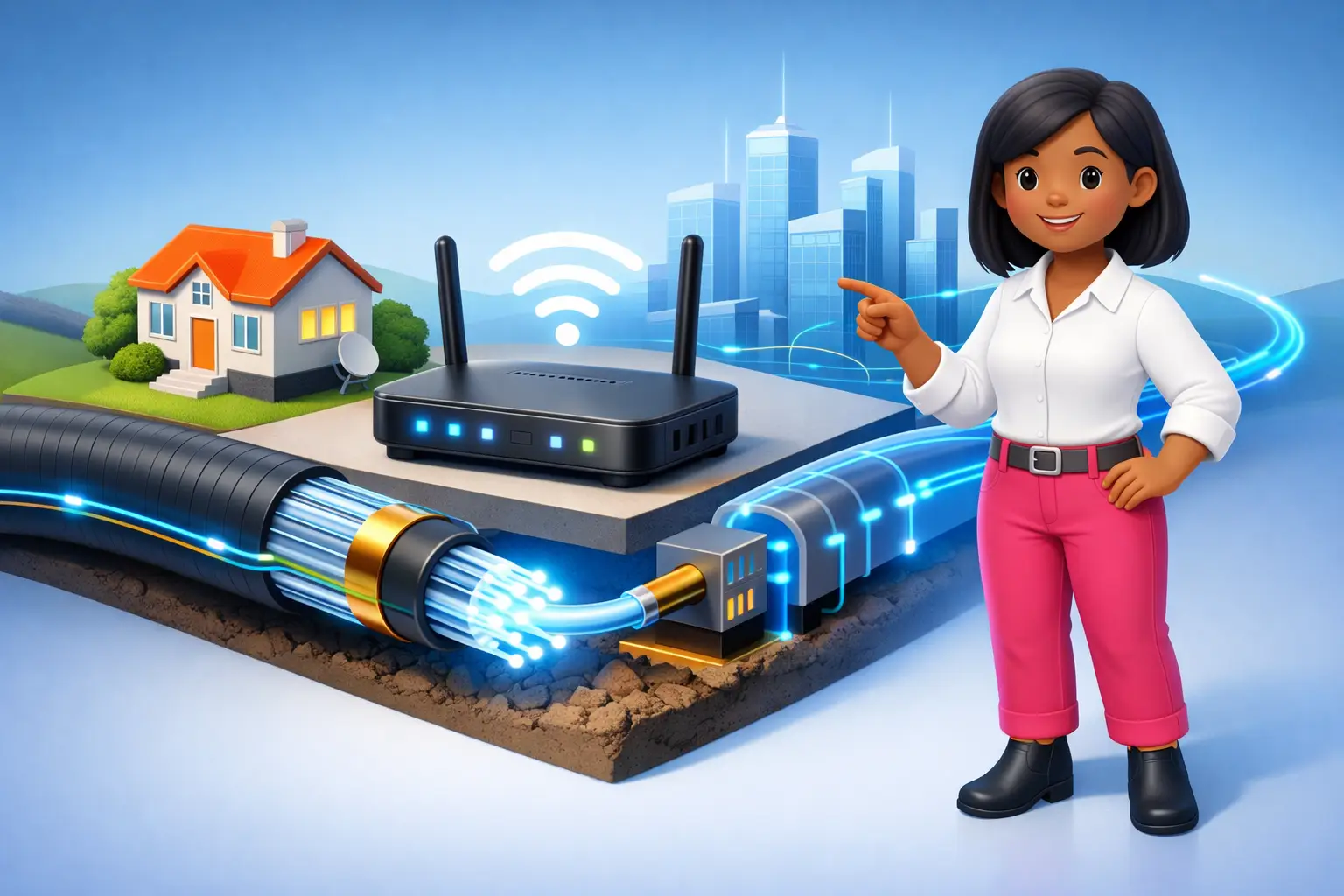
Direct answer: full fibre broadband explained simply means a connection that uses fibre optic cable all the way to your home, rather than stopping at the street cabinet. In the UK, this is usually called FTTP. It is typically faster, more consistent and more future-ready than older part-fibre services, but availability, installation timing and contract cost still matter.
- Full fibre usually means FTTP, not FTTC.
- It tends to deliver more reliable speeds, especially at busy times.
- Availability is address-specific, so the best first step is to compare broadband deals by postcode.
- The cheapest option is not always the lowest total contract cost once setup fees and in-contract rises are included.
What does full fibre broadband explained actually mean?
Full fibre broadband means fibre optic cable runs from the exchange to the property.
That is the key difference. With older superfast broadband, often called FTTC, fibre runs part of the way and the final stretch uses copper phone lines. With FTTP, the connection is fibre all the way in.
This matters because copper is usually the weak point. It loses performance over distance and is more vulnerable to interference. Full fibre removes much of that limitation, so speeds are generally more stable and upload performance is often much better too.
If you are comparing terms, FTTP is the one to look for. Some providers market it as full fibre, ultrafast broadband or gigabit-capable broadband, but the underlying idea is the same.
How is full fibre different from standard fibre?
Standard fibre in older broadband deals is often only part-fibre.
This is where broadband advertising can get confusing. A service described as fibre broadband is not always full fibre. Many UK households have had FTTC for years through Openreach-based networks, where the cabinet is fibre-fed but the final connection into the home remains copper.
Virgin Media also uses a different network setup in many areas, and newer providers, often called altnets, build their own FTTP networks. Openreach, CityFibre-backed providers and altnets can all offer full fibre, but the installation process, router, support model and contract terms can differ.
A simple comparison helps:
| Type | Usual UK term | Final connection to home | Typical experience | |---|---|---|---| | FTTC | Superfast fibre | Copper | Good for many homes, but speed drops depend on line length | | FTTP | Full fibre | Fibre | Faster, steadier, often stronger uploads |
If you want a broader view of speed tiers and what they mean in practice, our broadband speed guide gives more context.
Is full fibre always better?
Yes for performance, but not automatically for value.
If your home works, studies and streams on several devices, full fibre is usually the better technical option. It is especially useful for remote workers sending large files, homes with multiple users online at once, and small businesses that depend on stable connectivity.
That said, better does not always mean better value for every household. A single occupant who mostly browses and watches catch-up television may not need the fastest package available. In those cases, the real question is not whether full fibre is superior, it is whether the extra monthly cost earns its keep.
This is where comparison matters. Look beyond the headline monthly price. Setup charges, contract length, mid-contract price rises and any reward cards or introductory discounts can change the true cost. If you are weighing cheaper options, broadband deals under £25 and broadband deals under £30 can be useful benchmarks.
What speeds can you expect from full fibre?
Full fibre supports a wide range of speed tiers, from modest upgrades to gigabit services.
There is no single full fibre speed. Providers sell different packages over the same type of network, so one FTTP deal might suit a smaller household whilst another is aimed at heavier use. The best fit depends on how many people are online, whether anyone works from home regularly, and how sensitive your household is to slow uploads or buffering.
Ofcom advises consumers to focus on the provider's minimum guaranteed download speed where one is given, not just the advertised average. That is sensible because real-world performance varies by network, home setup and Wi-Fi conditions. Your router placement and internal wiring still affect the experience, even with an excellent line coming into the property.
If you are choosing between providers rather than technologies, our provider guide can help you compare the trade-offs between major names such as BT, Sky, TalkTalk, Vodafone, EE and Plusnet, alongside altnets where available.
Can you get full fibre at your address?
Availability is exact-address specific, not just postcode-wide.
Two homes on the same road can have different options. One may have Openreach FTTP, another may have an altnet alternative, and a nearby flat might be waiting on landlord permissions or building-specific installation work. New build developments can be particularly mixed, because infrastructure may be present but not yet live with every provider.
That is why broad coverage claims are less useful than an address-level check. If you are ready to see what is actually available where you live, compare broadband deals by postcode.
If full fibre is available, you can also review current FTTP broadband deals to narrow down contract lengths, speed tiers and pricing structure before switching.
What happens during a full fibre installation?
Some homes need only a simple activation, others need a new line installed.
If your property already has an active FTTP line, switching can be relatively straightforward. In other cases, an engineer visit is needed to bring fibre into the home and fit an optical network terminal, which is the small box where the fibre connection ends indoors. The router then connects to that equipment.
Timing depends on the network and the property. A house with easy external access is different from a flat with communal areas or permissions involved. If you are moving home or your current contract is ending soon, leave enough time for the installation window rather than cancelling too early.
For many Openreach-based switches, the One Touch Switch process is designed to make changing provider easier, though the exact experience depends on the service type and network involved. Our switching hub covers the practical steps and common snags.
Are there trade-offs with full fibre providers?
Yes, and they are usually about network coverage, contract terms and support rather than the fibre itself.
Openreach-based providers such as BT, Sky, TalkTalk, Vodafone, EE and Plusnet often give wider familiarity and broad national availability where FTTP has rolled out. Altnets can offer strong value or faster symmetric options in certain areas, but coverage is patchier and switching choices can differ if you move.
Virgin Media is also worth comparing where available, particularly on speed, though its network setup is distinct from Openreach FTTP. No single provider is best for every address. The right choice often comes down to the total contract cost, whether prices rise during the term, installation lead time, and how much speed you genuinely need.
If affordability is the issue, do not overlook social tariffs if someone in your household qualifies. They can be a better fit than choosing too little speed on a standard contract simply to keep the monthly bill down.
Is full fibre worth it for home workers and small businesses?
Usually yes, because reliability and upload performance matter as much as headline download speed.
A remote worker on video calls all day feels broadband problems differently from a casual evening user. Slow uploads, unstable Wi-Fi and congestion become more noticeable when your income depends on staying connected. The same applies to sole traders, booking-based businesses and card payment setups operating from a small premises or home office.
That does not mean every business needs an expensive dedicated product. Many micro-businesses can start by comparing residential full fibre against entry-level business packages, especially where static IPs or business support are not essential. If that is your situation, the business broadband hub is a sensible next step.
FAQ
Is full fibre the same as FTTP?
Yes. In UK broadband terms, full fibre usually means FTTP, fibre to the premises.
Is FTTC full fibre?
No. FTTC uses fibre to the street cabinet and copper from the cabinet to your home.
Do I need full fibre for working from home?
Not always, but it is often the better option if your work depends on stable calls, file uploads or several people being online at once.
Does full fibre need a new router?
Sometimes. Some switches include a new router as part of the package, and some installations also require an optical network terminal inside the property.
Can I switch to full fibre before my contract ends?
Yes, but early termination charges can apply. Check the remaining term and the total switching cost before you move.
Is full fibre available everywhere?
No. Rollout is expanding, but availability still varies by exact address, building type and network.
If full fibre is available at your address, the next step is not guessing which provider sounds best. It is checking the real options, on your property, with the full contract cost in view. To do that, compare broadband deals by postcode.