








BT
Major Openreach brand
Directory verified
95/100
May 2026 analysis: typical savings when households switch broadband. Figures from our comparison dataset.
Enter your postcode to see live deals from BT, Sky, Virgin Media, Vodafone, Hyperoptic, Community Fibre and 30+ other UK providers. Most switches start today with a single contact.
Postcode only. No name, email or phone needed. Takes 10 seconds. Privacy notice.
Free to use. Paid by providers when you switch, never by you. This never affects which deals we show you or their order. Full disclosure · Methodology.
In short BroadbandSwitch.uk is a free, independent UK broadband comparison service. Enter a postcode to compare live deals from 35+ providers, ranked by Total Contract Value, the full cost over the contract including setup fees, rewards and confirmed price rises. Switching most providers takes one contact under One Touch Switch, live since 12 September 2024. Full fibre now reaches 82 percent of UK homes (Ofcom, Connected Nations Spring 2026 update). Every page is reviewed under a named editor with a published methodology and public corrections log.


A friendly animated walk-through of how BroadbandSwitch.uk works. Pop in your postcode, see real deals at your address, filter by price, speed and contract, then choose your deal and switch online. Your new provider takes care of the awkward breakup with the old one under One Touch Switch, you plug in the new kit, and you're away.
Produced by the SearchSwitchSave in-house marketing team. Visit the SearchSwitchSave YouTube channel for more, or jump to our step-by-step switching guide if you'd rather read it.
Real-time deals from the BroadbandSwitch.uk comparison engine, ranked by total contract cost. Filter by speed, contract length, broadband type or extras. Pricing pulled live from every UK provider we track.
Loading live broadband comparison results for shortlisting.
You can continue to the dedicated comparison page to check deals by postcode and exact address.
Affiliate disclosure: we earn a commission when you choose a provider via our comparison. This does not affect the prices you see.
Switching broadband used to be painful. Since One Touch Switch launched on 12 September 2024, you can start the move in a single contact. Most switches complete within 2 to 14 working days. We make sure you start with the right deal, ranked transparently on the full contract cost.
We check live availability at your exact address across Openreach, Virgin Media, CityFibre, Hyperoptic, Community Fibre and every altnet operating in your postcode.
Postcode comparison details →Our default sort accounts for monthly price, contract length, setup fees, rewards and confirmed mid-contract price rises. Switch to fastest, cheapest monthly, or shortest contract with one tap.
See ranking methodology →Choose your deal and start the switch with a single contact to the new provider. Under One Touch Switch, the new provider handles cancellation. Most switches complete in 2 to 14 working days. 14-day cooling-off applies.
Read the switching guide →
The UK broadband market changed more between 2024 and 2026 than in the entire decade before. Full-fibre coverage reached 78 percent of UK homes by July 2025 (Ofcom, Connected Nations 2025) and stands at 82 percent (24.9 million homes) as of January 2026 (Ofcom, Connected Nations Spring 2026 update). One Touch Switch made changing provider as simple as choosing your new deal online and letting them handle the rest. Ofcom forced providers to disclose mid-contract price rises in pounds and pence at the point of sale. And alternative network providers (the "altnets") became genuinely viable competitors to the big four in dozens of postcodes, pushing prices down across the board.
Most households still don't switch. According to Ofcom's most recent consumer research, around 40% of UK broadband customers are out of contract and paying significantly more than they need to. If you're one of them, the next 1,500 words are written for you. By the end you'll know exactly what to look for, what to ignore, and how to start your switch today.
Most UK addresses now have access to one of four broadband technologies. The difference matters more than the marketing does, so here's the order to think about them in.
Full fibre (FTTP) runs fibre-optic cable all the way to your home. It is faster, more reliable, and has a longer service life than every other technology. If you can get it, get it. Speeds typically start at 100 Mbps and run up to 1,000 Mbps, with some altnet providers offering 2 Gbps and even 5 Gbps in select postcodes. FTTP deals are now available across 82 percent of UK homes (24.9 million) per the Ofcom Connected Nations Spring 2026 update, as altnet rollout continues at pace.
Cable broadband, available almost exclusively from Virgin Media on their own coaxial network, covers around 60% of UK premises. Speeds match full fibre on download (up to 1 Gbps, 2 Gbps in select areas) but upload speeds are noticeably slower. For most households the difference is invisible. For anyone uploading large files, video calling for work, or running a small business from home, full fibre wins on technical merit.
Fibre to the cabinet (FTTC), sometimes branded "superfast fibre", runs fibre to the green street cabinet then copper from the cabinet to your home. Speeds max out around 80 Mbps and degrade significantly with distance from the cabinet. It's being phased out as full fibre rolls out, but it remains the cheapest option for households on tight budgets. Read our full-fibre vs FTTC vs cable vs 4G/5G comparison if you want the deeper detail.
4G and 5G home broadband use mobile masts rather than fixed lines. They're surprisingly capable now: 5G home broadband typically delivers 100 to 200 Mbps if you have strong signal, and rolls month-to-month so you can leave any time. They're a strong option for renters, short-let tenants, and anyone moving frequently. Satellite (Starlink) covers truly remote properties where nothing else reaches.
The UK has six networks worth knowing about. Most providers don't own theirs, they just sell service over someone else's. This matters because the network determines your speed ceiling and reliability, not the brand on the bill.
| Network | Type | UK coverage | Main retailers |
|---|---|---|---|
| Openreach | FTTP + FTTC + ADSL | ~96% | BT, Sky, TalkTalk, Vodafone, Plusnet, EE, Zen, Shell |
| Virgin Media O2 | Cable + FTTP | ~60% | Virgin Media (retail only) |
| CityFibre | FTTP altnet | ~30% | Vodafone, Zen, YouFibre, TalkTalk, Giganet |
| Hyperoptic | FTTP altnet (apartments) | ~3% | Hyperoptic (retail only) |
| Community Fibre | FTTP altnet (London) | ~5% (London) | Community Fibre (retail only) |
| Netomnia / YouFibre | FTTP altnet | ~12% | YouFibre, Brsk, others |
To check exactly which networks reach your address, see our guide to identifying your broadband network.
Headline monthly prices are designed to be misleading. A £24-a-month deal with a £30 setup fee on an 18-month contract is not cheaper than a £25-a-month deal with no setup fee on a 12-month contract, even though the brain wants to believe it is.
At BroadbandSwitch.uk, every deal is sorted by Total Contract Value (TCV) as the default. TCV multiplies monthly price by contract length, adds setup and activation fees, subtracts cashback and rewards, and factors in confirmed mid-contract price rises. It's the same principle as Money Saving Expert's Equivalent Monthly Cost, applied to the full contract. It is the only number that matters when you're committing to 18 or 24 months. Read the full ranking methodology and the deeper total contract cost calculator guide.
"If you can get full fibre at your address and you're paying for FTTC, you are paying more for less. The price gap is usually £3 to £8 a month." Dr Alex J. Martin-Smith, Lead Editor
From 17 January 2025, Ofcom requires every UK broadband provider to disclose any mid-contract price rises in pounds and pence at the point of sale. The old inflation-linked clauses (CPI plus 3.9% became infamous) are gone for new contracts. Most major providers now apply a fixed annual increase of around £3 to £4 a month, taking effect in March or April each year.
Where we have a confirmed price-rise figure from the provider, we include it on the deal card and factor it into Total Contract Value. A handful of providers, notably Hyperoptic and Community Fibre, commit to no mid-contract price rises at all. All else equal, that's worth around £40 to £60 over a typical 24-month contract. Read more on in-contract price rises in 2026 and exit fees.
If you or someone in your household claims Universal Credit, Pension Credit, Employment and Support Allowance, Jobseeker's Allowance or Income Support, you're eligible for a social tariff from most major UK broadband providers. Social tariffs typically cost £12 to £25 a month for full-fibre speeds, are exempt from mid-contract price rises, and have no early-termination charges.
Despite over 8 million UK households being eligible, take-up remains under 7% according to Ofcom. If this is you, the saving against a standard package is usually £15 to £25 a month. That's £180 to £300 a year. Check eligibility in our social tariff eligibility guide.
The UK market is dominated by four major providers. BT and its subsidiaries (Plusnet, EE) account for around 30% of the market and use the Openreach network. Sky and TalkTalk wholesale Openreach lines and add their own service layer. Virgin Media uses its own cable network covering around 60% of UK premises. Beyond the big four, more than 100 altnets build their own fibre networks in regional patches: Hyperoptic in apartment blocks, Community Fibre in London, CityFibre across multiple towns, Gigaclear in rural areas, YouFibre nationally on the CityFibre wholesale network, and many more.
Altnets often beat the big four on speed, price and customer service in the postcodes they cover. They're the reason it's worth comparing properly rather than going straight to the brand you recognise. Browse the full UK directory of 400+ providers with our verification scores.
Switching is straightforward for most homeowners. For others it gets a bit more involved. Renters usually don't need landlord permission for an existing line, but new fibre installs can require a wayleave. Moving home means deciding whether to take your contract with you or start fresh. New build homes built since December 2022 must include gigabit-ready cabling under building regulations. Rural addresses may need to fall back on 4G/5G or invoke the Universal Service Obligation, which guarantees 10 Mbps minimum.
Enter your postcode at the top of this page to see live deals at your exact address. We'll show you what's available across every UK provider operating in your postcode, ranked by Total Contract Value. If you want to read more first, our Broadband Questions and Answers hub gives straight answers to the questions people ask most, or try our step-by-step switching guide, speed guide and exit fees guide for the key decisions. And if you spot anything wrong with our data or analysis, please submit a correction: we publish every fix in our public corrections log, because we believe transparency is the only credible way to run a comparison site.
Each provider in our directory carries a Directory Verification Score based on Companies House registration, ISPA membership, Ofcom complaint volumes, network ownership transparency and customer review consistency. This reflects directory verification only, not service quality at your address. For that, compare live deals at your postcode. Updated monthly.
Run a quick speed test before you switch. You'll see whether you're getting what you pay for, set a baseline for any compensation claim under Ofcom's Voluntary Code of Practice, and know which package speed to choose next. Most UK households are surprised by the result.
Run a free UK speed testThe 28 most-asked questions about switching, speeds, contracts, social tariffs and your consumer rights, with definitive answers and links to deeper guides.
To switch broadband in the UK, you simply contact the new provider you want to join. Under Ofcom's One Touch Switch rules, in force since 12 September 2024, the new provider handles the entire move including cancelling your old contract and arranging service activation.
One Touch Switch is the Ofcom-mandated broadband switching process, live across the UK since 12 September 2024, that lets you change providers by contacting only the new provider. The new provider notifies the old one automatically, with no overlap, no double-billing and no need for two separate phone calls.
No, in most cases there is no downtime when switching. One Touch Switch is designed to keep you connected, with the new service activating as the old one ends. If a brief gap is unavoidable, your provider must tell you in advance and arrange compensation if it exceeds two working days.
Switching broadband typically takes between two and fourteen working days, depending on whether an engineer visit is required. Same-network switches under One Touch Switch can complete in one working day. Switches between Openreach and Virgin Media's cable network usually take longer because of the engineer install.
Most UK households need 50 to 100 Mbps for comfortable everyday use including streaming, video calls and gaming. Larger homes, or those with multiple people working from home, benefit from 200 to 500 Mbps full fibre. Single-person households can usually manage on 30 to 60 Mbps.
Standard fibre, sometimes branded superfast fibre, runs fibre to the street cabinet and copper from the cabinet to your home (FTTC), capping at around 80 Mbps. Full fibre (FTTP) runs fibre all the way to the property and supports speeds from 100 Mbps to 1.8 Gbps with much greater reliability.
FTTP, or Fibre to the Premises, is the UK term for full-fibre broadband, where a fibre-optic cable runs directly into your home with no copper bottleneck. FTTP coverage reached 78 percent of UK homes by July 2025 (Ofcom, Connected Nations 2025) and stands at 82 percent (24.9 million homes) as of January 2026 (Ofcom, Connected Nations Spring 2026 update). It is the only broadband technology with a long-term future.
5G home broadband is a viable alternative to fixed-line broadband if you have strong 5G coverage, typically delivering 100 to 200 Mbps with no engineer install. Three, EE and Vodafone offer 5G home broadband on rolling monthly contracts, making it a good option for renters or short-let tenants.
Most UK broadband contracts run for 24 months, with some 12-month and 18-month options and a small number of rolling 1-month deals. Shorter contracts cost slightly more per month but give you flexibility to switch when better deals become available, and they avoid early-termination charges.
Yes, most major UK providers apply an annual mid-contract price rise every April. Since 17 January 2025, these rises must be set out in pounds and pence at the point of sale. Ofcom has banned inflation-linked CPI increases on new contracts, replacing them with fixed annual increases of typically £3 to £4 a month.
CPI plus 3.9 percent was a pricing formula used by major UK providers to raise mid-contract prices each April based on inflation. Ofcom banned this style of increase on new contracts taken from 17 January 2025. New contracts must instead disclose any rise as a fixed pounds-and-pence figure at the point of sale.
Yes, you can leave a broadband contract early, but you will usually pay an Early Termination Charge equal to the remaining monthly payments. You can leave penalty-free if your provider raises prices outside the original contract terms, fails to deliver the minimum guaranteed speed, or breaches their service obligations.
A social tariff is a discounted broadband package, typically £12 to £25 a month, offered to UK households on means-tested benefits. Social tariffs are exempt from mid-contract price rises and have no early-termination charges. Most major providers including BT, Sky, Virgin Media and Vodafone offer them.
You qualify for a UK social tariff if you receive Universal Credit, Pension Credit, Income Support, income-based Jobseeker's Allowance or income-related Employment and Support Allowance. A few providers, including BT and Virgin Media, also accept Personal Independence Payment claimants.
Yes, every major UK provider with a social tariff accepts Universal Credit claimants. The cheapest widely available option is Vodafone Fibre 1 Essentials at £12 a month for 38 Mbps. Other notable options include Virgin Media Essential at £12.50 a month for 15 Mbps, Community Fibre Essential at £12.50 for 35 Mbps in supported areas, and BT Home Essentials at £15 a month for 36 Mbps.
Yes, in almost all cases your new provider will send you a new router. Most UK ISPs configure routers specifically for their network, and your old provider's router will not work. Most providers send the router free of charge a few days before activation.
The master socket is the main BT or Openreach phone socket where the external broadband line first enters your home. It contains a hidden test socket behind the front plate, used by engineers for diagnosing line faults. Your router should always plug into the master socket for best performance.
If your provider misses your agreed activation date, you are entitled to automatic compensation of £6.24 per day under Ofcom's Automatic Compensation Scheme, applicable from 1 April 2025. You also receive £31.19 if your service goes down for more than two working days, and £9.98 for each missed engineer appointment.
82 percent of UK homes (24.9 million) had full-fibre (FTTP) availability by January 2026 according to the Ofcom Connected Nations Spring 2026 update, up from 78 percent in July 2025 (Ofcom, Connected Nations 2025). To check your address, use a postcode checker that searches Openreach, Virgin Media and altnet networks together. Coverage is expanding rapidly through Project Gigabit and commercial rollout.
Since 26 December 2022, all newly built homes in England must be fitted with gigabit-ready cabling and, where commercially viable, a working gigabit broadband connection. New builds typically receive Openreach FTTP, Virgin Media cable, or in some developments, a single bulk-deal altnet such as Hyperoptic or Vorboss.
For rural UK addresses, the best option depends on availability. Full-fibre rural altnets like Gigaclear, B4RN and Quickline are gold standard where they reach. Otherwise consider 4G or 5G home broadband, satellite (Starlink), or invoke the Universal Service Obligation which guarantees 10 Mbps minimum, delivered by BT or KCOM.
You do not need landlord permission to use an existing broadband line in a flat. Installing new fibre usually requires a wayleave, but since December 2022 telecoms operators have a court-backed right of access if landlords fail to respond within 35 days, under the Telecommunications Infrastructure (Leasehold Property) Act 2021.
A bundle is worth it if you regularly watch live or premium sports content, but most UK households save money by separating broadband from streaming services. Bundles from Sky, Virgin Media and BT typically discount the bundle by 10 to 25 percent, but mix-and-match Netflix, Disney+ and YouTube TV usually costs less overall.
Mobile and broadband bundles can be worth it if you are already a customer of a multi-service provider like BT, EE, Vodafone, Sky or Virgin Media O2. Discounts are typically 10 to 25 percent off one or both services. Compare against standalone deals before committing to a bundle.
Slow broadband usually has one of five causes: WiFi interference from neighbours or appliances, an outdated router, peak-time congestion on the local network, a line fault on the copper or fibre, or simply a package speed too low for your needs. Run a wired speed test to diagnose which applies.
Yes, always run a wired speed test before switching broadband. It tells you what speed you are actually getting now, sets a baseline for any compensation claim, and helps you choose an appropriately faster package. Use ukspeedtest.co.uk or Ofcom's official broadband test for an unbiased result.
If your wired broadband speed consistently falls below the minimum guaranteed speed quoted at sale, you have the right to leave penalty-free under Ofcom's Voluntary Code of Practice on Broadband Speeds. The provider has 30 days to fix the issue. After that, you can exit the contract without paying any termination charges.
Start with a formal written complaint to your provider, request a deadlock letter if they cannot resolve it, and after eight weeks (six weeks from 8 April 2026) escalate free of charge to CISAS or the Communications Ombudsman. Both schemes are free for consumers and binding on providers.
Editorially curated guidance on switching, contracts, social tariffs and the regulatory changes shaping UK broadband in 2026. Updated weekly.
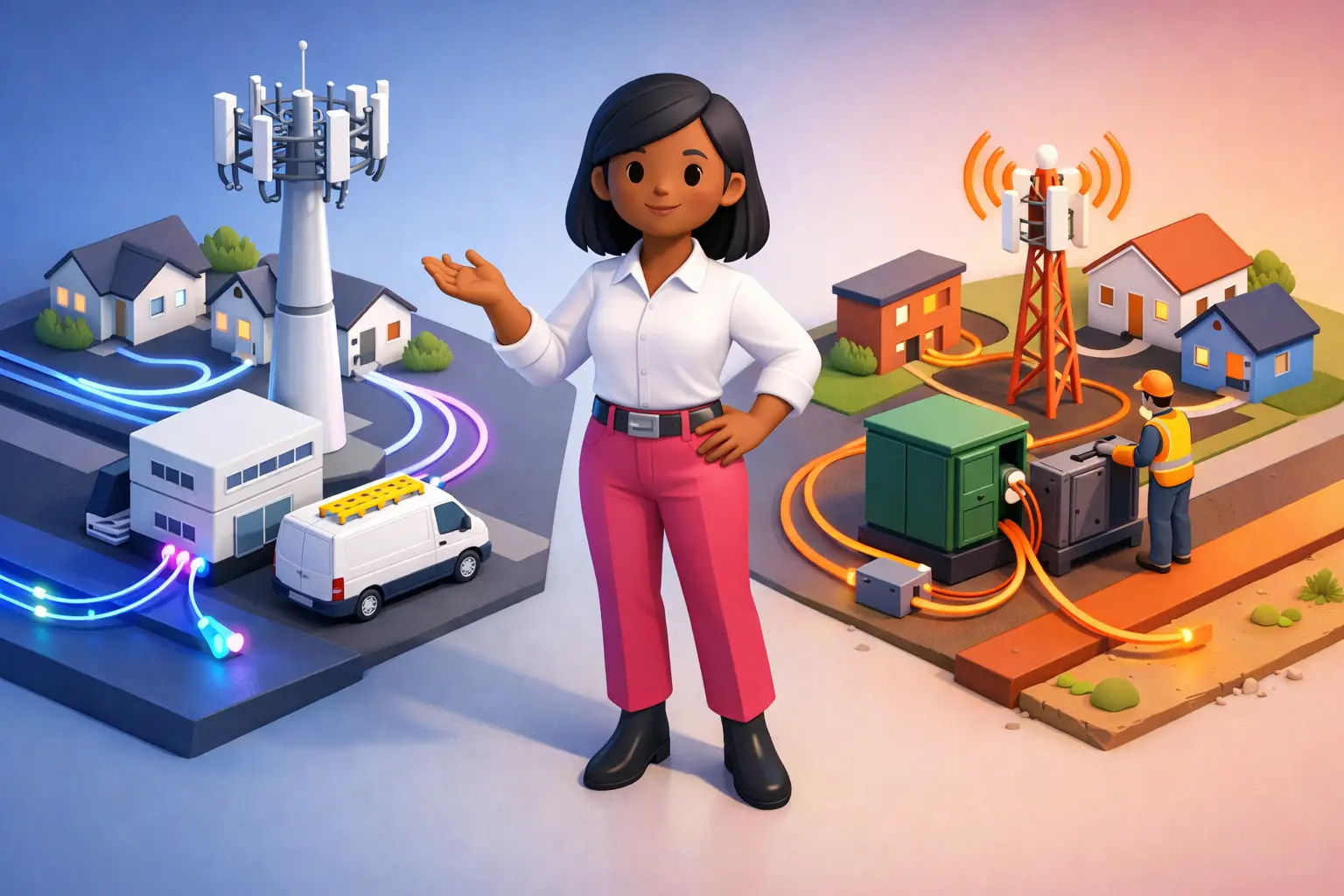
Openreach vs altnet broadband explained: compare coverage, speed, pricing, installation and switching to choose the right UK fibre deal.

Broadband provider comparison UK guide to speeds, costs, contract terms and switching, so you can choose the right deal by postcode with confidence.

Learn how to check broadband availability by postcode and address, compare UK fibre options, spot trade-offs, and switch with confidence.

Find the best value broadband deals under thirty pounds a month by comparing total cost, speed, fees and contract terms, not headline price only.

How to change my broadband in the UK: check contracts, compare full fibre deals, avoid exit fees and switch with less hassle by postcode.

Are broadband bundles with TV and mobile worth it? See when bundling cuts costs, when it adds extras you will not use, and what to check first.
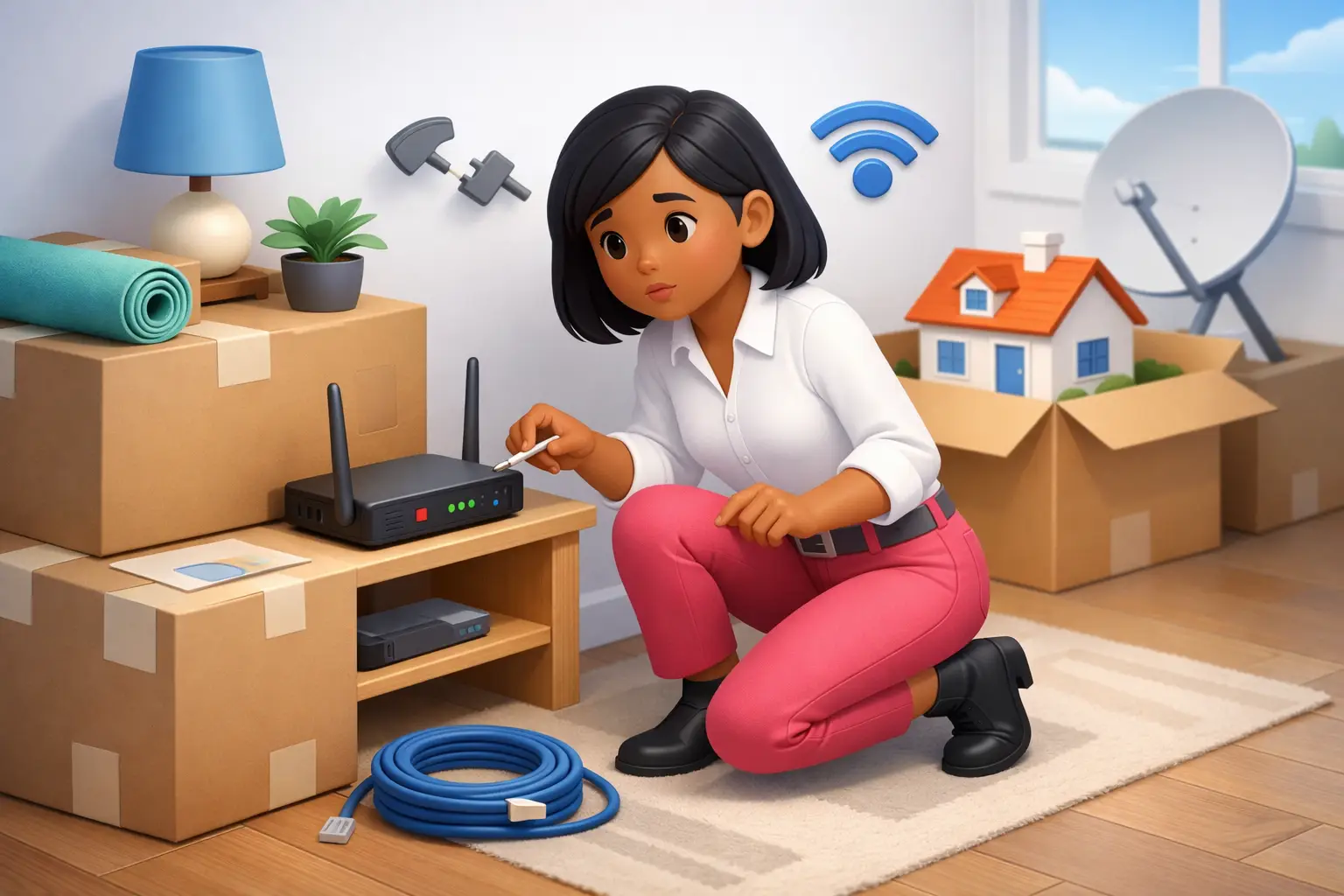
Moving home soon? Be careful when signing up to broadband. Avoid early mistakes on contracts, install dates, fees and speeds at your new address.

Who has the most broadband customers in the UK? See the biggest providers, what market size means, and how to compare deals by postcode.

Who gets cheaper UK broadband deals or special tariffs, and can you get free broadband in the UK? Clear help on social tariffs and support.
The most-visited explainers and comparison guides on BroadbandSwitch.uk, covering switching, speed, fibre types, social tariffs and the small print most people miss.
Pop in your postcode. We'll show every live UK broadband deal at your address in under a minute, ranked by Total Contract Value, signed off by a named editor. Save £180 to £292 a year. Most switches complete within 2 to 14 working days. No spam. No surprises.
Postcode used only to check availability. Or browse all 400+ UK ISPs · Contact our editors
Switching UK broadband has never been easier. Full-fibre (FTTP) now reaches roughly four in five homes, the average switcher pockets £180 to £292 a year, and One Touch Switch makes moving provider feel like a 10-second job. Our May 2026 update unpacks the deals worth grabbing this month, the providers who held prices steady, and the postcode check that gets you there.
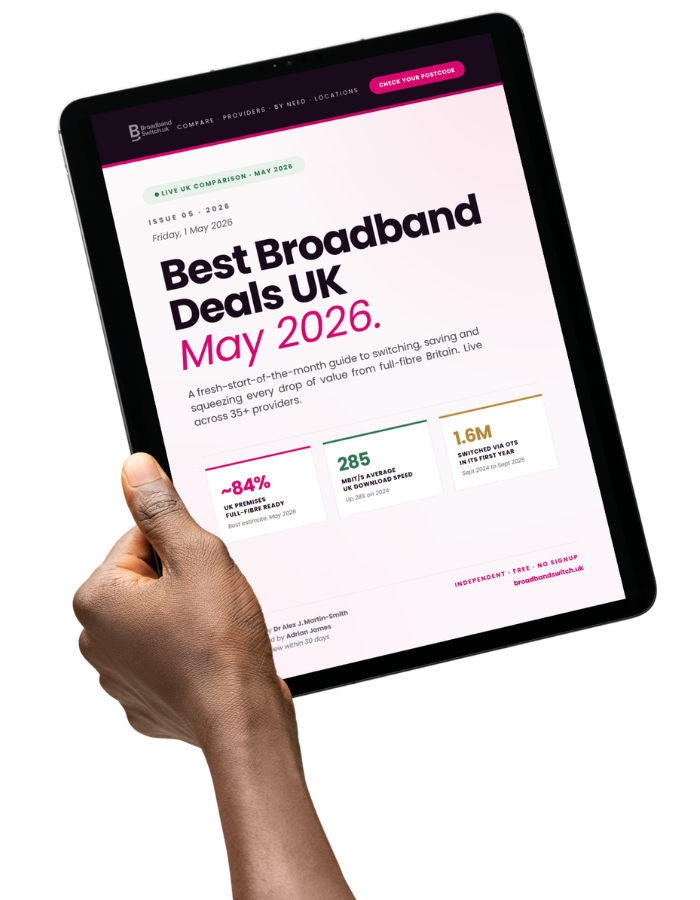
What the typical UK switcher saves a year. One postcode check away.
Of UK premises now full-fibre ready in May 2026. Including, very probably, yours.
You contact only the new provider; everything else is handled. 1.6m did it last year.
Every in-contract rise stated up front in pounds and pence. No more inflation surprises.
Independent Free No signup 35+ providers compared 429 ISPs tracked